The discovery, explained · Chemist no. 161 of 350
Thomas Cech and Self-Splicing RNA: The First Ribozyme
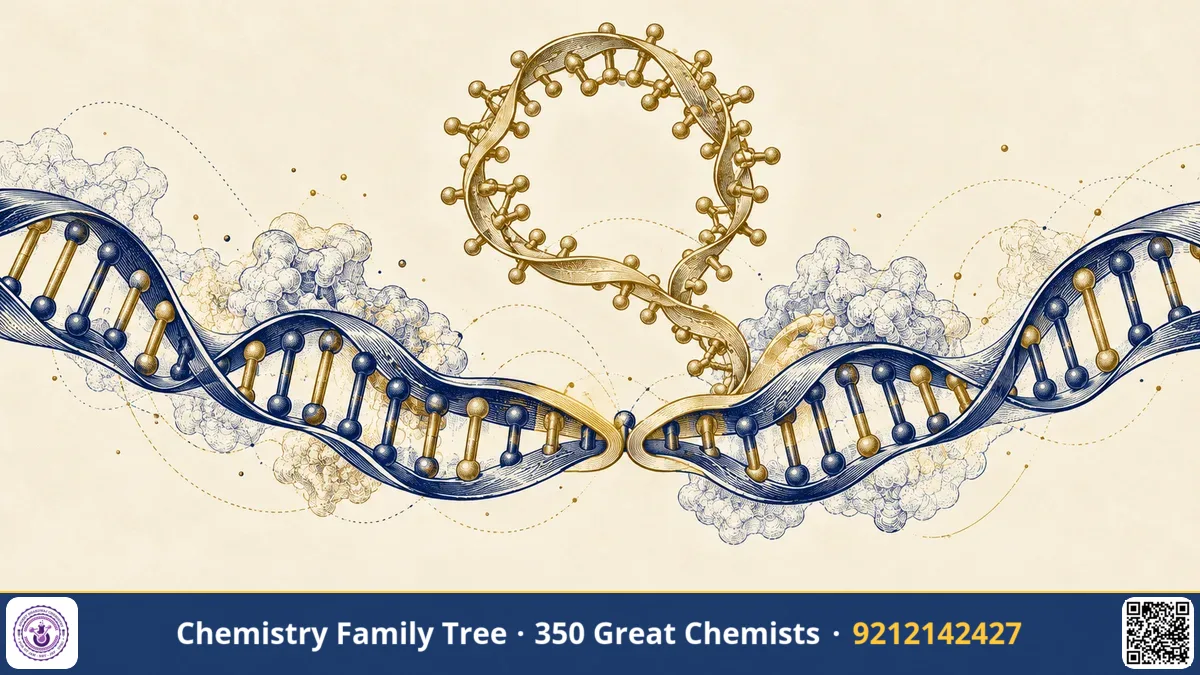
In 1982, a team led by Thomas Cech at the University of Colorado, Boulder, was trying to find the protein enzyme that removes a piece of RNA from the ribosomal RNA precursor of a pond organism. They never found it. Instead, they found something far more surprising: the RNA removed its own internal segment, with no protein at all. This was the first clear example of an RNA catalyst, now called a ribozyme. Cech shared the 1989 Nobel Prize in Chemistry with Sidney Altman, who had found catalytic RNA in a different enzyme, RNase P. The discovery rewrote a basic rule of biochemistry and gave new strength to the idea of an "RNA world" at the origin of life.
The Scientific Problem Before the Discovery
By the late 1970s scientists had learned that many genes in higher organisms are interrupted: coding sequences (exons) are separated by non-coding stretches called introns. The RNA copy of the gene contains both, and the introns must be removed and the exons joined together in a process called RNA splicing. Everyone assumed that splicing was carried out by protein enzymes, since only proteins were known to have catalytic power.
Cech chose a convenient model: the single-celled ciliate Tetrahymena thermophila. Its large nucleus contains many copies of the ribosomal RNA gene (rDNA), and the precursor rRNA contains one intron of about 413 nucleotides. This made it easy to obtain large amounts of material. The question was: which protein carries out the splicing?
The Discovery: Splicing Without Protein
Cech's team, including Arthur Zaug, Kelly Kruger and Paula Grabowski, designed experiments to isolate the splicing activity. The steps were as follows.
- Prepare the nuclear extract. Nuclei of Tetrahymena were isolated, and transcription was carried out to make precursor rRNA.
- Observe splicing. In the test tube, the precursor was spliced to give mature rRNA and a free intron.
- Remove the proteins. The researchers treated the RNA with protease enzymes, phenol extraction and other methods to eliminate protein. Surprisingly, splicing still occurred.
- Use a cell-free source of RNA. They cloned the rDNA in E. coli and made the precursor RNA by transcription with a bacterial RNA polymerase. Since bacteria do not have the Tetrahymena splicing proteins, the RNA made in this way had never been near any such protein. It still spliced itself, needing only guanosine, Mg²⁺ and a suitable buffer.
- Conclude. The RNA itself has the catalytic activity. The results were published in 1982.
The mechanism turned out to be a two-step transesterification, and no energy source like ATP is needed:
Step 1: The 3′-OH of an exogenous guanosine attacks the phosphorus at the 5′ splice site.
        Exon 1 is released with a 3′-OH, and G becomes attached to the 5′ end of the intron.
Step 2: The 3′-OH of exon 1 attacks the phosphorus at the 3′ splice site.
        Exons are joined; the intron is released as a linear molecule.
The linear intron can later cyclise and shorten itself by further reactions. Since each step swaps one phosphoester for another, the number of phosphodiester bonds stays the same, and the reaction is energetically feasible without an external energy source.
The Chemistry Behind It
The Tetrahymena intron belongs to the group I introns. Its folded structure creates a pocket that binds guanosine and brings the splice sites together. Metal ions, especially Mg²⁺, help to position the substrates and activate the nucleophile. Later, Cech and his colleagues converted the intron into a true catalyst that works on other RNA molecules: a shortened version missing 19 nucleotides at the 5′ end, called L-19 IVS, acts as an enzyme, with multiple turnover and Michaelis–Menten kinetics.
| Term | Meaning |
|---|---|
| Exon | Sequence retained in mature RNA |
| Intron | Sequence removed during splicing |
| Transesterification | Exchange of one ester linkage for another, here at phosphorus |
| Ribozyme | RNA with catalytic activity |
| Group I intron | Self-splicing intron that uses an external guanosine as nucleophile |
Note the difference from the spliceosome in higher cells, where introns are removed in a similar two-step chemistry by a large complex of RNA and proteins, and where an internal adenosine 2′-OH is the first nucleophile, forming a branched lariat.
Applications Today
- Origin of life: Ribozymes support the idea that early life might have used RNA as both genetic material and catalyst.
- Biotechnology: Engineered ribozymes can cut or repair chosen RNA sequences and are studied as tools and potential therapeutics.
- Understanding the ribosome: The peptide-bond-forming centre of the ribosome is made of RNA, a major example of an RNA enzyme at work.
- Telomerase research: Cech later worked on telomerase, an enzyme with an essential RNA component that extends chromosome ends.
- Medicine: Many genetic diseases involve faulty splicing, so knowledge of splicing chemistry guides therapy design.
Exam Corner
- The 1989 Nobel Prize in Chemistry was shared by Thomas Cech and Sidney Altman for catalytic RNA.
- Cech's system: self-splicing rRNA intron of Tetrahymena thermophila (group I intron).
- Splicing needs guanosine as a cofactor and Mg²⁺; no ATP or protein is required.
- Two transesterification steps; the number of phosphodiester bonds is conserved.
- Introns removed, exons joined; spliceosomal splicing uses a branch-point adenosine and forms a lariat.
Common Misconceptions
- "A ribozyme is consumed in the reaction." The original intron was a one-time reactant, but engineered versions are true catalysts with turnover.
- "Guanosine is the energy source." It is a nucleophile; the reaction needs no energy input.
- "Cech and Altman made the same discovery." They worked on different RNAs, an intron and RNase P, and both were needed to establish the principle.
Quick Revision Box
- 1982: self-splicing of the Tetrahymena rRNA intron (about 413 nucleotides).
- Proof: RNA made in E. coli from cloned DNA still spliced itself.
- Cofactors: guanosine, Mg²⁺.
- Two transesterification steps.
- L-19 IVS: shortened intron that acts as a true enzyme.
- Shared the 1989 Nobel Prize in Chemistry with Altman.
FAQ
Why was the E. coli experiment so important?
It proved that the RNA had never been in contact with any Tetrahymena protein, so protein contamination could not explain the splicing.
What is an intron?
An intron is a non-coding sequence in a gene that is removed from the RNA before it is used.
Did Cech get the Nobel in Chemistry or Medicine?
Chemistry, in 1989.
Why does it matter for exams?
Questions on RNA splicing, ribozymes and the role of metal ions are common in biochemistry and bioinorganic chemistry sections.
Published by ABC Chemistry — IIT-JAM | CSIR-NET | GATE Chemistry Coaching. Visit abcchemistry.com
About the chemist
Thomas Cech
1947- · United States · Nobel Chemistry 1989
Discovery of catalytic RNA