Biography · Chemist no. 42 of 350
Thomas Martin Lowry: The Cambridge Chemist Behind the Proton-Donor Definition
Introduction
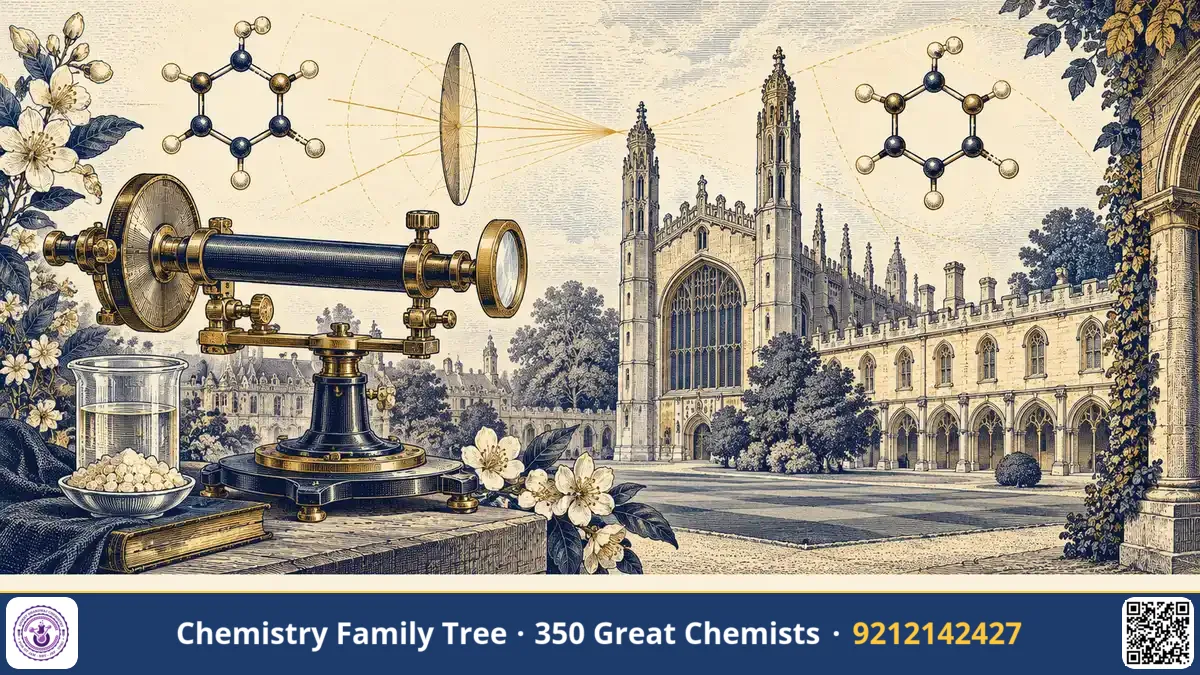
Thomas Martin Lowry (1874-1936) was an English physical chemist who spent his career in London and Cambridge. Students know him as the second half of "Brønsted-Lowry", but he was also a pioneer in studying optical rotation, mutarotation and the way acids and bases speed up reactions. He became the first holder of the chair of physical chemistry at Cambridge. Legacy in one line: he showed that the transfer of a proton is the central act of acid-base chemistry and catalysis.
Early Life & Family
Lowry was born on 26 October 1874 in Low Moor, near Bradford in Yorkshire, England. Bradford was an industrial town of wool and dyes, and many future chemists grew up around its textile and chemical industries. He attended school locally, and then moved to London for higher studies. Few details of his family life are widely recorded, so we focus on his scientific career.
Education & Mentors
Lowry studied at the Central Technical College in South Kensington, London (part of the City and Guilds institution, later merged into Imperial College). His teacher and mentor there was Henry Edward Armstrong, a leading chemist who strongly promoted the "heuristic" method of teaching, in which students learn by experiment and discovery. Armstrong guided Lowry's early research on camphor derivatives and optical activity. Lowry became Armstrong's assistant and then a demonstrator at the college. This training in careful experimentation and in questioning ideas remained with him for life.
Career Timeline
| Year | Event |
|---|---|
| 1874 | Born in Low Moor, Bradford, England |
| 1890s | Studies and assists at the Central Technical College, London, under H. E. Armstrong |
| 1899 | Studies mutarotation of nitrocamphor; uses the term dynamic isomerism |
| 1904 | Teaches chemistry at Westminster Training College, London |
| 1913 | Becomes head of chemistry at Guy's Hospital Medical School, London |
| 1914 | Elected Fellow of the Royal Society |
| 1920 | Appointed to the newly created chair of physical chemistry at Cambridge |
| 1923 | Proposes the proton-donor/acceptor definition of acids and bases |
| 1927 | Reports concerted acid-base catalysis of mutarotation in pyridine and cresol |
| 1935 | Publishes the book Optical Rotatory Power |
| 1936 | Dies in Cambridge on 2 November |
Major Scientific Contributions
- Dynamic isomerism and mutarotation: showed that changes of optical rotation in solution reflect equilibration between isomers.
- Acid-base catalysis: demonstrated that acids and bases together can catalyse a reaction by a concerted mechanism.
- Proton-donor theory (1923): acids as proton donors and bases as proton acceptors, independently of Brønsted.
- Optical rotatory dispersion: he studied how optical rotation changes with wavelength, laying groundwork for later methods used to find absolute configuration of chiral molecules. His book Optical Rotatory Power (1935) summarised the field for a generation.
- Teaching and history: he wrote Historical Introduction to Chemistry (1915), a widely used book for students.
For the detailed chemistry, see our companion discovery article on Lowry's mutarotation studies and the proton-transfer idea.
Awards, Honours & Nobel Prize
Lowry did not win a Nobel Prize. He was elected a Fellow of the Royal Society in 1914. He was a respected leader of British physical chemistry, and the university created a chair of physical chemistry in Cambridge for him. His main honour is the lasting use of his name in the Brønsted-Lowry theory.
Personality, Struggles & Lesser-Known Facts
- A teacher's chemist. At Guy's Hospital he headed chemistry for medical students, which kept him close to the practical uses of chemistry.
- Parallel discovery. His 1923 proposal appeared in a short note in a British trade-style journal, Chemistry and Industry, while Brønsted's paper appeared in a Dutch research journal. The theory carries both names, but Lowry's note was brief and he followed it with experimental studies rather than long theory papers.
- Cambridge builder. He built a physical chemistry school at Cambridge almost from nothing. Before 1920 the university had no separate professorship in the subject.
- Faith in measurement. His life work rested on the polarimeter, a precise but simple instrument. He believed that careful measurement can reveal molecular behaviour.
- Quiet reputation. Compared with Nobel laureates of his time, Lowry is less well known to the general public, although his name is in every acid-base lesson.
Legacy & Influence on Modern Chemistry
Lowry's legacy has two parts. The first is the acid-base theory that every chemistry student learns. The second is his experimental approach to catalysis. Modern enzyme mechanisms, such as those of ribonuclease and lysozyme, are described using general acid-base catalysis. Today, chiroptical methods such as ORD and circular dichroism, which are used in protein and natural-product chemistry, trace their origin to the work he and others did on optical rotatory power. In India, polarimetry remains part of undergraduate and pharmacy practicals.
Lessons for Students
- Follow a puzzle for years. A small oddity, a drifting optical rotation, led to a major theory.
- Combine experiment and idea. His theory came out of laboratory observations.
- Learn from your teacher, then go further. Armstrong gave him a start; he built his own school.
- Be open about shared credit. Chemistry gave the theory two names, which is a good example of independent discovery.
Quick Facts Box
- Born: 26 October 1874, Low Moor, Bradford, England
- Died: 2 November 1936, Cambridge, England
- Nationality: British (English)
- Field: Physical chemistry; optical activity; acid-base catalysis
- Famous for: Brønsted-Lowry theory; mutarotation studies
- Nobel: None
FAQ
Who was Thomas Lowry's teacher?
Henry Edward Armstrong at the Central Technical College in London.
What was special about Lowry's position at Cambridge?
He was the first professor of physical chemistry there, from 1920.
Did Lowry work with Brønsted?
No. They announced the same acid-base definition separately in 1923.
What did Lowry write about the history of chemistry?
He authored Historical Introduction to Chemistry (1915).
Published by ABC Chemistry — IIT-JAM | CSIR-NET | GATE Chemistry Coaching. Visit abcchemistry.com
About the chemist
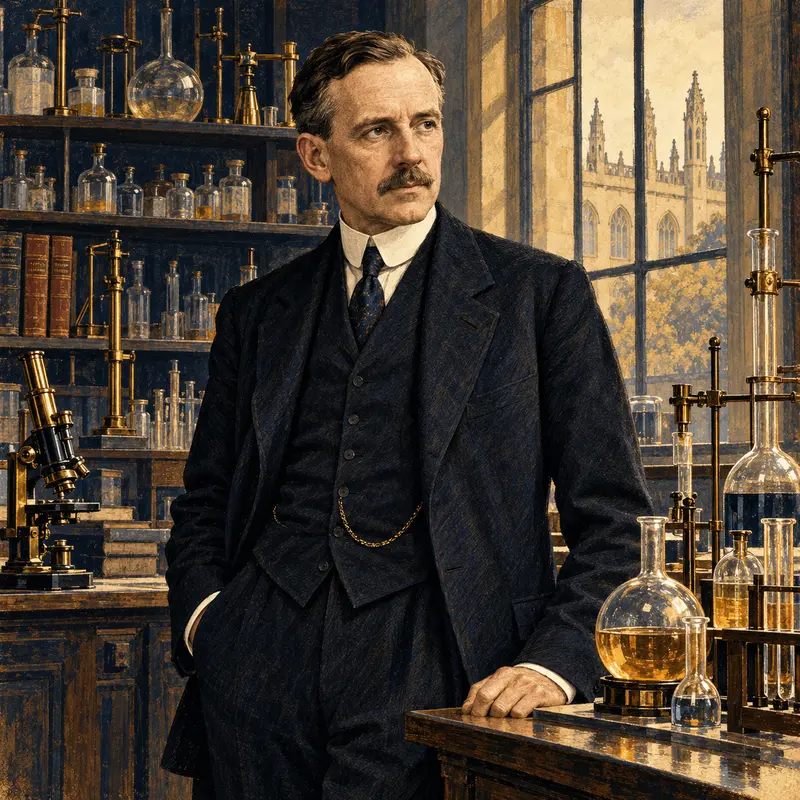
Thomas Martin Lowry
1874-1936 · United Kingdom
Brønsted-Lowry acid-base theory