The discovery, explained · Chemist no. 42 of 350
Thomas Lowry: From Mutarotation to the Idea of Proton Transfer
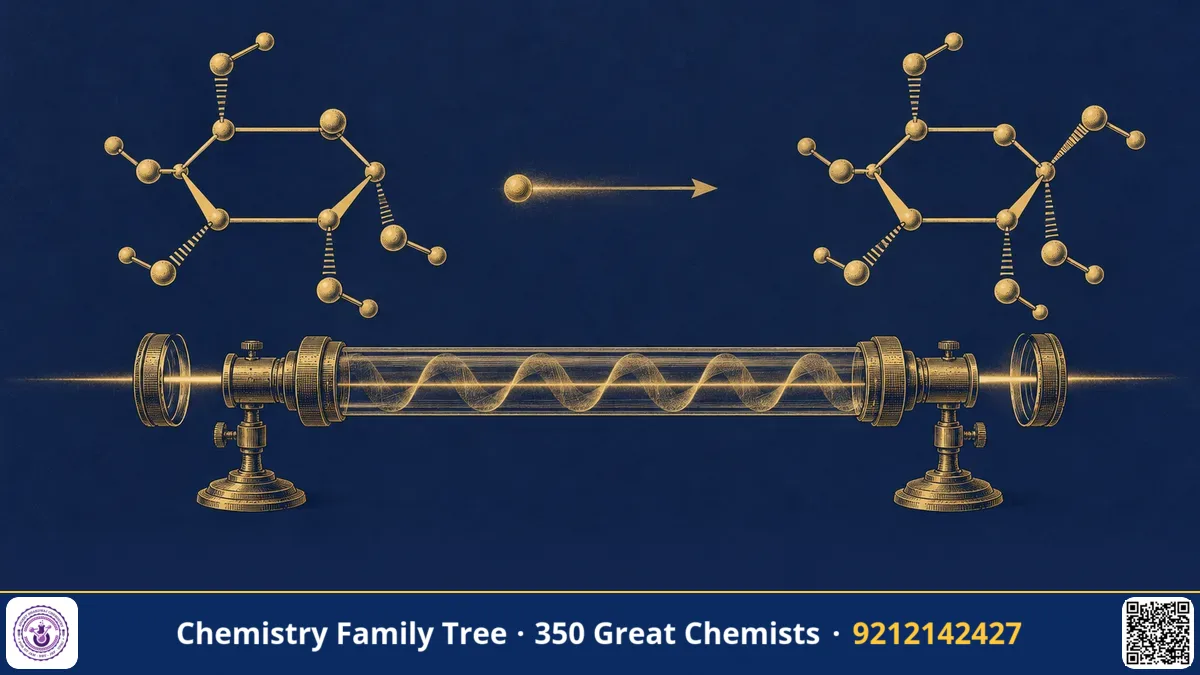
Dissolve fresh crystalline α-D-glucose in water and measure its optical rotation. The reading is +112°. Wait a few hours and the number slowly drifts down to +52.7° and stops there. Start with β-D-glucose instead and the reading rises from +18.7° to the same +52.7°. This puzzling change, called mutarotation, occupied the English chemist Thomas Martin Lowry for much of his life. His studies of how acids and bases catalyse it led him in 1923 to propose, at the same time as Johannes Brønsted, that an acid is a proton donor and a base is a proton acceptor. This article explains Lowry's chemistry in a way useful for B.Sc., IIT-JAM, CSIR-NET and GATE.
The Scientific Problem Before the Discovery
In the 19th century, polarimetry was a major tool. Louis Pasteur and others had shown that optical activity connects with molecular structure. But some solutions of sugars and of certain camphor derivatives changed their optical rotation over time. If a pure compound has a fixed structure, why should its rotation change?
- It was not clear whether this involved decomposition, a change of structure, or a slow interconversion of isomers.
- Acids and bases greatly sped up the change, but nobody understood how.
- Acid-base theory itself was tied to Arrhenius's ionic picture and water as solvent, which could not explain catalysis in non-aqueous media.
The Discovery: Step by Step
Step 1: Recognising dynamic isomerism
Lowry studied optically active compounds such as nitrocamphor and glucose derivatives in the late 1890s with his teacher Henry Armstrong. He concluded that the changing rotation was due to the slow interconversion of two forms of the same compound until equilibrium was reached. He used the term dynamic isomerism for this behaviour. In glucose the two forms are the α and β anomers, which differ only at C-1, the anomeric carbon.
α-D-glucopyranose  ⇌  open-chain aldehyde  ⇌  β-D-glucopyranose
   [α] = +112°          (very little)             [α] = +18.7°
                    equilibrium mixture: [α] = +52.7°
                    (about 36% α, 64% β)
Step 2: The mechanism
The ring opens through the hemiacetal OH of C-1, giving the open-chain aldehyde form (a tiny fraction, far less than 1%), which re-closes with either orientation of the new C-1–OH. In acid, the ring oxygen is protonated and the ring opens; in base, the anomeric O–H loses a proton and the ring opens. In neutral water the reaction is slow.
Step 3: Concerted catalysis (1927)
Lowry then studied mutarotation of tetramethylglucose in the solvent pyridine and found something unusual. In pyridine alone (a base) or in cresol alone (an acid) the reaction was extremely slow. A mixture of the two was much faster than either alone. Further, the rate was higher than expected from simple sum. He reasoned that a base removes a proton from the OH group at the same moment as an acid donates a proton to the ring oxygen. This is concerted (bifunctional) acid-base catalysis. A bifunctional molecule such as 2-pyridone, which has both an acidic N–H and a basic C=O, is a very efficient catalyst. This work is cited in textbooks as an early model for enzymes which use acid and base groups at the active site together.
Step 4: The proton-transfer definition (1923)
Seeing that catalysis occurs by giving and taking protons, Lowry wrote a short paper "The Uniqueness of Hydrogen" in Chemistry and Industry (1923). In it he said that the special property of hydrogen is its ability to be passed as a bare nucleus between molecules, and he defined acids as proton donors and bases as proton acceptors. Brønsted published the same definition independently in the same year.
Acid₁ + Base₂ ⇌ Base₁ + Acid₂
CH₃COOH + H₂O ⇌ CH₃COO⁻ + H₃O⁺
The Chemistry Behind It
Anomers and mutarotation
Glucose in solution exists mainly as cyclic hemiacetals. Cyclisation creates a new stereocentre at C-1. Because the two forms differ at only one stereocentre among several, they are anomers, a special type of diastereomers, not enantiomers. In α-D-glucopyranose the C-1 OH is axial (trans to the CH₂OH group on C-5 in the Haworth projection, drawn down), while in β-D-glucopyranose it is equatorial. The β form is more stable because all large groups are equatorial, which explains the roughly 64% β at equilibrium. The anomeric effect stabilises the axial form somewhat and is the reason α is still present at 36%.
Rate law and catalysis types
Mutarotation is first-order in sugar approaching equilibrium:
ln[(α₀ − α∞)/(αt − α∞)] = kt
where α₀, αt and α∞ are the optical rotations at start, time t and infinity, and k is the sum of the forward and reverse rate constants. This is a standard polarimetry kinetics question. The overall rate constant includes terms for water, H₃O⁺ and OH⁻:
k = k(H₂O) + k(H₃O⁺)[H₃O⁺] + k(OH⁻)[OH⁻]
This split into specific acid, specific base and general acid-base catalysis is part of the physical organic chemistry course.
Relation with the Brønsted-Lowry concept
Lowry's theory is a natural extension: if catalysis proceeds by proton transfer, then any proton donor (not only H₃O⁺) can be a general acid catalyst, and any proton acceptor can be a general base catalyst. This was developed quantitatively by Brønsted's catalysis law.
Applications Today
- Carbohydrate chemistry: the idea of anomers underlies the structure of starch (α-1,4 links) and cellulose (β-1,4 links). Humans digest starch but not cellulose.
- Food industry: crystallised glucose or sucrose products and syrups depend on anomer ratios, which affect sweetness and crystallisation.
- Enzymology: enzymes such as mutarotase and glycosidases use bifunctional acid-base catalysis.
- Drug analysis: polarimetry is used in pharmacopoeias, including the Indian Pharmacopoeia, for chiral drugs and sugars.
Exam Corner
- Specific rotation of α-D-glucose is +112°, of β-D-glucose +18.7°, and the equilibrium value is +52.7°.
- Mutarotation is the change in optical rotation of freshly prepared solutions of anomers until equilibrium; it is shown by reducing sugars in cyclic hemiacetal form.
- Anomers differ in configuration at C-1 only (C-2 in ketoses such as fructose).
- Sucrose does not show mutarotation because both anomeric carbons are tied up in the glycosidic bond (non-reducing sugar).
- Lowry (1923): acid = proton donor; Brønsted-Lowry conjugate acid-base pairs differ by one H⁺.
Common Misconceptions
- "Mutarotation involves racemisation." No. It is an interconversion of diastereomers (anomers), and the final rotation is not zero.
- "Anomers are enantiomers." No. Enantiomers are mirror images (D- and L-glucose); anomers differ at only one carbon.
- "Lowry copied Brønsted." Both reached the same idea independently in 1923.
Quick Revision Box
- Lowry coined/used the term dynamic isomerism for mutarotation-type changes.
- Glucose: α (+112°) ⇌ β (+18.7°); equilibrium +52.7°, about 36% α and 64% β.
- Pyridine + cresol (or 2-pyridone) show concerted acid-base catalysis.
- 1923: Lowry's proton-donor/acceptor definition, simultaneous with Brønsted.
- Mutarotation follows first-order kinetics on approach to equilibrium.
- Non-reducing sugars (sucrose) do not mutarotate.
FAQ
What is mutarotation in simple words?
It is the slow change in optical rotation of a freshly dissolved sugar as its two ring forms interconvert and reach equilibrium.
Why does the equilibrium favour the β form of glucose?
In β-D-glucopyranose all large substituents are equatorial, which lowers steric strain.
Why did Lowry use pyridine and cresol together?
To show that an acid and a base working together catalyse faster than either alone, which suggested a concerted proton transfer.
Is Lowry's name always attached to the acid-base theory?
Yes, in most textbooks it is called the Brønsted-Lowry theory.
Published by ABC Chemistry — IIT-JAM | CSIR-NET | GATE Chemistry Coaching. Visit abcchemistry.com
About the chemist
Thomas Martin Lowry
1874-1936 · United Kingdom
Brønsted-Lowry acid-base theory