Biography · Chemist no. 346 of 350
Thomas Midgley Jr.: Inventor, Innovator and Cautionary Tale

Thomas Midgley Jr. (1889-1944) was an American mechanical engineer and chemist who worked for General Motors and related companies. He is known for two inventions that shaped the twentieth century: tetraethyl lead as an anti-knock fuel additive, and the chlorofluorocarbon refrigerant Freon. Both were hailed as great advances at the time. Later research showed that leaded petrol polluted the environment with lead, and that CFCs destroyed the ozone layer. One line sums up his legacy: a gifted inventor whose work shows why chemists must think about long-term consequences. This biography presents his life with balance, using facts alone.
Early Life and Family
Thomas Midgley Jr. was born on 18 May 1889 in Beaver Falls, Pennsylvania. His father, Thomas Midgley Sr., was an inventor who worked on rubber tyres, and his maternal grandfather, James Emerson, was also an inventor. In an inventive household, young Thomas grew up with a natural interest in machines. The family later moved to Columbus, Ohio, where he spent his school years. From childhood he showed a practical, tinkering mind, more at home with engines than with books.
Education and Mentors
Midgley studied mechanical engineering at Cornell University and graduated in 1911. Note that he was trained as an engineer and not as a chemist, and he was happy to learn chemistry as the need arose. After working in several jobs, including at a company making tyres, he joined the Dayton Engineering Laboratories Company (Delco), where he came under the influence of the inventor and research director Charles F. Kettering, who later led General Motors Research. Kettering, a self-taught engineer, was his chief mentor and encouraged an experimental, problem-solving style of research. Thomas Midgley later worked with chemists such as Albert Henne, who gave him greater depth in organic chemistry, especially for the Freon project.
Career Timeline
| Year | Event |
|---|---|
| 1889 | Born in Beaver Falls, Pennsylvania |
| 1911 | Graduates in mechanical engineering from Cornell University |
| 1916 | Begins research at Delco under Charles Kettering on engine knock |
| 1921 | 9 December: finds that tetraethyl lead is a highly effective anti-knock agent |
| 1923 | Leaded petrol goes on sale in the United States |
| 1920s | Suffers lead poisoning and takes a rest cure |
| 1928 to 1930 | Leads the team that develops Freon (CFC-12) |
| 1930s | Works on other projects, including synthetic rubber research |
| 1940 | Contracts polio, which leaves him disabled |
| 1944 | Dies in Worthington, Ohio; also president of the American Chemical Society that year |
Major Scientific Contributions
- Anti-knock fuel additive: identification of tetraethyl lead,
Pb(C₂H₅)₄, as a powerful anti-knock agent, along with early tests showing that iodine compounds and ethanol also worked. - Freon refrigerants: development of dichlorodifluoromethane,
CCl₂F₂, a safe, non-flammable refrigerant. - Systematic method: using periodic-table trends in properties to guide the search for new compounds.
- Rubber research: later in life he worked on natural and synthetic rubber.
For reaction mechanisms and exam notes, read the companion discovery article.
Awards, Honours and Nobel Prize
Midgley did not win a Nobel Prize. His contemporary honours, however, were many:
- The Nichols Medal of the New York Section of the American Chemical Society (1937).
- The Perkin Medal of the Society of Chemical Industry, American Section (1937).
- The Priestley Medal, the highest honour of the American Chemical Society (1941).
- President of the American Chemical Society (1944).
Personality, Struggles and Lesser-Known Facts
- A showman. He liked memorable demonstrations. To show that Freon is safe, he inhaled the gas and breathed it out onto a candle, which went out.
- Lead poisoning. After working with tetraethyl lead, he fell ill in 1923 and went to Florida to recover. He held a press conference in 1924 in which he poured TEL over his hands and breathed its vapour to claim it was safe, though he knew he had suffered poisoning. Workers at TEL plants in the 1920s died or became seriously ill, leading to public concern and a temporary pause in sales.
- Disease and inventions. After polio left him unable to leave his bed unaided in 1940, he designed a system of ropes and pulleys to help him out of bed.
- The manner of his death. In 1944 he was found strangled by the ropes of this device. The death was ruled accidental.
- Deeply curious. He worked on many subjects, from engines to rubber, and held many patents.
Legacy and Influence on Modern Chemistry
Midgley's legacy is mixed. Leaded petrol made higher compression engines possible, but spread lead through air, soil and the blood of children for decades. Lead was gradually removed from petrol from the 1970s onwards, and India completed its phase-out in 2000. Freon CFCs made modern refrigeration and air-conditioning safe, but they thinned the ozone layer. The Montreal Protocol (1987) is now one of the most successful environmental treaties, and the ozone layer is slowly recovering. Chemists and teachers use Midgley's story to illustrate the need for green chemistry: design chemicals that perform well and also break down safely. At the same time, his method of systematic, property-guided molecular design is still admired by researchers.
Lessons for Students
- Success today may not equal safety tomorrow. Test long-term, environmental and health effects.
- Listen to warnings. Public health experts raised concerns about lead early, and they were right.
- Be wary of conflicts of interest. Research funded by a company that sells a product needs independent checking.
- Use periodic trends. Midgley's selection of fluorine compounds from periodic table logic is a model of reasoning.
- Science can correct itself. Later scientists discovered the damage and fixed it through policy.
Quick Facts Box
- Born: 18 May 1889, Beaver Falls, Pennsylvania, USA
- Died: 2 November 1944, Worthington, Ohio, USA
- Nationality: American
- Field: Mechanical engineering and industrial chemistry
- Famous for: Tetraethyl lead anti-knock additive and Freon CFC refrigerant
- Nobel Prize: None; Priestley Medal 1941
FAQ
Was Midgley a chemist or an engineer?
He was trained as a mechanical engineer but worked as an industrial chemist and research leader.
Why was leaded petrol banned?
Because lead is a neurotoxin that accumulates in the body, harms children's development and also poisons catalytic converters.
Which Nobel Prize relates to the CFC problem?
The 1995 Nobel Prize in Chemistry went to Paul Crutzen, Mario Molina and F. Sherwood Rowland for work on atmospheric ozone chemistry.
How did Midgley die?
He died in 1944 after becoming entangled in a rope-and-pulley device he had designed to help him move after polio. The death was accidental.
Published by ABC Chemistry — IIT-JAM | CSIR-NET | GATE Chemistry Coaching. Visit abcchemistry.com
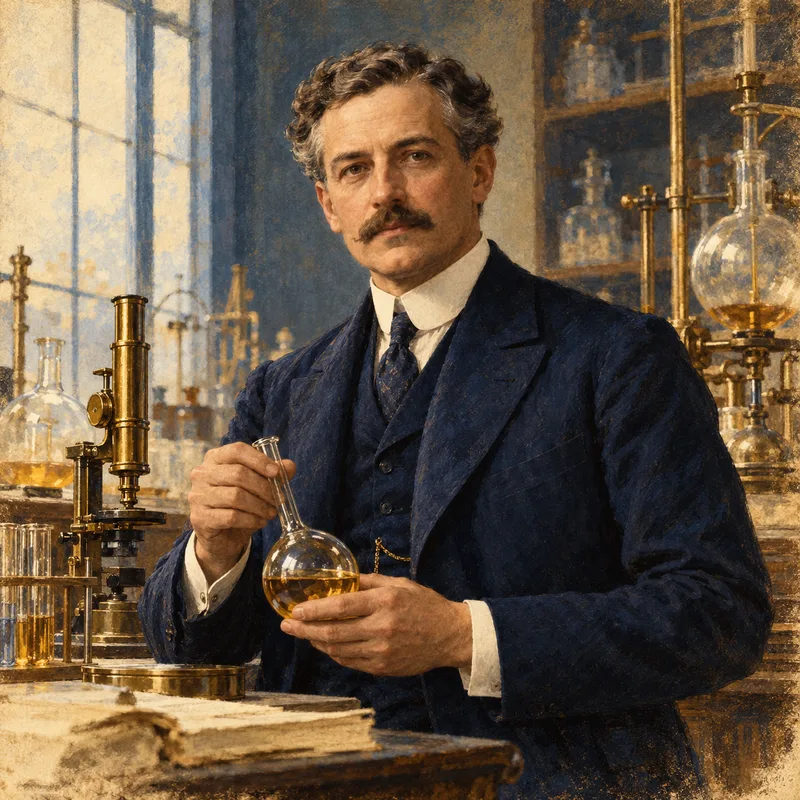
About the chemist
Thomas Midgley Jr.
1889-1944 · United States
Leaded gasoline; CFC refrigerants