The discovery, explained · Chemist no. 346 of 350
Thomas Midgley Jr.: Tetraethyl Lead, Freon and a Lesson in Chemical Responsibility
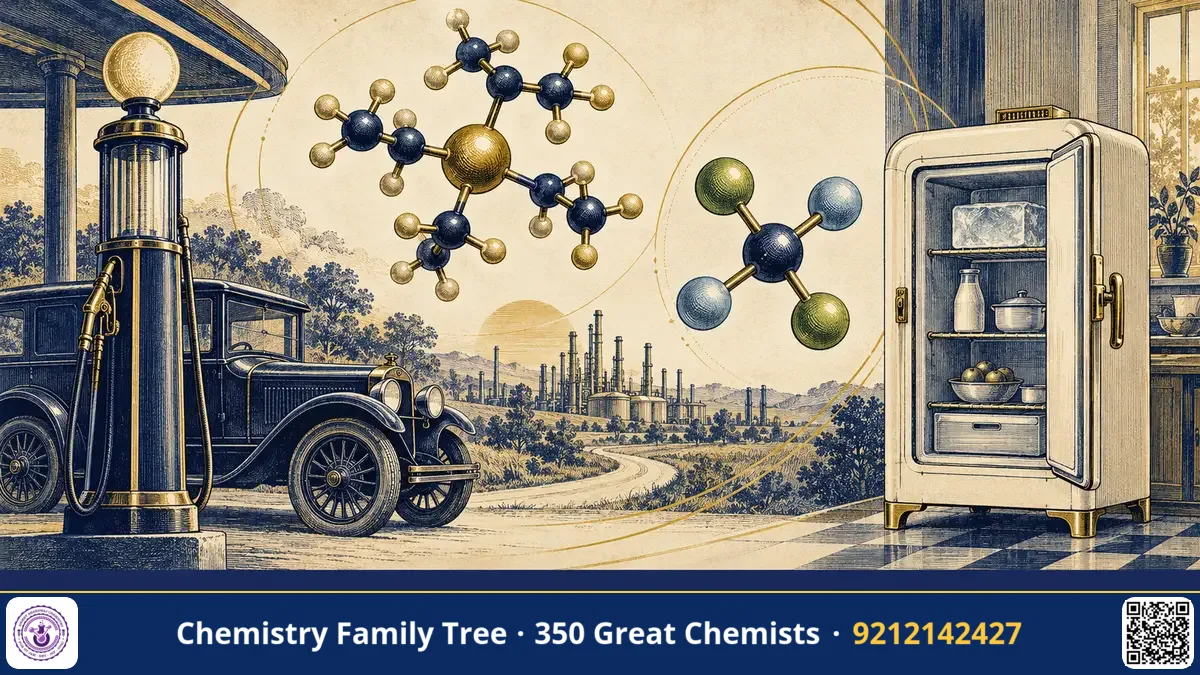
Few chemists have had as great an effect on the twentieth-century world, for good and for harm, as Thomas Midgley Jr. In 1921 he found that adding a small amount of tetraethyl lead to petrol stopped engine knock, and so made higher-performance engines possible. In 1930 his team introduced Freon, a family of non-toxic, non-flammable chlorofluorocarbon (CFC) refrigerants that made safe refrigerators and air-conditioners possible. Decades later, scientists found that leaded petrol spread lead through the environment and that CFCs damaged the stratospheric ozone layer. Both products were eventually phased out. For students, Midgley's story is a rich case study in organic chemistry, radical reactions, atmospheric chemistry and the importance of testing long-term effects.
The Scientific Problem Before the Discovery
Engine knock
In a petrol engine, the fuel-air mixture should burn smoothly after the spark. In early engines, parts of the mixture would ignite on their own before the flame front reached them, creating pressure waves that gave a metallic "knocking" sound, lost power and damaged engines. Knock limited the compression ratio, and hence the efficiency, of engines. General Motors researcher Charles Kettering wanted a fix, and he hired Midgley to find it.
Dangerous refrigerants
Home refrigerators in the 1920s used ammonia, sulphur dioxide or methyl chloride. These gases were toxic or flammable, and leaks caused deaths. Industry needed a safe refrigerant with the right boiling point.
The Discovery: Step by Step
Tetraethyl lead (TEL)
- Midgley first found that iodine and some iodine compounds reduced knock, but they were too costly and corrosive for general use.
- His group screened a very large number of substances for anti-knock activity, looking at the periodic table for elements that might work.
- On 9 December 1921, tetraethyl lead,
Pb(C₂H₅)₄, was found to be an excellent anti-knock additive in tiny quantities. - Ethanol also reduced knock, but could not easily be patented, so the industry pursued TEL.
- Leaded petrol was sold commercially from 1923. Ethylene dibromide was added so that the lead was carried off as volatile lead bromide, avoiding deposits in the engine.
Freon
- In 1928 Midgley, with Albert Henne and Robert McNary, looked for a safe refrigerant. Using boiling point trends in the periodic table, they suggested compounds that contain fluorine.
- They synthesised dichlorodifluoromethane, CCl₂F₂ (CFC-12), by swapping chlorine atoms in carbon tetrachloride with fluorine, using antimony fluoride (Swarts reaction).
- It was shown to be stable, non-flammable and of low toxicity. Midgley dramatically demonstrated its safety to the American Chemical Society in 1930 by inhaling a lungful and using it to blow out a candle.
3 CCl₄ + 2 SbF₃ → 3 CCl₂F₂ + 2 SbCl₃ (Swarts reaction, with SbCl₅ catalyst)
The Chemistry Behind It
How does TEL stop knock?
Knock results from a free-radical chain reaction in the unburnt gas ahead of the flame. TEL breaks down at engine temperature to give lead and lead oxide particles, which quench the reactive radicals (such as peroxy radicals) and so interrupt the chain reaction. In simplified form:
Pb(C₂H₅)₄  →  Pb + 4 C₂H₅•     (thermal decomposition)
Pb → PbO (with O₂); PbO scavenges chain-carrying radicals
Octane number scales: n-heptane = 0, isooctane = 100. Adding TEL raises the octane number of a fuel by several units at a very low concentration, around a few millilitres per gallon at that time.
Why are CFCs good refrigerants?
CCl₂F₂ boils at about −30 °C, so it evaporates easily and takes in latent heat from the surroundings in the cooling coil, and condenses on compression. The strong C–F and C–Cl bonds make CFCs chemically inert, non-flammable and non-corrosive at ground level.
The problem: ozone depletion
Because CFCs are so inert, they do not break down in the lower atmosphere. They drift into the stratosphere, where ultraviolet radiation breaks the weaker C–Cl bond to release chlorine radicals:
CCl₂F₂  --(UV)-->  •CClF₂ + Cl•
Cl• + O₃  →  ClO• + O₂
ClO• + O  →  Cl• + O₂
Net: O₃ + O  →  2 O₂   (Cl• acts as a catalyst)
One chlorine atom can destroy many thousands of ozone molecules before being removed. In 1974, Mario Molina and F. Sherwood Rowland proposed this mechanism; the discovery of the Antarctic ozone hole in the 1980s confirmed the concern. Molina and Rowland shared the 1995 Nobel Prize in Chemistry with Paul Crutzen. The Montreal Protocol (1987) set up a global phase-out of CFCs.
Applications Today
- Octane improvement: modern petrol gets its octane number from refining processes (alkylation, reforming) and from additives such as ethanol and ethers, instead of lead. India phased out leaded petrol in 2000.
- Refrigeration and air conditioning: CFCs were replaced by HCFCs, then HFCs and now by low-global-warming gases such as hydrocarbons and HFOs.
- Catalytic converters: removal of lead was necessary because lead poisons platinum-based catalysts.
- Policy: the Montreal Protocol is often cited as a successful international environmental agreement.
Exam Corner
- TEL formula Pb(C₂H₅)₄; it acts as an anti-knock agent by quenching radicals; ethylene dibromide is added as a lead scavenger.
- CFC-12 is CCl₂F₂; the Swarts reaction replaces Cl by F using SbF₃ or AgF.
- Ozone depletion: Cl• catalytic cycle; ClO• is the chain carrier; the net reaction converts O₃ and O to 2 O₂.
- Octane number: higher means more resistance to knock. Branching raises octane number.
- Lead is a poison to catalytic converters, which is another reason leaded petrol was banned.
Common Misconceptions
- "CFCs cause global warming but not ozone loss." They do both: they deplete ozone and are strong greenhouse gases. The ozone hole is a different issue from climate change.
- "TEL is added in large amounts." It is added in very small quantities, but over many years it released huge amounts of lead.
- "Midgley knew the harm." The long-term harm of CFCs was not known at the time; lead dangers were recognised by many contemporaries, but he and the industry argued the amounts were safe.
Quick Revision Box
- TEL, Pb(C₂H₅)₄: anti-knock additive found in December 1921.
- Freon-12, CCl₂F₂: safe refrigerant introduced around 1930.
- Swarts reaction: alkyl chloride to alkyl fluoride with SbF₃.
- Cl• catalyses ozone destruction: Cl• + O₃ → ClO• + O₂.
- Montreal Protocol 1987 phases out CFCs.
- India phased out leaded petrol in 2000.
FAQ
Why was lead added to petrol?
To raise the octane number and stop engine knock by quenching reactive radicals in the combustion chain reaction.
Why are CFCs harmful if they are inert?
Their inertness lets them reach the stratosphere, where UV light splits off chlorine atoms that destroy ozone catalytically.
What replaced CFCs?
HCFCs and HFCs were used first, then hydrofluoroolefins and natural refrigerants like propane, ammonia and carbon dioxide.
What is the lesson for chemists?
Useful chemicals need long-term testing for environmental and health effects, a principle behind green chemistry.
Published by ABC Chemistry — IIT-JAM | CSIR-NET | GATE Chemistry Coaching. Visit abcchemistry.com
About the chemist
Thomas Midgley Jr.
1889-1944 · United States
Leaded gasoline; CFC refrigerants