The discovery, explained · Chemist no. 203 of 350
Tomas Lindahl and the Discovery That DNA Needs Constant Repair
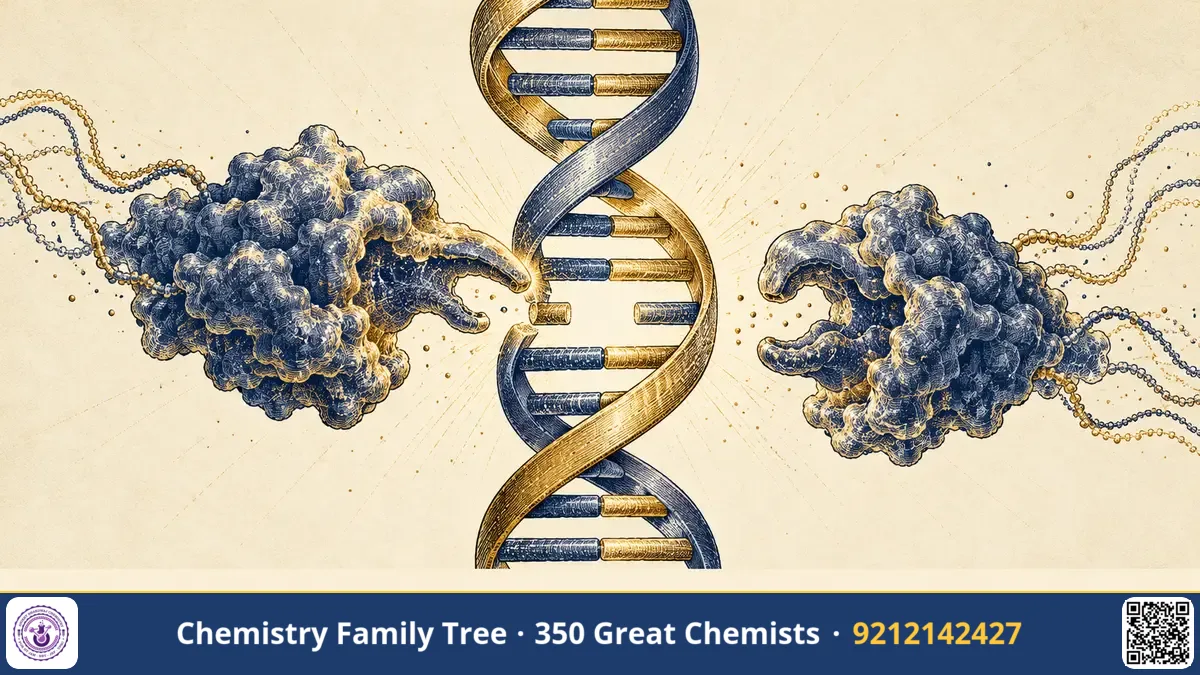
Textbooks of the 1960s often described DNA as the stable molecule of heredity, the "eternal" code passed from generation to generation. Tomas Lindahl, a Swedish biochemist, asked a simple but uncomfortable question: if DNA is a chemical, how stable can it really be at 37 °C in water? His measurements in the early 1970s showed that DNA decays spontaneously at a significant rate. Then he went further and found the enzymes that fix the damage, starting with uracil-DNA glycosylase and the pathway called base excision repair (BER). For this work he shared the 2015 Nobel Prize in Chemistry with Paul Modrich and Aziz Sancar "for mechanistic studies of DNA repair". This post explains the reactions and the repair pathway.
The Scientific Problem Before the Discovery
After Watson and Crick (1953), DNA was seen as a stable store of genetic information. Mutations were thought to come from external agents such as radiation and chemicals, or from rare errors in replication. If the information were chemically unstable, life could not persist over many generations. Yet two basic facts of organic chemistry suggested otherwise. First, the N-glycosidic bond between a purine base and deoxyribose can be hydrolysed in water. Second, the amino groups on cytosine, adenine and guanine can undergo hydrolytic deamination. Lindahl, who was then studying RNA at Princeton and Rockefeller Universities, noticed that RNA samples were unstable and wondered about DNA. Since the human genome has about 3 × 10⁹ base pairs in each haploid set, even a tiny rate of damage per base could add up to thousands of events per cell per day.
The Discovery: Step by Step
- Measuring depurination (1972). Lindahl and Barbro Nyberg incubated DNA at physiological pH and temperature and measured the release of purine bases. They found a slow but significant loss of purines (adenine and guanine), leaving apurinic (AP) sites. By extrapolation they estimated that a human cell loses on the order of 10,000 purines per day.
- Measuring cytosine deamination (1974). They then showed that cytosine in DNA is converted to uracil by hydrolytic deamination, much faster in single-stranded DNA than in double-stranded DNA, but still at a measurable rate in the double helix, on the order of 100-500 events per cell per day.
- A problem of consequences. Uracil pairs with adenine during replication. If left unrepaired, a C:G base pair will mutate to T:A after replication. If AP sites are unrepaired, replication stalls or inserts wrong bases. Lindahl reasoned that cells must have repair enzymes.
- Finding uracil-DNA glycosylase (1974). Lindahl purified an enzyme from E. coli that specifically removes uracil from DNA by cleaving the glycosidic bond, leaving an AP site. He named it uracil-DNA glycosylase (UDG). Similar enzymes were soon discovered in mammalian cells.
- Building the pathway. Lindahl's laboratory and others showed what happens next: an AP endonuclease cuts the DNA backbone next to the AP site, a DNA polymerase fills the gap, and DNA ligase seals the nick. The pathway was named base excision repair.
- Other glycosylases. Lindahl discovered many other enzymes, including 3-methyladenine DNA glycosylases, and studied how cells deal with alkylation damage, including the bacterial Ada response. In later years, his laboratory at Clare Hall in the UK also described enzymes that deal with oxidative damage.
The Chemistry Behind It
Depurination is acid-catalysed hydrolysis of the N-glycosidic bond. Protonation of the purine (at N7 or N3) makes it a better leaving group, and water attacks the anomeric carbon (C1') of deoxyribose via an oxocarbenium-like transition state:
Purine–dR–DNA + H₂O → HO–dR–DNA (apurinic site) + purine (free base)
Deamination of cytosine is hydrolytic substitution at C4 of the pyrimidine ring, in which water replaces NH₂, giving uracil and ammonia:
Cytosine + H₂O → Uracil + NH₃
Similar deamination of 5-methylcytosine yields thymine, a normal DNA base, which the cell cannot easily recognise as damaged (by the G:T mismatch). This is why 5-methylcytosine sites are mutation hotspots, converting C to T, an important point in cancer genetics.
Base excision repair proceeds in the following sequence:
- DNA glycosylase (for example UDG) flips the damaged base out of the helix into its active site and hydrolyses the N-glycosidic bond, leaving an AP site.
- AP endonuclease (APE1 in humans) cuts the phosphodiester backbone on the 5' side of the AP site.
- DNA polymerase β (in humans) removes the sugar-phosphate residue and inserts the correct nucleotide.
- DNA ligase (ligase III with XRCC1, or ligase I) seals the nick.
Rates of spontaneous chemical reactions follow first-order kinetics, rate = k[DNA lesions available], and the Arrhenius equation k = A e^(−Ea/RT) explains why higher temperature speeds damage.
Applications Today
- Cancer biology. Defects in repair pathways increase cancer risk. Drugs called PARP inhibitors (for example olaparib), which work by blocking a related repair step, are used against tumours with BRCA1/2 mutations.
- Chemotherapy. Temozolomide, an alkylating agent used in brain tumours, creates methyl lesions that repair enzymes can undo, so repair status can predict response.
- Ageing and neurodegeneration. Accumulated DNA damage is linked to ageing and certain neurological diseases.
- Biotechnology. UDG is used in laboratories to prevent contamination in PCR (the dUTP/UDG system) and in some cloning methods.
- Ancient DNA. Damage patterns such as C to T changes, caused by cytosine deamination, help to authenticate DNA from old fossils.
Exam Corner
- Nobel Prize in Chemistry 2015: Lindahl, Modrich and Sancar, for mechanistic studies of DNA repair (BER, mismatch repair, nucleotide excision repair respectively).
- Cytosine + H₂O → uracil + NH₃; uracil in DNA is removed by uracil-DNA glycosylase.
- Depurination leaves an AP (apurinic/apyrimidinic) site; BER sequence: glycosylase, AP endonuclease, polymerase, ligase.
- Deamination of 5-methylcytosine gives thymine, hence C→T mutational hotspots at CpG sites.
- Estimates: about 10,000 depurinations and 100-500 cytosine deaminations per human cell per day.
Common Misconceptions
- "DNA damage comes only from radiation and chemicals." Water and oxygen inside the cell alone cause constant damage.
- "A glycosylase cuts the DNA backbone." It cleaves the base-sugar bond; the backbone is cut by a separate AP endonuclease (monofunctional glycosylases).
- "Repair is perfect." Repair is highly efficient but not perfect; residual errors lead to mutations, which are the raw material of evolution and also of cancer.
Quick Revision Box
- 1972: depurination of DNA measured (Lindahl and Nyberg).
- 1974: cytosine deamination shown; uracil-DNA glycosylase discovered.
- BER steps: glycosylase, AP endonuclease, polymerase β, ligase.
- 5-methylcytosine deamination gives thymine and CpG mutational hotspots.
- PARP inhibitors exploit repair defects in cancer.
- Nobel Prize in Chemistry 2015 (with Modrich and Sancar).
FAQ
What is an AP site?
An apurinic or apyrimidinic site is a position in DNA where the base is missing but the sugar-phosphate backbone remains.
Why does uracil not belong in DNA?
Uracil is a normal base of RNA. In DNA, it signals damage because it comes from cytosine deamination; the cell uses thymine (5-methyluracil) so that uracil can always be recognised as an error.
Which repair pathway did each Nobel laureate study?
Lindahl: base excision repair. Sancar: nucleotide excision repair (and photolyase). Modrich: mismatch repair.
Is DNA repair part of the Indian syllabus?
Yes. It appears in biochemistry sections of CSIR-NET and in the life-science related portions of GATE and JAM chemistry-biology topics.
Published by ABC Chemistry — IIT-JAM | CSIR-NET | GATE Chemistry Coaching. Visit abcchemistry.com

About the chemist
Tomas Lindahl
1938- · Sweden · Nobel Chemistry 2015
Base excision repair of DNA