Biography · Chemist no. 191 of 350
Venkatraman Ramakrishnan: From Chidambaram to Cambridge and the Ribosome
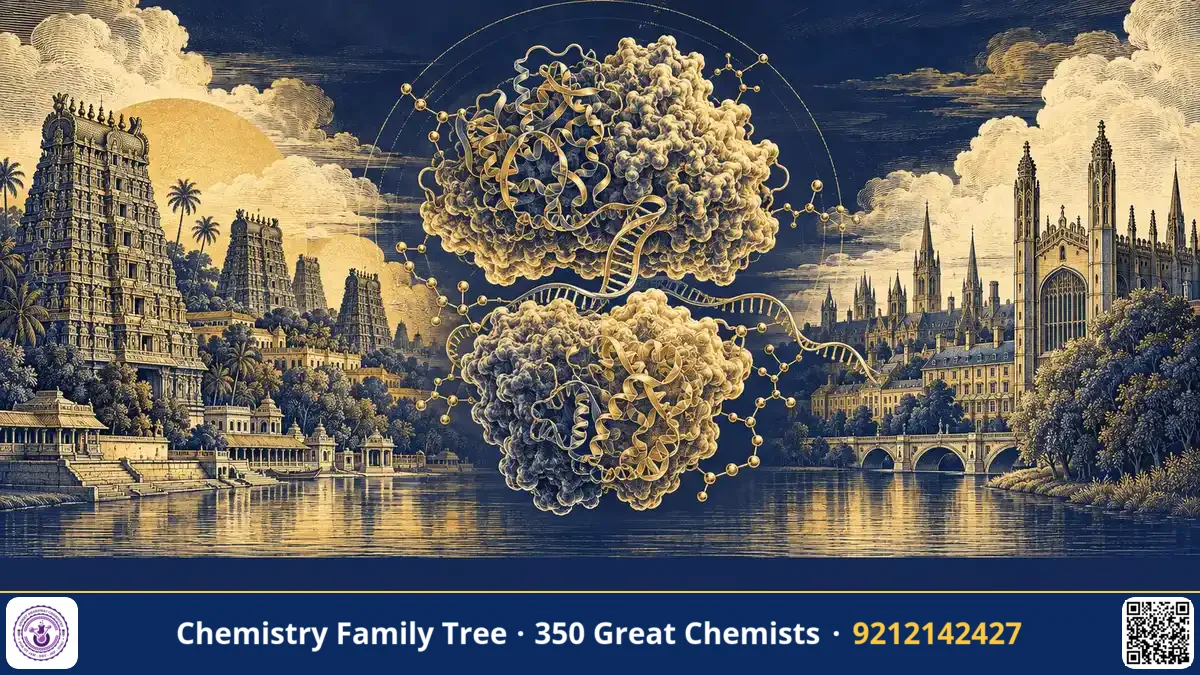
Venkatraman "Venki" Ramakrishnan (born 1952) is an Indian-born British-American structural biologist at the MRC Laboratory of Molecular Biology in Cambridge, UK. He solved the atomic structure of the 30S ribosomal subunit and explained how the ribosome reads the genetic code accurately. In 2009 he shared the Nobel Prize in Chemistry with Thomas Steitz and Ada Yonath. He is also a former President of the Royal Society, the world's oldest scientific academy. For students in India, his journey from a small town in Tamil Nadu to Stockholm is a deeply motivating story.
Early Life and Family
Ramakrishnan was born in Chidambaram, Tamil Nadu, in southern India, in 1952. His parents were both scientists: his father, C. V. Ramakrishnan, was a biochemist, and his mother, Rajalakshmi, was a scientist who worked in neuroscience. When Venki was a small child the family moved to Baroda (now Vadodara) in Gujarat, where his father headed a department of biochemistry at the Maharaja Sayajirao University. He spent part of his childhood in Adelaide, Australia, during a sabbatical of his father, and learned English there. Venki grew up in Baroda and attended a Catholic school (Convent of Jesus and Mary) there. In his own telling, his schooling in India was ordinary, and he was not a model student, but he developed an interest in physics and science.
Education and Mentors
He studied physics at Maharaja Sayajirao University of Baroda and obtained his BSc in 1971, supported by a National Science Talent Scholarship. He then moved to the United States and earned a PhD in physics from Ohio University in 1976, working on theoretical solid-state physics. After his PhD, he decided to change to biology, and spent two years as a graduate student in biology at the University of California, San Diego, learning the subject from the beginning. He then went to Yale University as a postdoctoral fellow with Peter Moore, who studied the ribosome using neutron scattering. In Moore's laboratory he mapped the positions of ribosomal proteins. Moore remained an important mentor and, years later, a friendly competitor in the field of ribosome research.
Career Timeline
| Year | Event |
|---|---|
| 1952 | Born in Chidambaram, Tamil Nadu, India |
| 1971 | BSc in physics, Maharaja Sayajirao University of Baroda |
| 1976 | PhD in physics, Ohio University |
| Late 1970s to early 1980s | Postdoctoral research at Yale University with Peter Moore (after biology studies at UC San Diego) |
| 1983–1995 | Scientist at Brookhaven National Laboratory, New York |
| 1995 | Professor of biochemistry at the University of Utah |
| 1999 | Moved to the MRC Laboratory of Molecular Biology, Cambridge |
| 2000 | Published the atomic structure of the 30S ribosomal subunit |
| 2009 | Nobel Prize in Chemistry (shared) |
| 2010 | Padma Vibhushan, India's second-highest civilian award |
| 2012 | Knighted for services to molecular biology |
| 2015–2020 | President of the Royal Society |
Major Scientific Contributions
Ramakrishnan's key result is the structure of the 30S subunit from Thermus thermophilus. It revealed the 16S rRNA fold and the positions of the ribosomal proteins. Further structures with antibiotics and tRNA/mRNA fragments showed how the decoding centre works: two adenines, A1492 and A1493, flip out and monitor the correct codon-anticodon helix, supporting an induced-fit mechanism that, with kinetic proofreading, produces an error rate close to 1 in 10,000. Aminoglycoside antibiotics such as paromomycin disturb this process and cause misreading. The details are in our discovery article.
Before the ribosome he worked on histone H5 and the structure of the nucleosome-binding globular domain (published in 1993) and on neutron scattering of the ribosome. Later, he used cryo-electron microscopy to determine structures of the mitochondrial ribosome, the eukaryotic ribosome and of ribosomes at different stages of translation, such as initiation and termination.
Awards, Honours and Nobel Prize
- Nobel Prize in Chemistry 2009: shared by Venkatraman Ramakrishnan, Thomas A. Steitz and Ada E. Yonath "for studies of the structure and function of the ribosome". It was a Chemistry prize.
- Padma Vibhushan (India, 2010).
- Knighted (Knight Bachelor) in 2012 for services to molecular biology.
- Fellow of the Royal Society, and its President from 2015 to 2020; member of the US National Academy of Sciences and the European Molecular Biology Organization.
- Fellow of Trinity College, Cambridge.
Personality, Struggles and Lesser-Known Facts
- A physicist who changed fields: He had a PhD in physics but switched to biology in his late twenties and started again as a student.
- A tough job search: He has described how he applied for many academic positions in his early career and had difficulty getting a permanent post, a fact that encourages many young scientists.
- The ribosome race: He was in competition with the groups of Ada Yonath, Thomas Steitz and Peter Moore, and he has written candidly about the pressure and the rivalry in his book Gene Machine (2018).
- Straightforward speaker: He is known for advocating the importance of basic research and for commenting on science policy, including the effect of Brexit on science.
- Family: He is married to Vera Rosenberry, an author and illustrator.
Legacy and Influence on Modern Chemistry
The ribosome structures are a milestone of structural biology; they proved that the ribosome is a ribozyme and explained how antibiotics work. Pharmaceutical researchers use ribosome structures to design new antibiotics against resistant bacteria such as drug-resistant tuberculosis, which is an important health issue in India. Through public lectures, mentoring and his Royal Society presidency, he has also promoted science education and international exchange. For Indian students, he is an example that a graduate of an Indian state university can reach the top of world science.
Lessons for Students
- You can change your field: a physicist became a leader in biology.
- Choose big, difficult problems, and accept that progress can be slow.
- Stay open to learning from mentors and from competitors.
- Technique matters: new methods, such as synchrotron X-rays and cryo-EM, create new science.
- Your hometown or university does not limit your ambitions.
Quick Facts Box
- Born: 1952, Chidambaram, Tamil Nadu, India
- Died: Living
- Nationality: Indian-born; British and American citizen
- Field: Structural biology, biochemistry
- Famous for: Atomic structure of the 30S ribosomal subunit; decoding mechanism
- Nobel: Chemistry 2009 (shared with Thomas Steitz and Ada Yonath)
FAQ
Which Indian university did Ramakrishnan attend?
The Maharaja Sayajirao University of Baroda, where he studied physics.
Did he win the Nobel in Chemistry or Medicine?
Chemistry, in 2009.
What is the name of his book?
Gene Machine: The Race to Decipher the Secrets of the Ribosome, published in 2018.
Where does he work now?
At the MRC Laboratory of Molecular Biology in Cambridge, UK.
Published by ABC Chemistry — IIT-JAM | CSIR-NET | GATE Chemistry Coaching. Visit abcchemistry.com
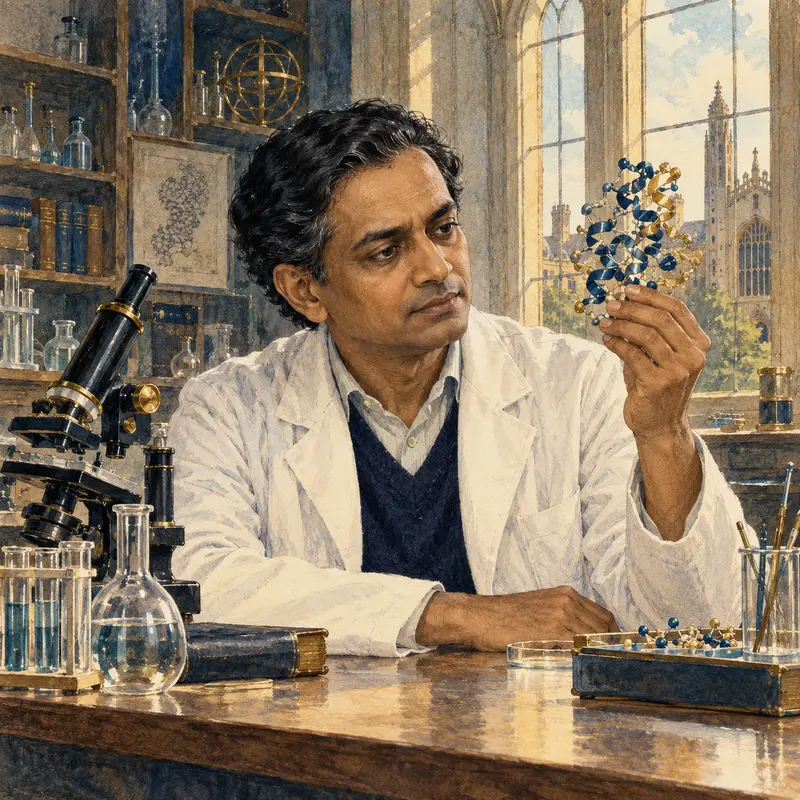
About the chemist
Venkatraman Ramakrishnan
1952- · United Kingdom · Nobel Chemistry 2009
Structure of the ribosome