Biography · Chemist no. 26 of 350
Victor Grignard: From a Sailmaker's Son to a Nobel Laureate
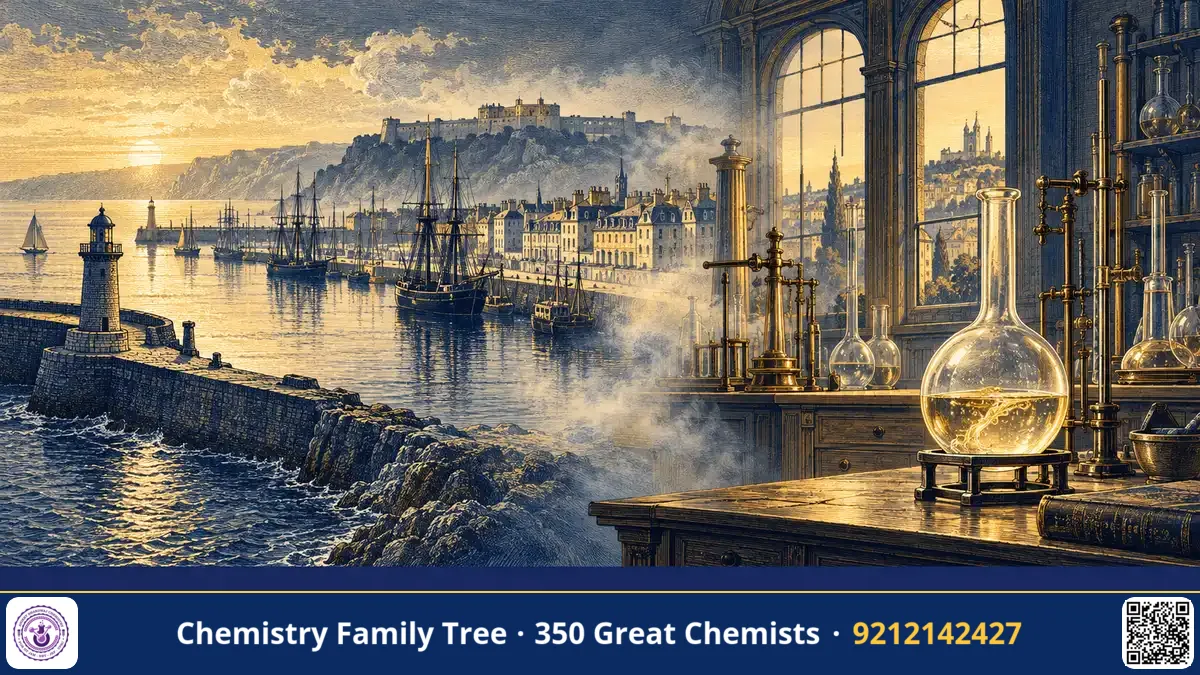
François Auguste Victor Grignard (1871–1935) was a French organic chemist who discovered the organomagnesium halides now known as Grignard reagents. This discovery gave chemists a simple, versatile way to form carbon–carbon bonds, and it earned him the 1912 Nobel Prize in Chemistry, shared with Paul Sabatier. His story shows how a patient student can transform an idea from his teacher into one of the most important tools of chemistry. His legacy: the reagent is still used in laboratories and factories around the world today.
Early Life and Family
Victor Grignard was born on 6 May 1871 in Cherbourg, a port in Normandy, France. His father, Théophile Grignard, worked in the naval dockyard as a sailmaker and foreman. The family lived modestly. Victor attended local schools in Cherbourg, where he showed talent in mathematics, and he won a scholarship to continue his studies.
In 1910 he married Augustine Marie Boulant. They had two children. Their son, Roger, became a chemist and later helped to edit his father's major work on organic chemistry.
Education and Mentors
Grignard went to the École Normale Spéciale at Cluny to train as a teacher, and then in 1892 he moved to the University of Lyon to study mathematics. He changed to chemistry after being attracted to the subject, and became a student and assistant of Philippe Barbier and Louis Bouveault. He obtained his bachelor's degree in 1893 and received his doctorate at Lyon in 1901. The title of the thesis was on organomagnesium compounds and their use in synthesis. It was Barbier who gave him the problem, and Grignard acknowledged the debt throughout his life, although a later disagreement over the credit made their relationship difficult.
Career Timeline
| Year | Event |
|---|---|
| 1871 | Born in Cherbourg, 6 May |
| 1892 | Enters the University of Lyon |
| 1899 | Barbier's magnesium experiment; Grignard begins his investigation |
| 1900 | Discovers the preparation of organomagnesium halides in ether |
| 1901 | Doctorate at Lyon |
| 1910 | Professor of organic chemistry at Nancy; marriage |
| 1912 | Awarded the Nobel Prize in Chemistry (shared with Paul Sabatier) |
| 1914–1918 | Military service; research on chemical warfare agents |
| 1919 | Returns to Lyon as professor, succeeding Philippe Barbier |
| 1935 | Dies in Lyon, 13 December |
Major Scientific Contributions
- Organomagnesium halides (1900). The discovery of the reagents RMgX in ether and their reactions with carbonyl compounds, carbon dioxide, epoxides and others. See our discovery post for the reaction table and exam points.
- Synthesis of alcohols, acids and hydrocarbons. He demonstrated the preparation of primary, secondary and tertiary alcohols from simple halides.
- Terpene and perfume chemistry. He applied the reagent to the synthesis of natural products, including terpenes and related fragrance compounds.
- A treatise on organic chemistry. He edited the large French multi-volume Traité de chimie organique, which collected the knowledge of his time.
- Teaching and leadership. At Nancy and then at Lyon he led large laboratories and trained many students in organic synthesis.
Awards, Honours and Nobel Prize
The Royal Swedish Academy of Sciences awarded Grignard the Nobel Prize in Chemistry for 1912, shared with Paul Sabatier, "for the discovery of the so-called Grignard reagent, which in recent years has greatly advanced the progress of organic chemistry". Sabatier's half of the prize was for the method of hydrogenating organic compounds in the presence of finely divided metals. Grignard also received the Légion d'honneur and was a member of the French Academy of Sciences and of several foreign academies. At the time of the prize, he was only 41 years old, and the discovery was just twelve years old.
Personality, Struggles and Lesser-Known Facts
- A late start. Grignard did not take a straight path. He began studying mathematics and only later moved to chemistry. He was nearly thirty when he made his famous discovery, and his career shows that talent can bloom later than expected.
- A teacher's challenge. Barbier had found that magnesium could be used in place of zinc. Grignard's insight was to prepare the reagent first in ether, and then use it. This simple step changed an irregular reaction into a general method.
- The question of credit. Because the Nobel Prize named only Grignard for this discovery, Barbier felt that his contribution had not been recognised. Chemists today speak of both the Barbier reaction and the Grignard reaction.
- War service. During the First World War, Grignard served in the French army, and later worked on the study of chemical warfare agents, including the preparation of phosgene, and on defence against them. He was a patriot who used his science for his country in a time of crisis.
- Modest and hardworking. Colleagues remembered him as modest, kind and diligent in teaching, with a close interest in the careers of his students.
Legacy and Influence on Modern Chemistry
Grignard's reagent opened the field of organometallic chemistry, which would later give us organolithium reagents, Gilman cuprates, Ziegler–Natta catalysts, and the palladium cross-coupling reactions that won the Nobel Prize in 2010 (Heck, Negishi and Suzuki). Reactions of the Kumada type directly use Grignard reagents with nickel or palladium catalysts. In every university course, from the first year of B.Sc. to M.Sc., the Grignard reaction is the main example of C–C bond formation. Lyon's chemistry school remained a centre of excellence after him, and the reaction still appears regularly in questions of JAM, NET and GATE.
Lessons for Students
- Do not worry if you change your subject. Grignard started in mathematics and became a chemist.
- Improve methods by simplifying them: separating two steps made the reaction reliable.
- Respect your teachers and give credit, as Grignard did at first, but also develop your own ideas.
- Learn with care: always keep apparatus dry when you work with organometallic reagents.
Quick Facts Box
- Born: 6 May 1871, Cherbourg, France
- Died: 13 December 1935, Lyon, France
- Nationality: French
- Field: Organic and organometallic chemistry
- Famous for: Grignard reagent (RMgX) and the Grignard reaction
- Nobel: Chemistry, 1912 (shared with Paul Sabatier)
FAQ
Who was Grignard's teacher?
Philippe Barbier at the University of Lyon, who also worked on magnesium reactions.
With whom did Grignard share the Nobel Prize?
With Paul Sabatier, a French chemist known for catalytic hydrogenation using nickel.
How old was Grignard when he made his discovery?
He was about 29 years old in 1900.
Why is the Grignard reaction so important?
It lets chemists make new carbon–carbon bonds easily, using simple halides and carbonyl compounds, and so to build complex molecules from simple ones.
Published by ABC Chemistry — IIT-JAM | CSIR-NET | GATE Chemistry Coaching. Visit abcchemistry.com
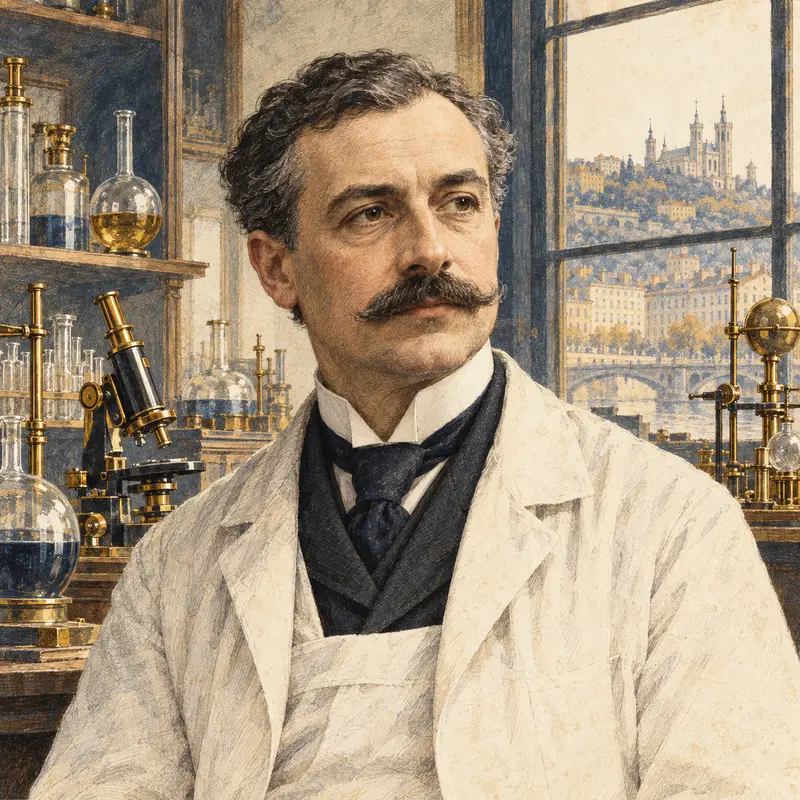
About the chemist
Victor Grignard
1871-1935 · France · Nobel Chemistry 1912
Grignard reagents