The discovery, explained · Chemist no. 26 of 350
Victor Grignard and the Reagent That Builds Carbon Skeletons
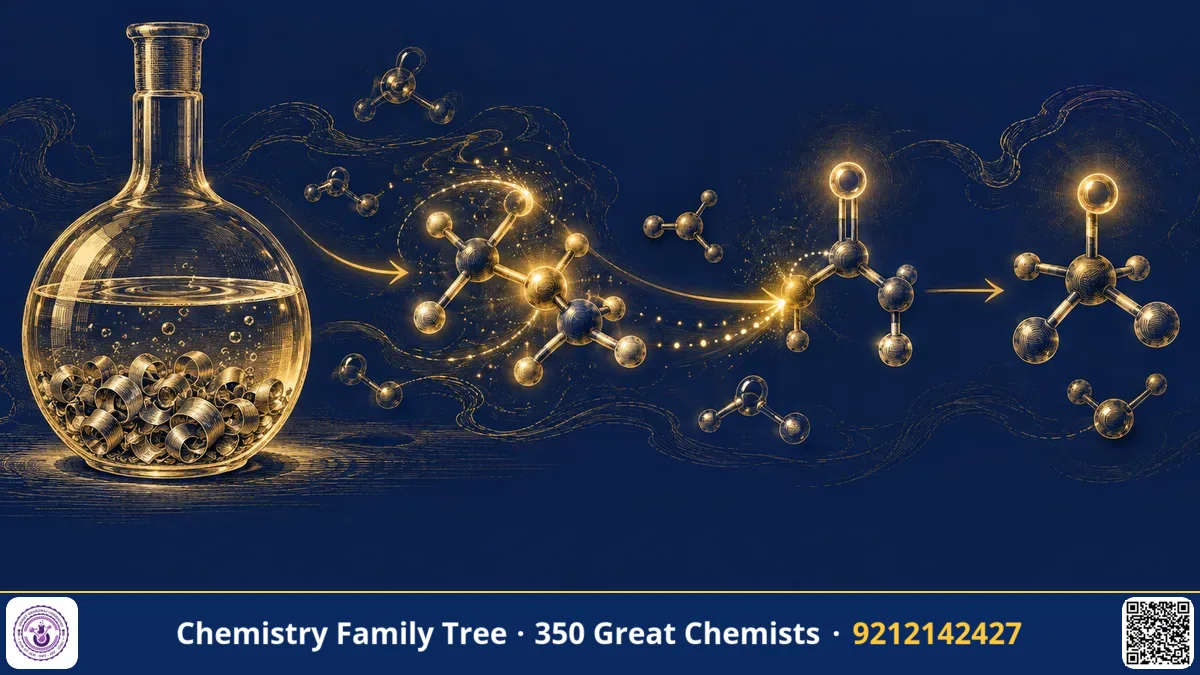
Almost every student of organic chemistry learns one reagent above all others for building carbon–carbon bonds: the Grignard reagent, RMgX. In 1900 a young French chemist, Victor Grignard, found that magnesium metal reacts with alkyl halides in dry ether to give a solution of an organomagnesium halide. This solution attacks aldehydes, ketones, esters, carbon dioxide and epoxides, and lets chemists build almost any alcohol, acid or hydrocarbon skeleton they can draw. In 1912 Grignard received the Nobel Prize in Chemistry, which he shared with Paul Sabatier, "for the discovery of the so-called Grignard reagent, which in recent years has greatly advanced the progress of organic chemistry".
The Scientific Problem Before the Discovery
Organic synthesis in the 1890s was limited by the difficulty of joining carbon atoms together in a controlled way. Chemists had the Wurtz reaction, which couples two alkyl halides with sodium, and organozinc compounds, first prepared by Edward Frankland in 1849. Zinc reagents such as diethylzinc could make new C–C bonds, but they had major drawbacks. Diethylzinc catches fire in air, it is not very reactive towards many functional groups, and it was inconvenient to prepare and handle.
In 1899 Philippe Barbier, a professor at Lyon, found that magnesium could replace zinc in a reaction in which methyl iodide and a ketone (methylheptenone) were mixed in a single flask with the metal. The reaction gave a tertiary alcohol, but the results were irregular. Barbier suggested to his student Victor Grignard that he should study the problem more fully.
The Discovery: Step by Step
Grignard made the key change: he separated the two stages.
- Step 1 – Make the reagent. Magnesium turnings are placed in dry diethyl ether, and an alkyl or aryl halide is added slowly. The magnesium dissolves as the organomagnesium halide forms.
- Step 2 – React with the substrate. After the reagent has formed, the carbonyl compound is added to the solution.
- Step 3 – Work-up. Dilute acid or aqueous ammonium chloride is added to liberate the product.
The first step is:
R–X + Mg → R–MgX (dry ether or THF; X = Cl, Br, I)
Grignard described this work in his 1901 doctoral thesis at Lyon. Using ether was important, since the solvent dissolves and stabilises the reagent by coordination of its oxygen lone pairs to magnesium. Moreover, careful exclusion of water was essential.
The Chemistry Behind It
Nature of the reagent. The C–Mg bond is strongly polarised: carbon is the negative end (Cδ⁻–Mgδ⁺). The R group therefore behaves like a carbanion, a strong nucleophile and a strong base. In solution, there is the Schlenk equilibrium: 2 RMgX ⇌ R₂Mg + MgX₂.
Reactions with carbonyl compounds. R⁻ adds to the electrophilic carbonyl carbon to give a magnesium alkoxide, which is hydrolysed to an alcohol:
| Substrate | Product (after H₃O⁺) |
|---|---|
| Formaldehyde, HCHO | Primary alcohol, RCH₂OH |
| Other aldehyde, R'CHO | Secondary alcohol, RR'CHOH |
| Ketone, R'COR" | Tertiary alcohol, RR'R"COH |
| Ester, R'COOR" (2 equiv. RMgX) | Tertiary alcohol, RR(R')COH (two identical R groups) |
| Carbon dioxide, CO₂ | Carboxylic acid, RCOOH (one carbon more) |
| Ethylene oxide | Primary alcohol, RCH₂CH₂OH (two carbons more) |
| Nitrile, R'CN | Ketone, RCOR' (via imine) |
Examples to remember:
CH₃MgBr + CH₃COCH₃ → (CH₃)₃C–OMgBr → (CH₃)₃COH(tert-butanol)C₂H₅MgBr + CO₂ → C₂H₅COOMgBr → C₂H₅COOH(propanoic acid)C₆H₅MgBr + C₆H₅COC₆H₅ → (C₆H₅)₃COH(triphenylmethanol)
Reaction with acidic hydrogens. Because the reagent is a very strong base, it reacts at once with water, alcohols, carboxylic acids, amines and terminal alkynes:
RMgX + H₂O → RH + Mg(OH)X
This is why the reaction must be done with dry glassware and solvents, and why the substrate must not contain acidic –OH or –NH groups unless protected. The same reaction is used to measure active hydrogen in a compound, for example in the Zerewitinoff determination, where methane released from CH₃MgI is measured.
Mechanism. The carbonyl oxygen coordinates to Mg, which makes the carbon more electrophilic. Then the R group is transferred to carbon, probably through a cyclic six-membered transition state involving a second RMgX molecule. For hindered ketones, electron-transfer paths are also possible.
Applications Today
- Pharmaceuticals: Grignard steps appear in the industrial syntheses of drugs such as tamoxifen, used for breast cancer, and many other active ingredients. Indian pharmaceutical companies use Grignard chemistry in process development and bulk drug manufacture.
- Fine chemicals and fragrances: alcohols and acids with specific carbon skeletons are built from small units.
- Silicon industry: organosilicon polymers (silicones) can be prepared by Grignard routes from chlorosilanes, although the direct (Rochow) process is more common for large-scale production.
- Research laboratories: Grignard reagents are used in total synthesis of natural products, and in preparing other organometallic reagents, such as organoboron and organotin compounds.
- Teaching: the preparation of triphenylmethanol or benzoic acid via Grignard is a standard undergraduate laboratory experiment.
Exam Corner
- Preparation: RX + Mg in dry diethyl ether (or THF); reactivity of halides R–I > R–Br > R–Cl.
- Grignard with HCHO gives a primary alcohol; other aldehydes give secondary alcohols; ketones give tertiary alcohols; esters give tertiary alcohols with two identical R groups.
- With CO₂ gives a carboxylic acid with one more carbon; with ethylene oxide, a primary alcohol with two more carbons.
- Any compound with acidic hydrogen (water, alcohol, acid, terminal alkyne, amine) destroys the reagent, forming an alkane RH.
- Schlenk equilibrium: 2RMgX ⇌ R₂Mg + MgX₂. Ether solvates Mg through lone pairs on oxygen.
Common Misconceptions
- "Grignard reagent is RMgX in an ionic form." The C–Mg bond is polar covalent, not fully ionic.
- "Any solvent with oxygen will do." The solvent must be aprotic and dry. Ethanol would destroy the reagent.
- "Esters give secondary alcohols." Esters give tertiary alcohols with two equivalents of Grignard reagent, because the ketone formed as intermediate reacts further. (Formate esters give secondary alcohols.)
Quick Revision Box
- Discovered in 1900; Grignard's doctoral thesis in 1901.
- Nobel Prize in Chemistry in 1912, shared with Paul Sabatier.
- R–X + Mg → RMgX in dry ether; C–Mg bond is polar, carbon is nucleophilic.
- HCHO → 1° alcohol; RCHO → 2° alcohol; R₂C=O → 3° alcohol.
- CO₂ → RCOOH; ethylene oxide → alcohol with two more carbons.
- Destroyed by water or any acidic H: RMgX + H₂O → RH.
FAQ
Why is dry ether used?
Ether does not have acidic hydrogens, and its oxygen lone pairs coordinate to magnesium, stabilising the reagent. Water would decompose it.
What is the role of iodine crystal in the preparation?
A small crystal of iodine helps to clean the surface of the magnesium and start the reaction.
How does a Grignard reaction differ from the Barbier reaction?
In the Barbier reaction, the organometallic reagent is formed in the presence of the carbonyl compound in one pot. In the Grignard reaction, the reagent is prepared first and then added to the substrate.
Can Grignard reagents react with a C=C double bond?
Generally not, unless it is conjugated with a carbonyl group, where 1,4-addition may compete, especially in the presence of copper salts.
Published by ABC Chemistry — IIT-JAM | CSIR-NET | GATE Chemistry Coaching. Visit abcchemistry.com
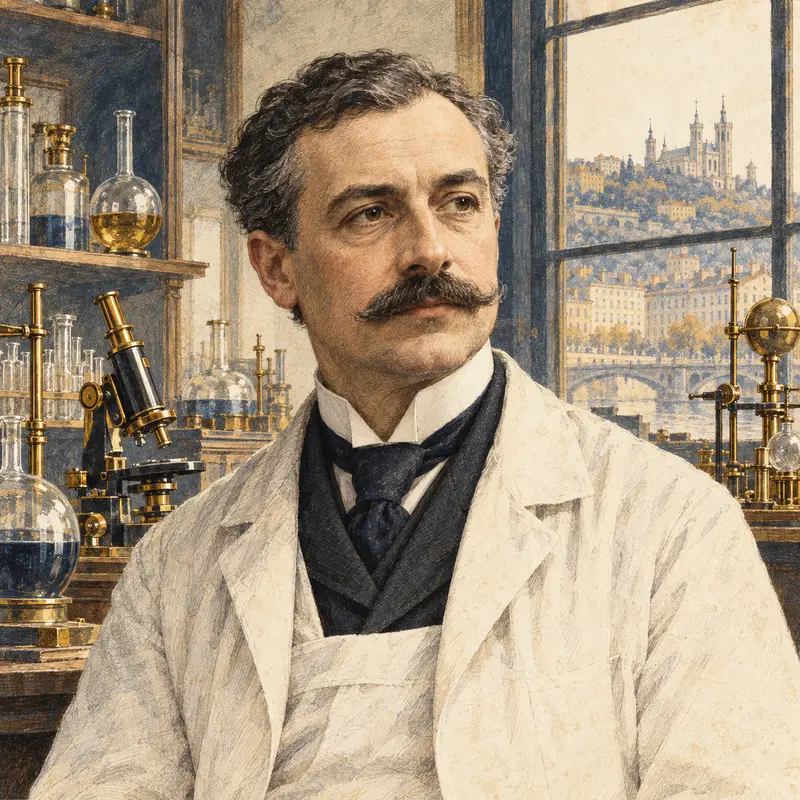
About the chemist
Victor Grignard
1871-1935 · France · Nobel Chemistry 1912
Grignard reagents