Biography · Chemist no. 287 of 350
Victor Meyer (1848–1897): A Brilliant Career Cut Short
Introduction
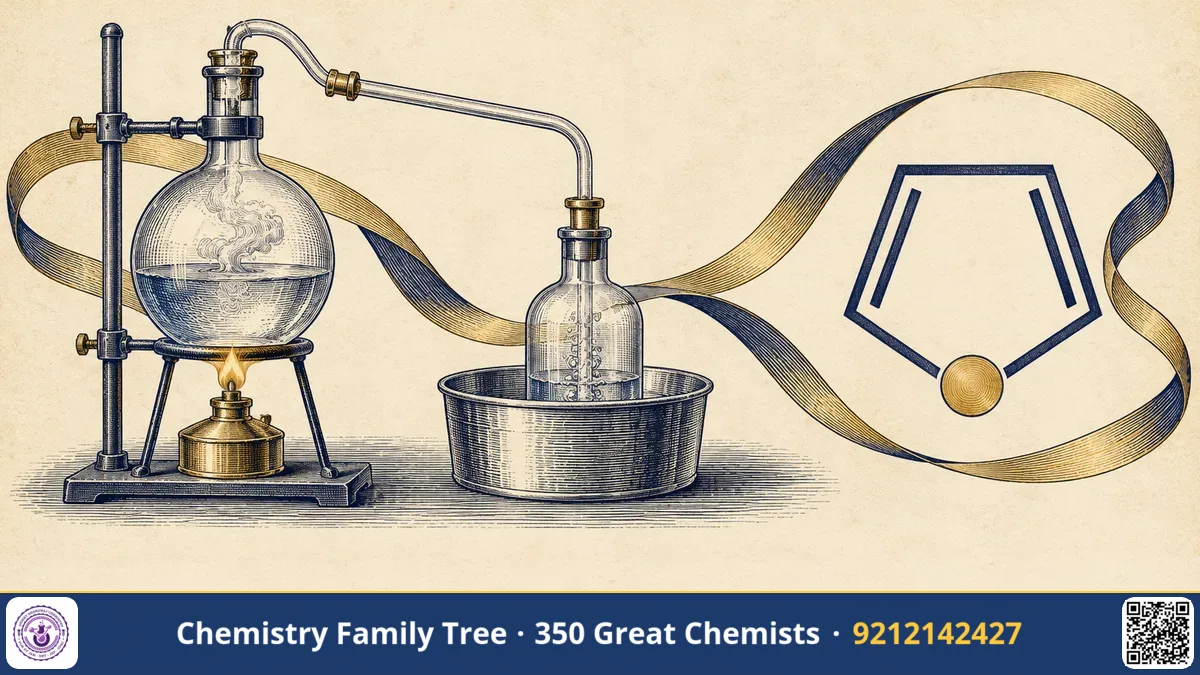
Victor Meyer was one of the most gifted German chemists of the late nineteenth century. He took his doctorate while still a teenager, became a professor in his twenties, and in the span of barely three decades discovered thiophene, devised a famous method for vapour density, explored the chemistry of oximes and nitro compounds, and introduced the idea of steric hindrance. He succeeded Robert Bunsen at Heidelberg, but died young. In one line: Victor Meyer was a fast, creative experimenter whose work shaped heterocyclic, physical and mechanistic organic chemistry.
Early Life & Family
Viktor (Victor) Meyer was born on 8 September 1848 in Berlin into a Jewish family. His father Jakob Meyer was a businessman, and his brother Richard Meyer also became a well-known chemist. The Meyer household encouraged education, and young Victor became a keen student with a remarkable ability to learn quickly. He was fortunate to be growing up in Berlin at a time when science was flourishing in Prussia, and he soon developed a passion for chemistry which dominated his life.
Education & Mentors
Meyer first studied at the Gewerbeakademie in Berlin, where he attended lectures of Adolf von Baeyer, and then went to Heidelberg to study under Robert Bunsen, whose laboratory was one of the most famous in Europe. He earned his doctorate at Heidelberg in 1867 at the age of eighteen. He then worked with Baeyer in Berlin. These years under two outstanding mentors, Bunsen and Baeyer, gave him expertise in both inorganic and organic chemistry. His early talent was recognised, and he started his independent teaching career before reaching the age of twenty-five.
Career Timeline
| Year | Event |
|---|---|
| 1848 | Born in Berlin |
| 1867 | Doctorate at Heidelberg under Bunsen |
| Early 1870s | Works with Baeyer in Berlin |
| 1872 | Professor at the Zurich Polytechnic |
| 1878 | Devises the vapour density apparatus |
| 1882 | Discovers thiophene |
| 1885 | Moves to Göttingen as professor |
| 1889 | Appointed to the Heidelberg chair, succeeding Bunsen |
| 1894 | Publishes on steric hindrance in esterification |
| 1897 | Dies on 8 August in Heidelberg |
Major Scientific Contributions
- Thiophene: discovery of the sulphur analogue of benzene in coal tar, leading to the entire field of thiophene chemistry.
- Vapour density method: a quick way to measure the molar mass of volatile substances.
- Oximes: with Goldschmidt, he studied the formation of oximes from carbonyl compounds and hydroxylamine and recognised the possibility of isomeric oximes.
- Nitro compounds: reactions of nitroalkanes with nitrous acid, giving nitrolic acids and pseudonitroles, used to distinguish classes of alcohols.
- Steric hindrance: showing that bulky ortho substituents slow esterification, a principle that became a central idea in mechanistic organic chemistry.
- Hypervalent iodine: with Willgerodt, he prepared iodosobenzene and diaryl iodonium compounds, early examples of hypervalent iodine reagents.
- High-temperature chemistry: he used his apparatus to study the dissociation of molecules such as halogens at very high temperatures.
For the chemistry behind these discoveries, see our companion discovery post on Victor Meyer.
Awards, Honours & Nobel Prize
Meyer did not receive a Nobel Prize, since he died four years before the first awards in 1901. Honours came in the form of chairs at prestigious institutions: the Zurich Polytechnic, Göttingen and above all the Heidelberg chair previously held by Bunsen. His name is attached to the Victor Meyer apparatus, the Victor Meyer test and the Victor Meyer esterification law, and thiophene stands as his lasting scientific monument.
Personality, Struggles & Lesser-Known Facts
- The teenage doctor. He received his doctorate at eighteen, an exceptional age even in an era of early achievers.
- A discovery from a failed demonstration. Thiophene came from a lecture experiment that did not work as expected. It is a classic example of how careful observation of a failure can produce a discovery.
- A hard worker with fragile health. Accounts describe him as a man of intense energy who pushed himself hard, and his later years were troubled by poor health.
- A family of chemists. His brother Richard Meyer was also a notable chemist, so the name Meyer appears often in the literature, and students should not confuse the two.
- Early death. He died at the age of forty-eight in 1897. His early death was a great loss to German chemistry, and the Heidelberg chair passed to Theodor Curtius.
- A famous teacher. Students from many countries came to his laboratories in Zurich, Göttingen and Heidelberg, and he was known as an inspiring lecturer.
Legacy & Influence on Modern Chemistry
Meyer's influence is easy to trace. Thiophene derivatives are in modern drugs and in electronic polymers. The vapour density method is still taught to demonstrate the relation between gas volume and molar mass. Steric hindrance is now a core concept in organic reactivity, in the design of bulky ligands for catalysts, and in drug-receptor binding. His work on hypervalent iodine anticipated a major area of modern reagent chemistry. His students carried German organic chemistry to many countries, and the method of studying anomalies, such as the unexpected colour test, remains a model for scientific curiosity.
Lessons for Students
- Look closely at failures; the missing blue colour led to a new compound.
- Do not accept an assumption, like "the test is a property of benzene", without verification.
- Master both inorganic and organic chemistry; Meyer worked comfortably in both.
- Take care of your health; research is a marathon, and Meyer's early death is a reminder not to neglect rest and support.
- Learn the effect of shape and size on reactions, because steric effects appear throughout chemistry.
Quick Facts Box
- Born: 8 September 1848, Berlin
- Died: 8 August 1897, Heidelberg, Germany
- Nationality: German
- Field: Organic and physical chemistry
- Famous for: Thiophene, vapour density method, steric hindrance in esterification
- Nobel Prize: None
FAQ
Who discovered thiophene?
Victor Meyer, in 1882, as an impurity in coal-tar benzene.
Whom did Victor Meyer succeed at Heidelberg?
Robert Bunsen, in 1889.
Was Victor Meyer related to another chemist?
Yes. His brother Richard Meyer was also a chemist.
Why did Meyer not receive a Nobel Prize?
He died in 1897, before the Nobel Prizes began in 1901.
Published by ABC Chemistry — IIT-JAM | CSIR-NET | GATE Chemistry Coaching. Visit abcchemistry.com
About the chemist
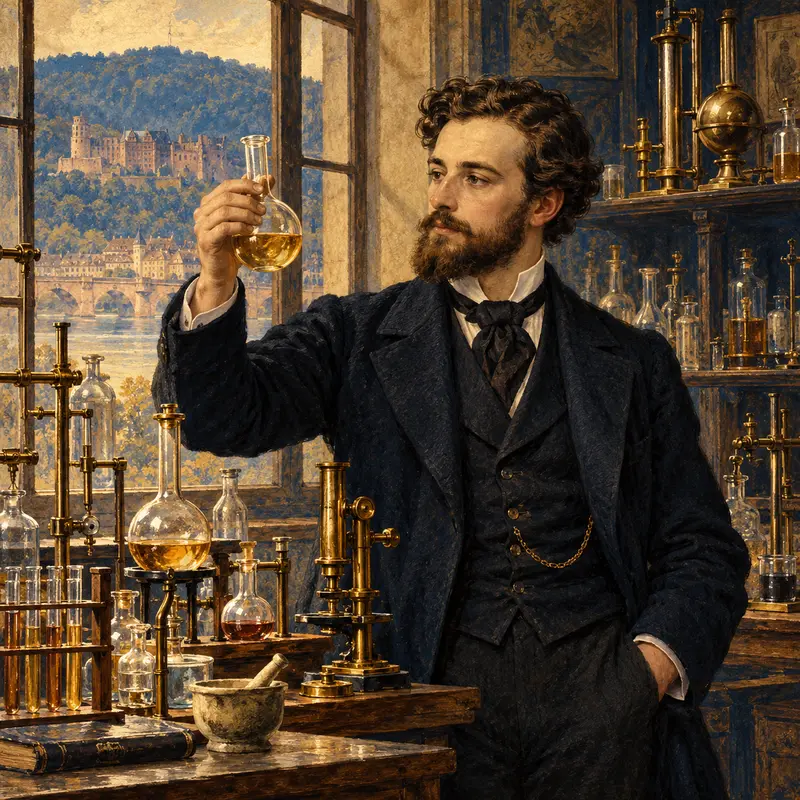
Victor Meyer
1848-1897 · Germany
Thiophene discovery; vapor density method