The discovery, explained · Chemist no. 287 of 350
Victor Meyer: How a Failed Lecture Demonstration Revealed Thiophene
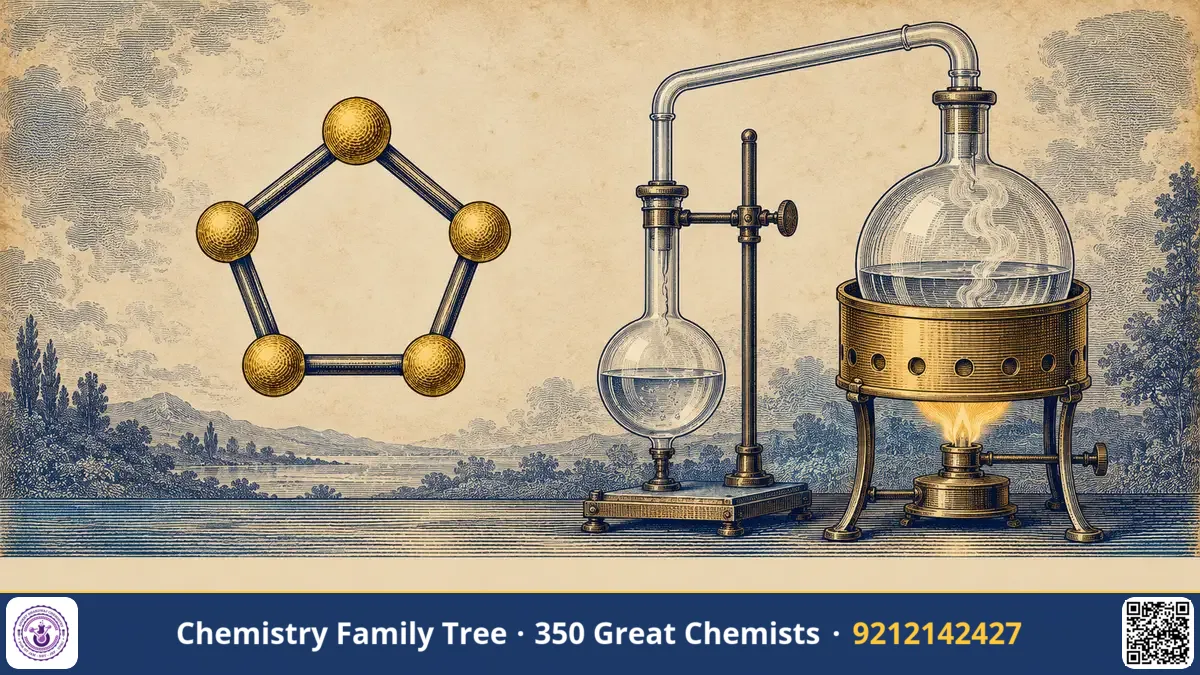
Every student who studies heterocyclic chemistry meets thiophene, the five-membered sulphur ring that behaves much like benzene. Few know that it was discovered because a lecture demonstration did not work. The man involved was Victor Meyer, a brilliant German chemist who, besides thiophene, designed the classical vapour density apparatus for finding molar masses, studied the chemistry of oximes and nitro compounds, and described what we now call steric hindrance in reactions. His name appears in physical chemistry, organic chemistry and heterocyclic chemistry, making him a very useful figure for JAM, NET and GATE preparation.
The Scientific Problem Before the Discovery
In the 1870s there were two big problems. First, determining the molar mass of a volatile compound quickly. Dumas had a vapour density method, but it needed large amounts of sample and was slow. Second, chemists believed that benzene was the only simple source of an important class of aromatic reactions. A famous test, described by Adolf von Baeyer, was that isatin dissolved in concentrated sulphuric acid, when shaken with benzene from coal tar, gave a beautiful deep-blue colour called indophenin. This test was assumed to be a property of benzene itself. Another question concerned how groups near a reactive centre affect the rate of a reaction; the idea that atoms occupy space and can block each other had not been tested properly.
The Discovery / Experiment
1. Vapour density method (1878). Meyer devised a simple apparatus: a long tube with a bulb at the bottom, heated in a jacket by a vapour of a liquid boiling well above the boiling point of the sample. A small weighed glass bulb of the liquid is dropped into the hot tube; it vaporises and pushes out an equal volume of air, which is collected over water in a graduated tube. From the volume of air displaced at known temperature and pressure, the molar mass can be found:
Volume of vapour = volume of air displaced (corrected to dry gas at room T, P)
M = (w · R · T) / (P · V)
2. Thiophene (1882). While preparing a lecture, Meyer wanted to show the isatin–indophenin blue test with benzene. To his surprise, a sample of benzene purified by repeated treatment with sulphuric acid failed to give the colour. The colour reaction did not belong to benzene but to an impurity, which was removed by sulphuric acid. Meyer isolated the impurity from coal-tar benzene and called it thiophene (from Greek theion, sulphur, and phaino, I show). Its formula was C₄H₄S, a sulphur-containing aromatic compound that behaves very like benzene.
3. Oximes and nitro compounds. Meyer and co-workers studied oximes and reactions of nitroalkanes with nitrous acid; primary nitroalkanes give nitrolic acids (red with alkali), secondary give pseudonitroles (blue), and tertiary do not react. This is the Victor Meyer test to distinguish 1°, 2° and 3° alcohols, using the nitroalkanes made from the corresponding iodides and silver nitrite.
4. Steric hindrance (1894). He found that benzoic acids with two groups in the ortho positions (such as 2,6-dimethylbenzoic acid) are esterified extremely slowly under normal conditions, though their para isomers react fast. He suggested that groups near the carboxyl block the approach of the alcohol.
The Chemistry Behind It
Aromaticity of thiophene. Thiophene has four carbon atoms and one sulphur in a planar five-membered ring. Each carbon contributes one π electron, and sulphur contributes a lone pair, giving six π electrons, which satisfy Hückel's (4n + 2) rule with n = 1. Thiophene is more aromatic than furan and pyrrole in terms of resonance energy (about 120–130 kJ/mol) because sulphur is less electronegative than oxygen and nitrogen's lone pair is shared less strongly. Order of aromatic stability: benzene > thiophene > pyrrole > furan.
Reactions. Thiophene undergoes electrophilic substitution (nitration, sulphonation, halogenation, Friedel–Crafts acylation) much faster than benzene, mainly at the 2-position (α), because attack at C-2 gives a more stabilised intermediate with three resonance structures.
Thiophene + Br₂ → 2-bromothiophene + HBr
Thiophene + (CH₃CO)₂O → 2-acetylthiophene (SnCl₄)
Esterification and steric hindrance. Normal Fischer esterification proceeds through a tetrahedral intermediate at the carboxyl carbon, which has to be crowded. With two ortho substituents the carbonyl group twists out of the ring plane, and the alcohol cannot reach the carbon. Meyer's practical trick: dissolve the hindered acid in concentrated H₂SO₄ to form an acylium ion (R–C≡O⁺), then pour into the alcohol. The linear acylium ion is easily attacked, so the ester forms easily. By contrast, hydrolysis of the ester is also hindered.
Applications Today
- Pharmaceuticals: Thiophene rings occur in drugs such as clopidogrel (an antiplatelet used widely in India), ticlopidine and the antipsychotic olanzapine.
- Conducting polymers: Polythiophenes are used in organic electronics, solar cells and displays.
- Petroleum refining: Thiophene derivatives in fuels are the target of hydrodesulphurisation to reduce sulphur dioxide emissions.
- Molar mass measurement: The Victor Meyer method is still performed in student laboratories to teach gas laws.
- Understanding hindered molecules: Steric hindrance is a general concept used in drug design, catalyst design and polymer chemistry, for example bulky phosphine ligands.
Exam Corner
- Victor Meyer method: vapour displaces air; the volume of air collected gives the vapour density and molar mass; useful for volatile liquids that do not decompose.
- Thiophene: C₄H₄S, aromatic with six π electrons; electrophilic substitution at C-2.
- Isatin + H₂SO₄ + thiophene gives blue indophenin (a test for thiophene in benzene).
- Victor Meyer test for alcohols: 1° gives red (nitrolic acid), 2° blue (pseudonitrole), 3° colourless.
- 2,6-disubstituted benzoic acids resist esterification due to steric hindrance.
Common Misconceptions
- "Thiophene is just benzene with sulphur." It is a five-membered ring that is aromatic only because the sulphur lone pair joins the π system.
- "The Victor Meyer method collects the vapour of the sample." It collects the displaced air, which equals the volume of vapour produced.
- "Steric hindrance only slows reactions." It can also control selectivity, direct substitution and stabilise reactive species.
Quick Revision Box
- Thiophene found in 1882 as an impurity in coal-tar benzene.
- Indophenin test with isatin and H₂SO₄ gives a blue colour.
- Vapour density method (1878) measures displaced air volume.
- Meyer's alcohol test uses nitroalkane, HNO₂, then alkali.
- Steric hindrance in ortho-substituted benzoic acids slows esterification.
- Aromatic stability: benzene > thiophene > pyrrole > furan.
FAQ
How was thiophene discovered?
Victor Meyer found that pure benzene did not give the blue isatin test. The colour came from a sulphur-containing impurity he isolated and named thiophene.
Why is the Victor Meyer method useful?
It needs only a small quantity of sample and works quickly for liquids that vaporise without decomposing.
Is thiophene more reactive than benzene?
Yes. Electrophilic substitution is much faster in thiophene, because the sulphur lone pair stabilises the cationic intermediate.
What did Meyer show about hindered acids?
That large groups next to the carboxyl group can block the approach of reagents and drastically slow reactions such as esterification.
Published by ABC Chemistry — IIT-JAM | CSIR-NET | GATE Chemistry Coaching. Visit abcchemistry.com

About the chemist
Victor Meyer
1848-1897 · Germany
Thiophene discovery; vapor density method