Biography · Chemist no. 130 of 350
Vincent du Vigneaud (1901-1978): The Biochemist Who Synthesised the First Peptide Hormone
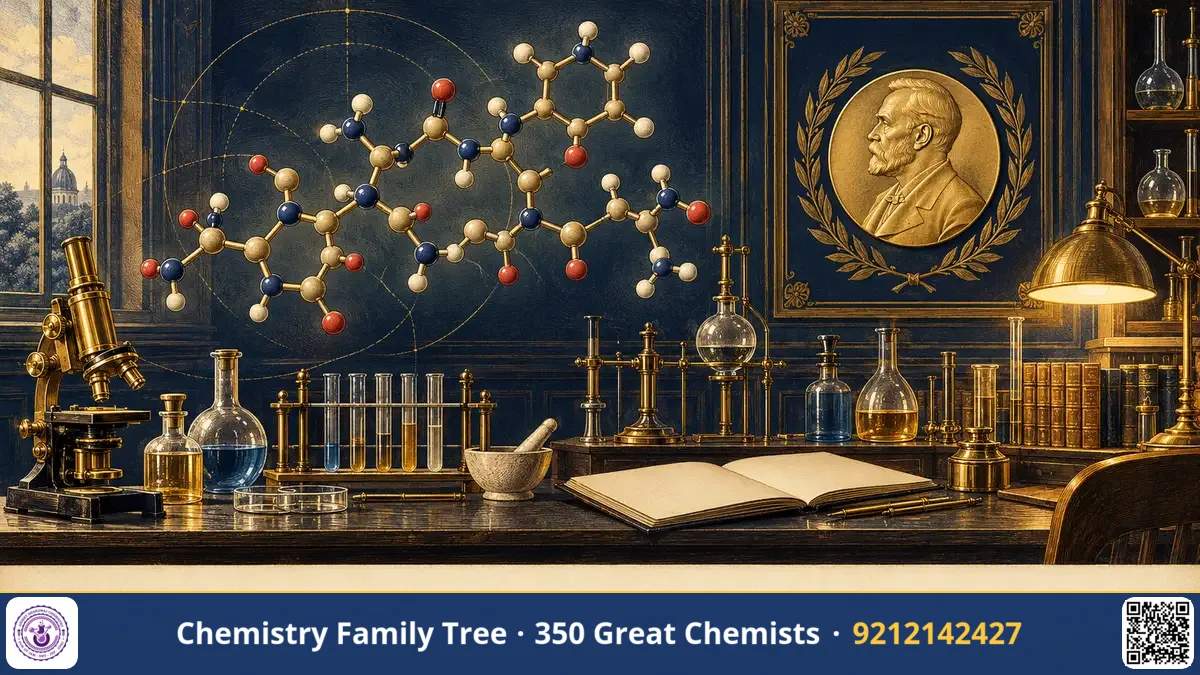
Vincent du Vigneaud was an American biochemist who spent his life studying sulfur-containing compounds in living systems. He explained the structure of the vitamin biotin, worked on insulin's sulfur content and on transmethylation, and in 1953 achieved the first laboratory synthesis of a polypeptide hormone, oxytocin. He received the 1955 Nobel Prize in Chemistry. His legacy in one line: he showed that the hormones of the body can be understood, and built, as ordinary molecules.
Early Life and Family
Du Vigneaud was born on 18 May 1901 in Chicago, Illinois, in a family of French descent. His father was an inventor and machinist. As a boy he enjoyed biology and kept animals; he became interested in chemistry in high school and the family later moved around the Chicago area. He attended Schurz High School in Chicago. His early interest in agriculture and animal science shaped his choice of university.
Education and Mentors
He studied chemistry at the University of Illinois at Urbana-Champaign, receiving his bachelor's degree in 1923 and master's degree in 1924. He then went to the University of Rochester, where he worked with John R. Murlin and earned his PhD in 1927 with a thesis on the sulfur content of insulin. After postdoctoral work with John Jacob Abel at Johns Hopkins, with Max Bergmann in Dresden, and with Charles Harington in London, he gained experience in peptide chemistry, which later proved central to his work on oxytocin.
Career Timeline
| Year | Event |
|---|---|
| 1901 | Born in Chicago |
| 1927 | PhD, University of Rochester; thesis on the sulfur in insulin |
| 1928-1932 | Postdoctoral work at Johns Hopkins, Dresden and London |
| 1932 | Becomes professor and head of biochemistry at George Washington University School of Medicine |
| 1938 | Moves to Cornell University Medical College, New York |
| 1940s | Determines the structure of biotin and studies transmethylation |
| 1953 | Announces the synthesis of oxytocin |
| 1955 | Awarded the Nobel Prize in Chemistry |
| 1967 | Becomes professor of chemistry at Cornell University, Ithaca |
| 1978 | Dies in White Plains, New York |
Major Scientific Contributions
Sulfur biochemistry. Du Vigneaud's first great interest was the role of sulfur in biology. He studied cystine, methionine and glutathione. He showed that the amino acid methionine can donate its methyl group in the body, a process called transmethylation. The methyl group goes from methionine, through S-adenosylmethionine (later identified by others), to other molecules such as choline.
Biotin. Biotin, often called vitamin H or vitamin B7, was isolated by Kögl and others, and du Vigneaud's group worked out its structure, which contains a fused ring system with a sulfur atom in a tetrahydrothiophene ring and a ureido ring.
Oxytocin and vasopressin. After purifying the two pituitary hormones, he determined their amino acid sequences. Oxytocin is Cys-Tyr-Ile-Gln-Asn-Cys-Pro-Leu-Gly-NH₂ with a disulfide bridge between the cysteines. In 1953 the team synthesised it, using protecting groups and coupling reactions, and showed that the synthetic hormone was identical in activity to the natural one. Vasopressin was determined and synthesised soon after.
For the underlying chemistry, see our companion discovery article on oxytocin synthesis.
Awards, Honours and Nobel Prize
Du Vigneaud received the 1955 Nobel Prize in Chemistry "for his work on biochemically important sulphur compounds, especially for the first synthesis of a polypeptide hormone". He was a member of the US National Academy of Sciences and received many other honours. He also gave lectures worldwide and served on many scientific committees.
Personality, Struggles and Lesser-Known Facts
- He grew up fond of animals and biology, and moved towards chemistry when he saw how much of biology rests on it.
- His PhD work on the sulfur of insulin started a lifelong theme. His career can be summed up as "sulfur in life".
- When the synthesis of oxytocin was announced, many scientists were amazed because a hormone had been thought too complex to build by chemistry.
- He worked with a large team, and he regularly credited his collaborators, including Charlotte Ressler and others, in his Nobel lecture.
- His laboratory trained many postdoctoral researchers from different countries, who carried peptide chemistry back to their own institutions.
Legacy and Influence on Modern Chemistry
The synthesis of oxytocin proved that biologically active peptides are definite molecules. It encouraged chemists to attempt other hormones and led to a long chain of developments: Merrifield's solid-phase peptide synthesis, synthetic insulin, desmopressin, and the modern GLP-1 peptide drugs. Peptide chemistry now sits at the junction of organic chemistry, medicine and biotechnology. In India, a large generic pharmaceutical industry produces synthetic oxytocin, insulin analogues and peptide drugs, which rest on these foundations. Students will also meet transmethylation (the role of S-adenosylmethionine) and biotin chemistry in biochemistry and bio-organic courses.
Lessons for Students
- Choose a theme and follow it for years. Sulfur chemistry ran through du Vigneaud's whole career.
- Learn skills from many places; his training in the US, Germany and Britain fed into one great synthesis.
- Do not assume that a molecule is too complex to make. Careful protecting-group strategy can solve it.
- Share credit with your team.
Quick Facts Box
- Born: 18 May 1901, Chicago, Illinois, USA
- Died: 11 December 1978, White Plains, New York
- Nationality: American
- Field: Biochemistry and peptide chemistry
- Famous for: First synthesis of a polypeptide hormone (oxytocin); biotin structure; transmethylation
- Nobel Prize: Chemistry, 1955
FAQ
Why did du Vigneaud receive the Nobel Prize?
For his work on biochemically important sulfur compounds, in particular the first synthesis of a polypeptide hormone.
Is oxytocin the same as vasopressin?
No. They are closely related nonapeptides differing at two positions, with different physiological roles.
What is transmethylation?
It is the transfer of a methyl group from one molecule to another in the body, such as from methionine derivatives to choline.
Where did du Vigneaud work most of his life?
At Cornell University Medical College in New York, and later at Cornell University in Ithaca.
Published by ABC Chemistry — IIT-JAM | CSIR-NET | GATE Chemistry Coaching. Visit abcchemistry.com
About the chemist
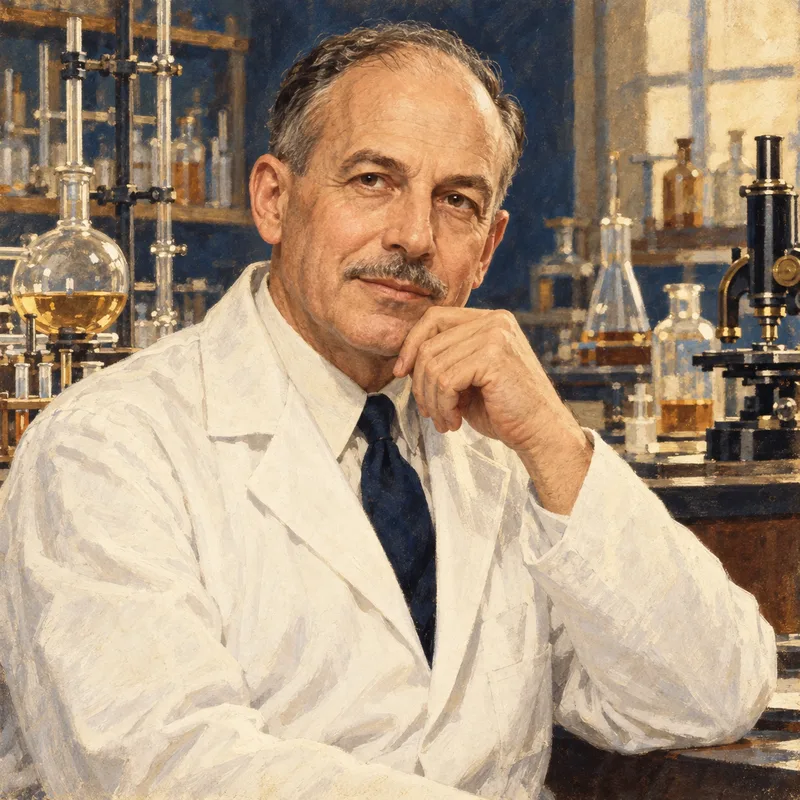
Vincent du Vigneaud
1901-1978 · United States · Nobel Chemistry 1955
First synthesis of a peptide hormone