The discovery, explained · Chemist no. 130 of 350
Vincent du Vigneaud and Oxytocin: The First Synthetic Peptide Hormone
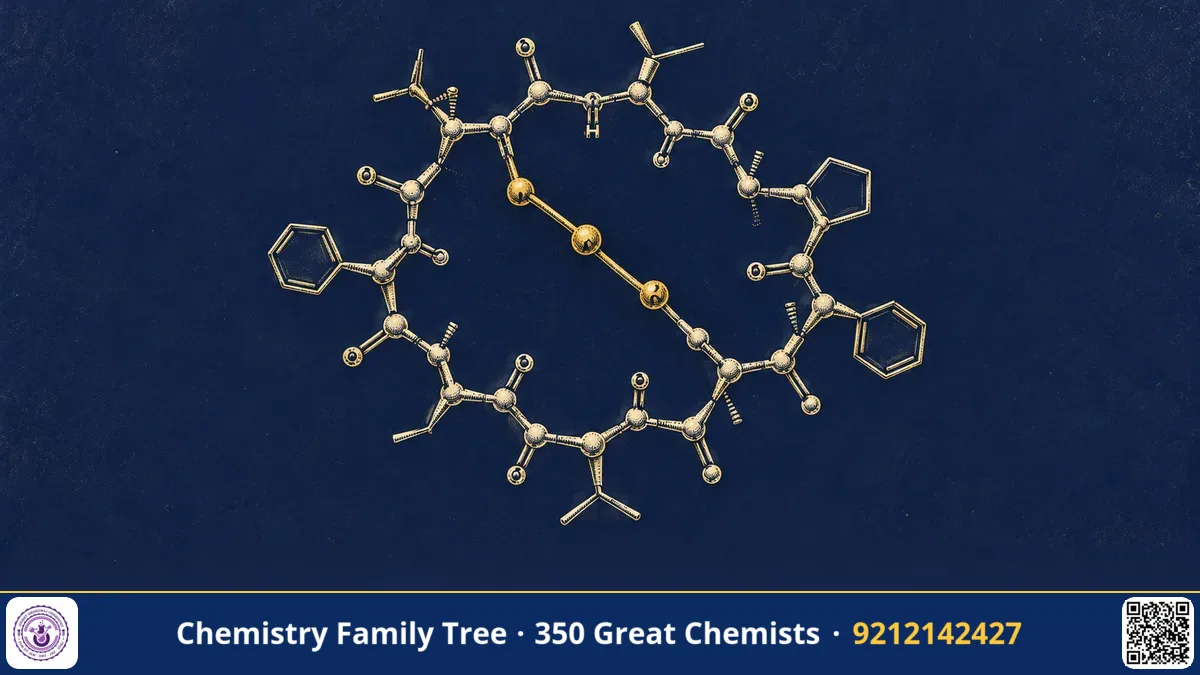
In 1953 a team at Cornell University Medical College in New York announced something that had never been done: the laboratory synthesis of a polypeptide hormone. The hormone was oxytocin, a small molecule of nine amino acids that causes contraction of the uterus during childbirth and release of milk. The leader of the team was Vincent du Vigneaud. He first worked out the structure of oxytocin and of the related hormone vasopressin, then built oxytocin step by step, and showed that the synthetic product behaved exactly like the natural one. For this work he received the 1955 Nobel Prize in Chemistry. His achievement proved that peptide hormones are definite chemical compounds that can be made by chemists, and it opened the way to modern peptide drugs.
The Scientific Problem Before the Discovery
The pituitary gland, at the base of the brain, was known to release substances that control blood pressure, water balance, and uterine contraction. Extracts of the posterior pituitary contained at least two active principles, one with oxytocic activity and one with pressor and antidiuretic activity. They were available only in tiny amounts, and nobody knew if they were proteins, peptides or something else. Chemists did not yet have a reliable way to prove the structure of a peptide, and no one had joined amino acids in a precise sequence without wrecking the molecule. Another problem was the sulfur: both hormones contain cystine, and the disulfide bond is easily broken or mis-formed during chemical work.
Du Vigneaud had already studied sulfur-containing biomolecules, so cystine, methionine and biotin were familiar territory. This experience helped him tackle the hormones.
The Discovery: Step by Step
- Purification. Posterior pituitary extract was fractionated, using the new tools of countercurrent distribution and chromatography (Craig's method and partition chromatography), until pure oxytocin and vasopressin were obtained.
- Composition. Acid hydrolysis showed that oxytocin gives eight different amino acids, with nine residues in total: cysteine (as cystine, two residues), tyrosine, isoleucine, glutamic acid and aspartic acid (present as amides, glutamine and asparagine), proline, leucine and glycine.
- Sequence. Partial hydrolysis produced small peptide fragments which were identified, and overlapping fragments gave the sequence. Du Vigneaud and his team found the structure: Cys-Tyr-Ile-Gln-Asn-Cys-Pro-Leu-Gly-NH₂, with a disulfide bridge between the two cysteines forming a ring.
- Synthesis (1953). Vincent du Vigneaud and co-workers, notably Charlotte Ressler, Julian Swan, Carleton Roberts and Panayotis Katsoyannis, built the chain by classical solution-phase peptide chemistry. Amino groups and side chains were protected with benzyl-type groups, peptide bonds were formed with activated carboxyl groups, and the protecting groups were finally removed using sodium in liquid ammonia. The two thiol groups were then oxidised to the disulfide bridge by air.
- Proof. The synthetic product matched natural oxytocin in biological activity (uterine contraction, milk ejection), in chemical behaviour and on chromatography.
In the following years, vasopressin was also determined and synthesised, which showed that two hormones with very different actions differ only by two amino acids.
The Chemistry Behind It
A peptide bond forms between the carboxyl group of one amino acid and the amino group of the next with loss of water:
R–CO–OH + H₂N–R′ → R–CO–NH–R′ + H₂O
To control the order, chemists must protect groups that should not react. Du Vigneaud's group used the carbobenzoxy (Cbz or Z) group, introduced by Bergmann and Zervas, to protect amines. It can be removed by sodium in liquid ammonia, which cleaves the benzyl–heteroatom bond. The same reagent removes benzyl groups from the sulfur of cysteine. Free thiols are then oxidised:
2 R–SH + ½ O₂ → R–S–S–R + H₂O
This disulfide link gives oxytocin its cyclic six-residue ring and a short tail of three residues (Pro-Leu-Gly-NH₂). The C-terminus is an amide, which is important for activity. Oxytocin and vasopressin differ at positions 3 and 8: oxytocin has isoleucine and leucine, vasopressin has phenylalanine and arginine (in humans). This small difference shifts activity from uterine contraction to blood-pressure and water control, a classic example of structure-activity relationship.
Applications Today
- Obstetrics. Synthetic oxytocin (sold as Pitocin and many generic brands in India) is used to induce labour and to control bleeding after delivery. It is on the WHO list of essential medicines.
- Peptide drugs. Desmopressin, a vasopressin analogue, treats diabetes insipidus and bedwetting. Peptide analogues for diabetes, cancer and hormone therapy follow the same logic.
- Solid-phase synthesis. Later, Bruce Merrifield automated peptide synthesis on a solid resin, building on the principles of protection and coupling that du Vigneaud demonstrated. Merrifield received the Nobel Prize in Chemistry in 1984.
- Research. Oxytocin is studied for its role in bonding and social behaviour.
Exam Corner
- Oxytocin is a nonapeptide with a disulfide bridge between Cys-1 and Cys-6.
- Sequence: Cys-Tyr-Ile-Gln-Asn-Cys-Pro-Leu-Gly-NH₂.
- First polypeptide hormone to be synthesised: du Vigneaud, 1953; Nobel Prize in Chemistry, 1955.
- Oxytocin and vasopressin differ in two amino acids (positions 3 and 8).
- Sodium in liquid ammonia removes benzyl protecting groups, and air oxidation closes the S-S bond.
Common Misconceptions
- "Oxytocin is a steroid hormone." No, it is a peptide hormone made from amino acids.
- "Du Vigneaud invented solid-phase synthesis." That was Merrifield (1963); du Vigneaud used solution-phase methods.
- "Vasopressin and oxytocin have unrelated structures." They are very similar nonapeptides with a ring formed by a disulfide bond.
Quick Revision Box
- Oxytocin: nine residues, one disulfide bridge, amidated C-terminus.
- Structure determined and synthesised by du Vigneaud's group (synthesis announced 1953).
- Protection by Cbz group; deprotection with Na/liquid NH₃.
- Disulfide formed by oxidation of two thiols.
- Vasopressin differs at two positions and has different physiological action.
- Nobel Prize in Chemistry, 1955.
FAQ
What did du Vigneaud synthesise?
Oxytocin, the first polypeptide hormone made in the laboratory.
Why is the disulfide bond important in oxytocin?
It joins the two cysteines into a ring, which gives the molecule the shape it needs to bind its receptor.
Was the Nobel Prize in Medicine?
No. Du Vigneaud received the 1955 Nobel Prize in Chemistry for work on biochemically important sulfur compounds and for the first synthesis of a polypeptide hormone.
How many amino acids does oxytocin have?
Nine amino acid residues, with eight different amino acids because cysteine appears twice.
Published by ABC Chemistry — IIT-JAM | CSIR-NET | GATE Chemistry Coaching. Visit abcchemistry.com
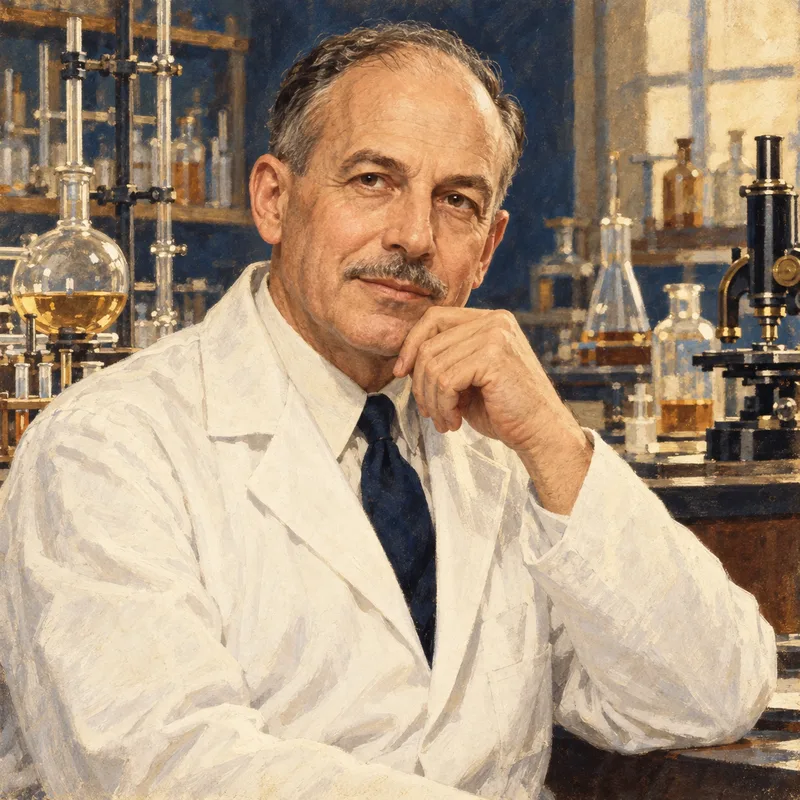
About the chemist
Vincent du Vigneaud
1901-1978 · United States · Nobel Chemistry 1955
First synthesis of a peptide hormone