Biography · Chemist no. 342 of 350
Vladimir Ipatieff: From Tsarist General to Father of Modern Catalysis
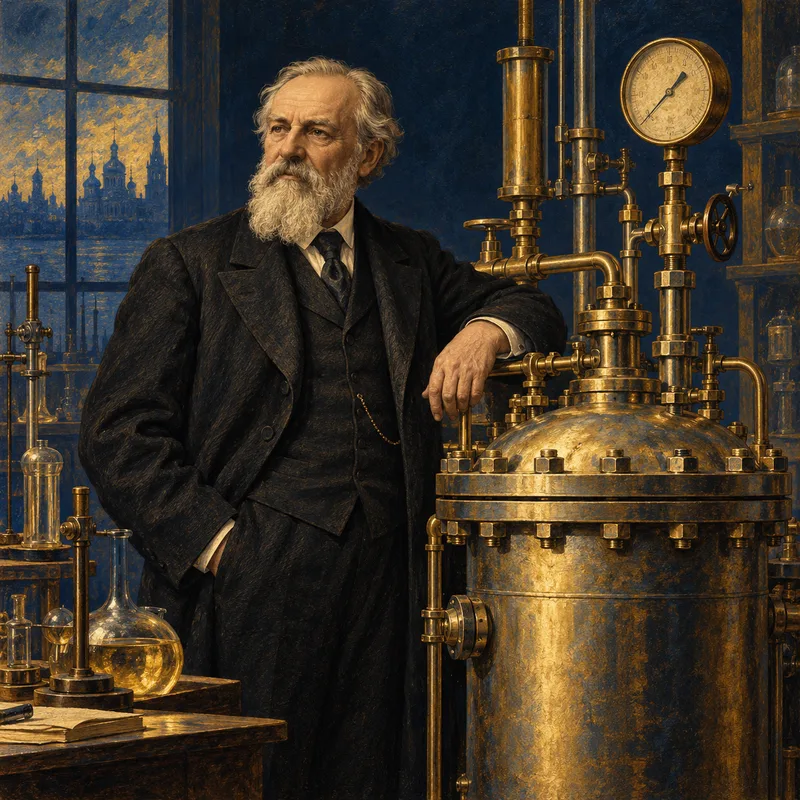
Vladimir Nikolayevich Ipatieff (1867-1952) was a Russian chemist who lived through the Tsarist empire, the First World War, the Russian Revolution and the Soviet era, and ended his life in the United States. He was a military officer as well as a research scientist, and rose to the rank of lieutenant-general in the artillery. His scientific legacy is the development of high-pressure catalytic reactions, which gave the world methods for making high-octane fuels. One line sums him up: he turned the steel pressure vessel into a precision tool of organic chemistry. This biography explores the man behind the autoclave.
Early Life and Family
Ipatieff was born in Moscow on 9 November 1867 into a well-off family. His father, Nikolai, was an architect. The family belonged to the educated professional class of Imperial Russia. As a young man he followed a military path, which was one of the main routes for talented students to get a technical education in Russia at that time. Despite the military setting, his interest in chemistry developed early and he balanced both careers for many years.
Education and Mentors
Ipatieff studied at the Mikhailovsky Artillery Academy in St Petersburg, where chemistry was taught as part of the science of explosives and ordnance. He became a teacher at the academy and later a professor. He also spent time studying abroad in Germany, where he worked in the laboratory of Adolf von Baeyer in Munich, then among the most famous organic chemists in the world. This experience exposed him to the best research methods in Europe. Back in Russia he built his own research programme in organic chemistry, particularly on the chemistry of small unsaturated molecules such as isoprene.
Career Timeline
| Year | Event |
|---|---|
| 1867 | Born in Moscow, Russian Empire |
| 1890s | Studies and teaches at the Mikhailovsky Artillery Academy, St Petersburg; studies in Munich |
| Early 1900s | Begins designing high-pressure reaction vessels for organic chemistry |
| 1916 | Elected a member of the Russian Academy of Sciences |
| 1914 to 1918 | Organises chemical production for the Russian war effort |
| 1920s | Continues research and leads Soviet chemical industry bodies |
| 1930 | While abroad, decides not to return to the USSR; moves to the United States |
| 1930s | Works with Universal Oil Products and Northwestern University in the Chicago area |
| 1930s to 1940s | Develops catalytic alkylation, polymerisation and isomerisation with Herman Pines |
| 1952 | Dies in Chicago, Illinois |
Major Scientific Contributions
- High-pressure autoclave: a robust steel reaction vessel for studying reactions under pressure, a model for later industrial reactors.
- Catalytic dehydration: showing that oxides such as alumina convert alcohols to alkenes.
- Catalytic hydrogenation under pressure: extension of the work of Sabatier to compounds that were difficult to hydrogenate.
- Polymerisation of alkenes: acid catalysts join small alkenes to larger branched ones.
- Alkylation of isoalkanes: isobutane plus alkene gives isooctane-type branched fuel, as in
(CH₃)₃CH + CH₂=C(CH₃)₂ → (CH₃)₃C–CH₂–CH(CH₃)₂. - Isomerisation: conversion of straight-chain alkanes to branched ones using aluminium chloride-type catalysts.
The companion article gives the mechanism and exam questions on these reactions.
Awards, Honours and Nobel Prize
Ipatieff did not win a Nobel Prize. His major honours include:
- Membership of the Russian (later Soviet) Academy of Sciences, elected in 1916.
- The Willard Gibbs Medal of the Chicago Section of the American Chemical Society (1940).
- The Priestley Medal of the American Chemical Society (1947), its highest honour.
- Honorary degrees and recognition from American universities and industry.
Personality, Struggles and Lesser-Known Facts
- Soldier and scientist. He kept an army career alongside his research for many years, and his military rank helped him obtain resources for experiments.
- Building apparatus himself. He insisted on understanding the equipment and designed pressure vessels that were safe enough to be used repeatedly. High-pressure work was dangerous and explosions were a real risk.
- Serving different regimes. After the Revolution, he stayed in Russia and used his knowledge to help organise chemical industry. He later wrote that he had hoped to continue to work for science in his homeland.
- A new life at 63. In 1930 he decided not to return to the USSR. He settled in the United States at an age when many scientists retire, learned to work in a new country and produced some of his most influential results there.
- Partnership with Herman Pines. His younger collaborator, Herman Pines, helped to turn his ideas into industrial processes, and the two published many papers together.
Legacy and Influence on Modern Chemistry
The modern refinery owes much to Ipatieff. Alkylation, isomerisation and catalytic polymerisation units exist in refineries around the world, including India. Aviation fuel developed using his ideas strongly helped Allied air forces in the Second World War, where high-octane fuel allowed more powerful engines. His work made catalysis a central subject of industrial chemistry. The Ipatieff Prize of the American Chemical Society for outstanding work in catalysis was set up in his honour, and the Ipatieff laboratory at Northwestern University carried his name. Students meet his legacy whenever they study octane number, carbocations and heterogeneous catalysis.
Lessons for Students
- Build tools to answer questions. Better equipment opened new chemistry.
- Combine practice and theory. His reactions began in the lab and moved to industry.
- Adapt to change. He restarted his career in a new country late in life.
- Collaborate across generations. His work with a younger colleague led to major processes.
- Respect safety. High-pressure experiments demand careful design and procedure.
Quick Facts Box
- Born: 9 November 1867, Moscow, Russian Empire
- Died: 29 November 1952, Chicago, Illinois, USA
- Nationality: Russian, later American-resident
- Field: Catalysis, petrochemistry, organic chemistry
- Famous for: High-pressure catalysis, alkylation and high-octane fuels
- Nobel Prize: None; Priestley Medal 1947
FAQ
Was Ipatieff a military officer?
Yes. He was an officer in the Russian artillery and reached the rank of lieutenant-general while working as a chemist.
Why did he move to the United States?
In 1930, while he was abroad, he chose not to return to the Soviet Union, and he later continued his research in the United States.
Which prize is named after him?
The Ipatieff Prize of the American Chemical Society is given for outstanding work in the field of catalysis.
Why is he important for exams?
His work underlies topics such as heterogeneous catalysis, carbocation reactions, alkylation and octane numbers.
Published by ABC Chemistry — IIT-JAM | CSIR-NET | GATE Chemistry Coaching. Visit abcchemistry.com
About the chemist
Vladimir Ipatieff
1867-1952 · Russia
High-pressure catalysis; alkylation