The discovery, explained · Chemist no. 342 of 350
Vladimir Ipatieff and the Birth of High-Pressure Catalysis
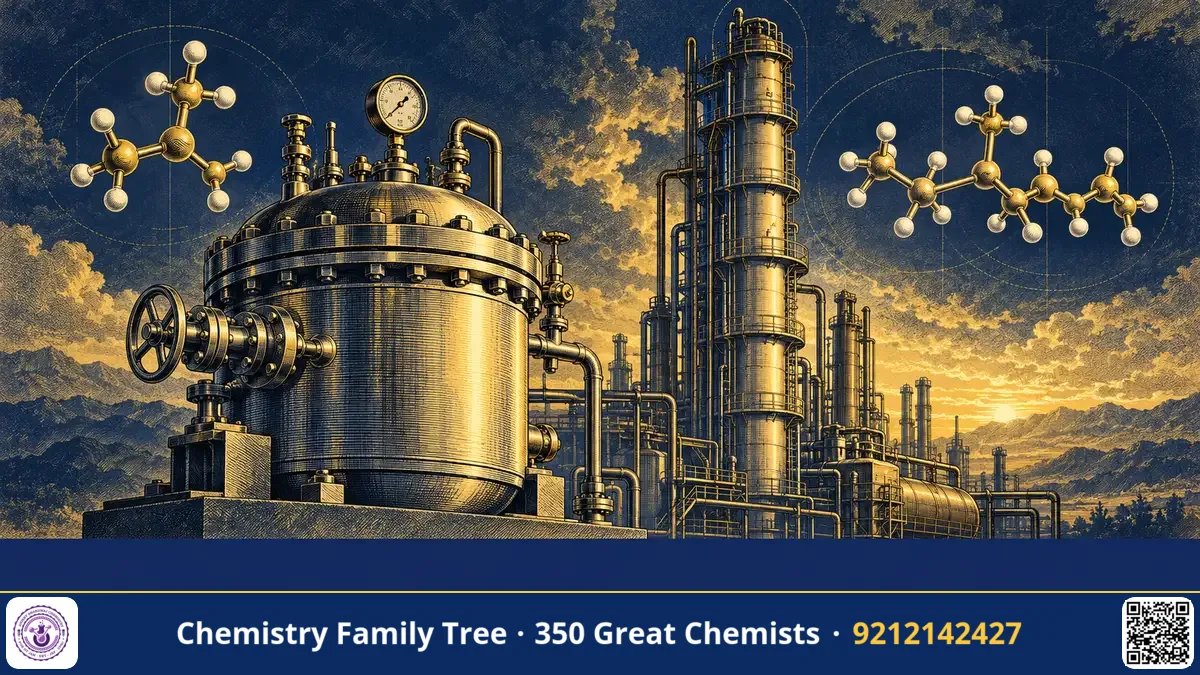
When an aeroplane engine runs smoothly at high power, or a car engine does not "knock", chemistry is working behind the scenes. Much of that chemistry started with Vladimir Nikolayevich Ipatieff, a Russian-born chemist who showed that organic reactions could be driven at high temperature and high pressure over solid catalysts. He built the first laboratory high-pressure reactors, now often called Ipatieff autoclaves, and used them to discover catalytic polymerisation, alkylation and isomerisation of hydrocarbons. These reactions gave the world high-octane fuels, including the aviation petrol that was crucial in the Second World War. His work also laid the foundation for modern petrochemistry, so it is directly relevant to the catalysis and industrial chemistry sections of JAM, NET and GATE.
The Scientific Problem Before the Discovery
At the start of the twentieth century, organic chemistry was done mostly in glass flasks at or near atmospheric pressure. Many industrially interesting reactions of gases such as ethylene, hydrogen and hydrocarbons needed pressures of tens or hundreds of atmospheres, and conditions in which glass would fail. The theory of catalysis was also young. Sabatier in France had shown that finely divided nickel could add hydrogen to unsaturated compounds, but the effects of high pressure combined with catalysts on a wide range of organic substances were not yet explored.
Another problem was practical. Internal combustion engines were improving, but engines would "knock" if the fuel ignited prematurely, which limited compression ratio, power and efficiency. Straight-chain alkanes knock badly while highly branched alkanes burn smoothly. Petroleum from the ground contains too few branched alkanes, so chemists needed methods to build or rearrange hydrocarbons.
The Discovery: Step by Step
- Building the autoclave. Ipatieff designed strong steel reaction vessels, often called "bombs", that could be heated while holding gases under high pressure. These allowed controlled experiments with gases and liquids far above ordinary conditions.
- Catalysts on solid supports. He tested metals, metal oxides, clays and acids as catalysts. One early finding was that alumina and other oxides could dehydrate alcohols to alkenes or ethers.
- Dehydration and hydrogenation. At the high temperature, ethanol over alumina gave ethylene; with other conditions, hydrogen could be added to a range of organic compounds using metal catalysts.
- Catalytic polymerisation of alkenes. Working with acid catalysts, he found that small alkenes such as propene and butenes join to form larger branched alkenes that can be hydrogenated to useful fuels.
- Alkylation. In the 1930s, with Herman Pines in the United States, he showed that isobutane adds to alkenes in the presence of strong acid catalysts, producing highly branched alkanes with high octane numbers.
Dehydration:    CH₃CH₂OH  --(Al₂O₃, heat)-->  CH₂=CH₂ + H₂O
Alkylation:     (CH₃)₃CH + CH₂=C(CH₃)₂  --(H⁺ / acid)-->  (CH₃)₃C–CH₂–CH(CH₃)₂
                isobutane   isobutene                    2,2,4-trimethylpentane (isooctane)
The Chemistry Behind It
Acid-catalysed alkylation mechanism
Alkylation proceeds through carbocations. A proton from the strong acid adds to an alkene to form a carbocation, which is then attacked by another molecule. In simplified form:
- Initiation: alkene + H⁺ → tertiary carbocation, for example (CH₃)₃C⁺ from isobutene.
- Addition: the carbocation adds to a second alkene molecule, forming a larger carbocation.
- Hydride transfer: the large carbocation takes a hydride ion (H⁻) from isobutane, giving the branched alkane product and a new (CH₃)₃C⁺ ion, which continues the chain.
The tertiary carbocation is the most stable type because of hyperconjugation and the inductive effect of three alkyl groups, so reactions proceed through it and give branched products.
Octane number
The octane number is a scale that measures resistance to knocking. By definition, n-heptane is given a rating of 0 and 2,2,4-trimethylpentane (isooctane) a rating of 100. Branched alkanes and aromatic compounds have high ratings; straight chains have low ones. Ipatieff's alkylation made high-octane isooctane-type fuel in bulk.
| Compound | Structure type | Octane rating |
|---|---|---|
| n-Heptane | Straight chain | 0 (by definition) |
| Isooctane | Highly branched | 100 (by definition) |
Role of the catalyst
A catalyst provides an alternative pathway of lower activation energy without being consumed. Heterogeneous catalysts such as alumina work by adsorbing reactant molecules on the surface and weakening bonds. Acid catalysts such as H₂SO₄, HF or AlCl₃ are Brønsted or Lewis acids that generate carbocations.
Applications Today
- Refineries: alkylation units still make "alkylate", a clean, high-octane petrol component, using sulphuric acid or hydrofluoric acid.
- Isomerisation: converting n-pentane and n-hexane to branched isomers to raise octane number.
- Petrochemicals: polymerisation of alkenes to produce gasoline-range or plastic-feed molecules, and later polyolefin catalysts.
- Autoclaves in the laboratory: high-pressure reactors are standard in research for hydrogenation and for synthesis of fuels and chemicals.
- India: Indian refineries use catalytic reforming, isomerisation and alkylation to meet Bharat Stage fuel standards.
Exam Corner
- Octane number: n-heptane = 0, isooctane (2,2,4-trimethylpentane) = 100. Higher branching gives higher octane number.
- Alkylation of isobutane with alkenes uses strong acid catalyst and proceeds via carbocations and hydride transfer.
- Tertiary carbocations are most stable: 3° > 2° > 1° > methyl.
- Dehydration of ethanol to ethylene over alumina at high temperature is an industrial route; compare with H₂SO₄ at 443 K.
- Catalysts lower activation energy and do not change ΔG or the equilibrium constant.
Common Misconceptions
- "A catalyst makes a non-spontaneous reaction go." A catalyst only speeds up a thermodynamically feasible reaction; it does not change equilibrium.
- "Higher octane number means more energy in fuel." It measures resistance to knocking, not energy content.
- "Isooctane is octane." Isooctane is a branched isomer, 2,2,4-trimethylpentane, not straight-chain n-octane.
Quick Revision Box
- Ipatieff pioneered organic reactions under high pressure with catalysts.
- He developed catalytic polymerisation, alkylation and isomerisation of hydrocarbons.
- Alkylation: isobutane + alkene gives branched alkane, via carbocations and H⁻ transfer.
- Isooctane has octane number 100; n-heptane 0.
- Catalyst lowers Ea, not ΔG.
- Laboratory high-pressure bombs are called Ipatieff autoclaves.
FAQ
What is alkylation in petroleum refining?
It is the reaction of isobutane with light alkenes in the presence of a strong acid to make highly branched, high-octane alkanes.
Why are branched alkanes better fuels?
They resist premature ignition under compression, so they burn smoothly in the engine and have higher octane numbers than straight-chain alkanes.
What is an autoclave?
It is a sealed, strong vessel in which reactions can be run at high temperature and pressure. Ipatieff's designs were among the first widely used in organic research.
Which acids are used in industrial alkylation?
Concentrated sulphuric acid and hydrofluoric acid are common; newer solid acid catalysts are being studied as safer alternatives.
Published by ABC Chemistry — IIT-JAM | CSIR-NET | GATE Chemistry Coaching. Visit abcchemistry.com
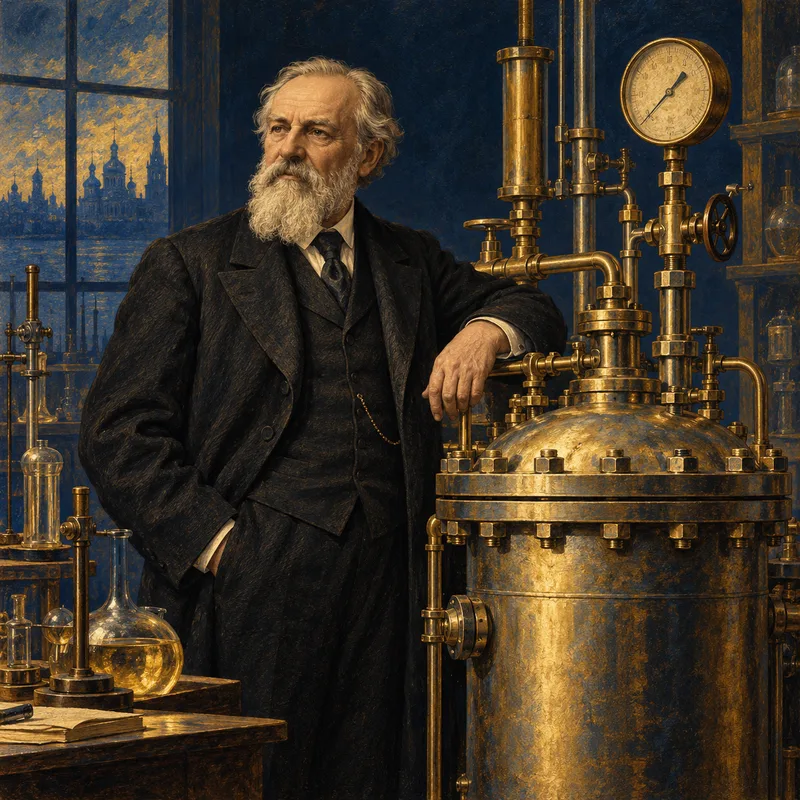
About the chemist
Vladimir Ipatieff
1867-1952 · Russia
High-pressure catalysis; alkylation