Biography · Chemist no. 63 of 350
Vladimir Prelog: A Wandering Scholar Who Gave Chemistry Its Language of Handedness
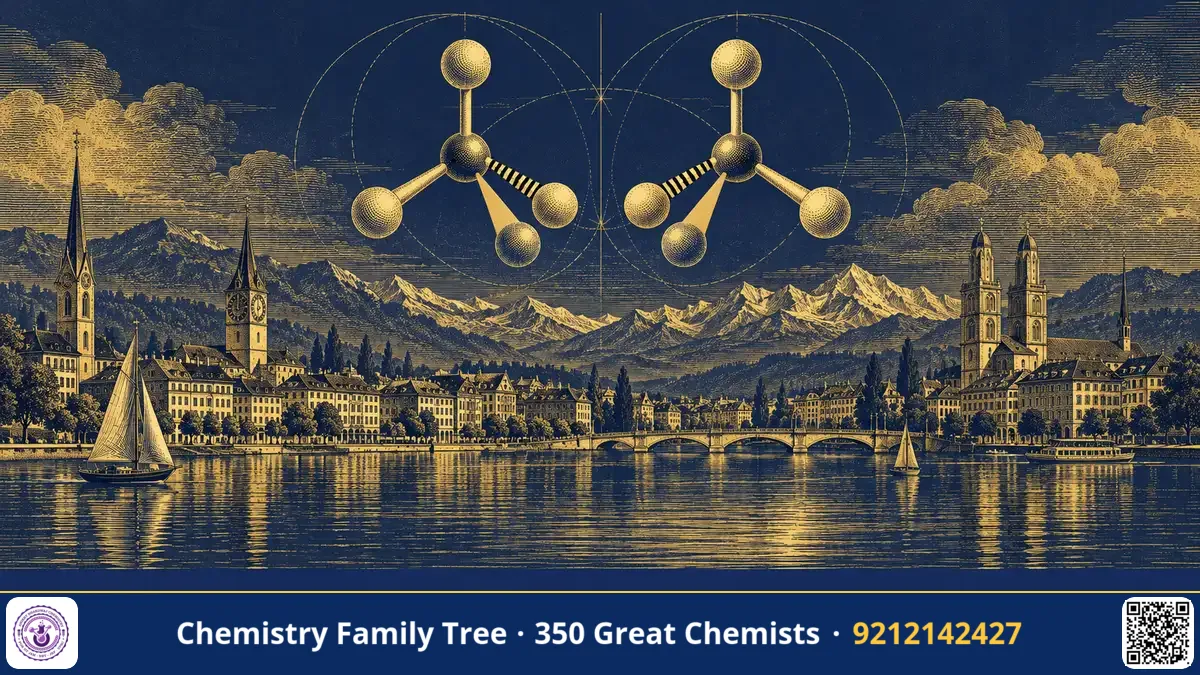
Vladimir Prelog (1906-1998) was a Croatian-Swiss organic chemist born in Sarajevo, who spent the second half of his life at ETH Zurich. He is best known for his work on stereochemistry. He co-developed the Cahn-Ingold-Prelog (CIP) rules for specifying R/S configuration, explored the strange chemistry of medium-sized rings, and studied the stereochemistry of enzyme reactions. He shared the 1975 Nobel Prize in Chemistry with John Cornforth. He was also an inspiring teacher, writer and a man who moved between several countries because of political changes, while never giving up his research.
Early Life and Family
Vladimir Prelog was born on 23 July 1906 in Sarajevo, which at that time was part of the Austro-Hungarian Empire (now the capital of Bosnia and Herzegovina). His father, Milan Prelog, was a historian. The family later moved to Zagreb in what became Yugoslavia, where Vladimir attended the gymnasium. As a boy he showed an interest in chemistry, but he also had broad interests in literature and in the arts, which stayed with him throughout his life.
Education and Mentors
After school in Zagreb, Prelog studied chemical engineering at the Czech Technical University in Prague, and completed his doctorate there in 1929 under the guidance of Emil Votoček, a well-known carbohydrate chemist. After the doctorate he worked for some time in industry at a small chemical company in Prague, where he prepared rare chemicals, and then returned to academic work. In 1935 he joined the University of Zagreb as a lecturer, becoming professor there. During this period he carried out research on alkaloids, including studies of the structure of quinine fragments.
Career Timeline
| Year | Event |
|---|---|
| 1906 | Born in Sarajevo (23 July) |
| 1929 | Doctorate in Prague under Emil Votoček |
| 1935 | Lecturer at the University of Zagreb |
| 1941 | Left Zagreb for Zurich after the outbreak of war and invited by Leopold Ružička |
| 1942-1950 | Worked at ETH Zurich, rising from lecturer to professor |
| 1950s | Studied medium-sized rings and transannular reactions |
| 1956 | First CIP paper with Cahn and Ingold |
| 1957 | Head of the Laboratory of Organic Chemistry, ETH Zurich |
| 1959 | Became a Swiss citizen |
| 1966 | Revised CIP rules published in Angewandte Chemie |
| 1975 | Nobel Prize in Chemistry, shared with John Cornforth |
| 1998 | Died in Zurich (7 January) |
Major Scientific Contributions
1. CIP sequence rules
Prelog, with Cahn and Ingold, defined the rules for assigning R and S to stereocentres and E and Z to double bonds. See the companion post for the rules and examples.
2. Medium-sized rings
Rings with 8 to 11 carbon atoms are strained and behave in unusual ways. Prelog and his students showed that atoms across the ring can react with each other in "transannular" reactions, because the interior of the ring is crowded. For example, certain cyclic compounds undergo hydride shifts across the ring during solvolysis or epoxide opening. The strain caused by crowding hydrogens inside the ring is called Prelog strain. This work extended the earlier ideas of Baeyer and Sachse-Mohr.
3. Asymmetric synthesis and Prelog's rule
In 1953, Prelog formulated a rule to predict the product stereochemistry from Grignard addition to chiral α-keto esters, one of the first models for asymmetric induction.
4. Natural products and enzymes
His group studied alkaloids, antibiotics (such as the macrolide group), and ionophores like nonactin, which transport ions across membranes. He also studied microbial reduction of ketones, giving rise to another Prelog's rule for predicting the configuration of alcohols formed.
5. Resolution and chirality
He developed methods for separating enantiomers (resolution), including early chromatographic resolution on chiral materials, which anticipated modern chiral chromatography used in drug analysis.
Awards, Honours and Nobel Prize
In 1975 Prelog shared the Nobel Prize in Chemistry with John Warcup Cornforth. The Nobel Committee honoured Prelog "for his research into the stereochemistry of organic molecules and reactions", and Cornforth for the stereochemistry of enzyme-catalysed reactions. He was a Foreign Member of the Royal Society (1962) and received honorary doctorates from many universities. He was also a member of the scientific academies of several countries.
Personality, Struggles and Lesser-Known Facts
- Forced to move: The outbreak of the Second World War and the German occupation of Yugoslavia in 1941 made life in Zagreb dangerous. He left for Zurich, where Leopold Ružička offered him a position at ETH. He stayed for the rest of his career and became a Swiss citizen.
- Wide cultural interests: He loved literature and music, and read widely in several languages, including Croatian, German, French and English.
- Autobiography with humour: His autobiography is titled My 132 Semesters of Chemistry Studies, which refers to the number of university semesters he spent as a student and then as a teacher, about 66 years. It is a witty and readable account of the life of a chemist.
- Generous teacher: He trained many students from different countries at ETH, and was known for his friendly and open discussions, sometimes in the form of long conversations in the laboratory corridors.
- Home and abroad: He kept ties with his homeland and helped chemists from Croatia and the former Yugoslavia to receive training in Zurich.
Legacy and Influence on Modern Chemistry
The R/S system is used in every chemistry paper and every drug label that specifies stereochemistry. Prelog's insight that chirality matters in biology fits today's pharmaceutical industry, where single-enantiomer drugs are the norm. His studies of medium rings influenced the understanding of macrocycles and ring strain, important today in macrocyclic drugs. His work with enzymes and microbes opened the path for biocatalysis, now a part of green chemistry. ETH Zurich continues to be a leading centre for organic chemistry.
Lessons for Students
- Learn languages and communicate: A universal naming system is itself a scientific achievement.
- Stay adaptable: Prelog moved countries and continued a successful research career.
- Study stereochemistry carefully: It explains the action of drugs and enzymes.
- Keep your cultural interests alive: Reading, music and art can sharpen scientific thinking.
Quick Facts Box
- Born: 23 July 1906, Sarajevo (then Austria-Hungary)
- Died: 7 January 1998, Zurich, Switzerland
- Nationality: Croatian-born; Swiss citizen from 1959
- Field: Organic chemistry, stereochemistry
- Famous for: CIP rules, medium-ring chemistry, asymmetric induction
- Nobel Prize: Chemistry 1975 (shared with John Cornforth)
FAQ
Where did Vladimir Prelog work?
He worked in Prague and Zagreb in his early career and then at ETH Zurich from the early 1940s, where he spent the rest of his working life.
What are the CIP rules?
They are priority rules used to assign R/S descriptors to stereocentres and E/Z descriptors to double bonds, developed by Cahn, Ingold and Prelog.
With whom did Prelog share the Nobel Prize?
With John Warcup Cornforth of Australia, in 1975.
What are transannular reactions?
These are reactions between atoms on opposite sides of a medium-sized ring, made possible by the crowded interior of the ring.
Published by ABC Chemistry — IIT-JAM | CSIR-NET | GATE Chemistry Coaching. Visit abcchemistry.com
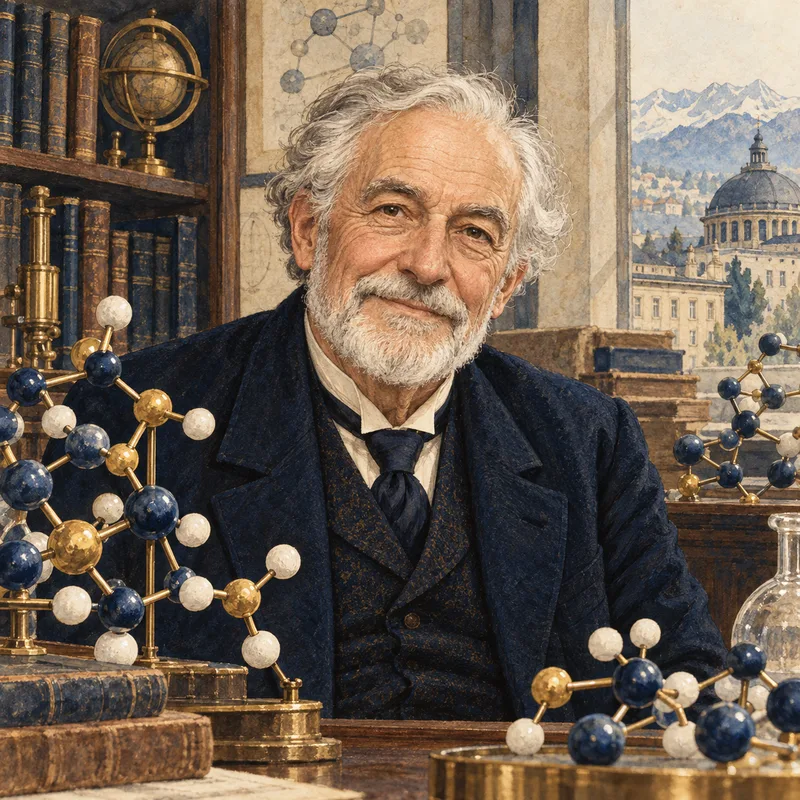
About the chemist
Vladimir Prelog
1906-1998 · Croatia/Switzerland · Nobel Chemistry 1975
Stereochemistry; CIP rules