The discovery, explained · Chemist no. 63 of 350
The Cahn-Ingold-Prelog Rules: How Vladimir Prelog Gave Chemistry a Universal Language for 3D Structure
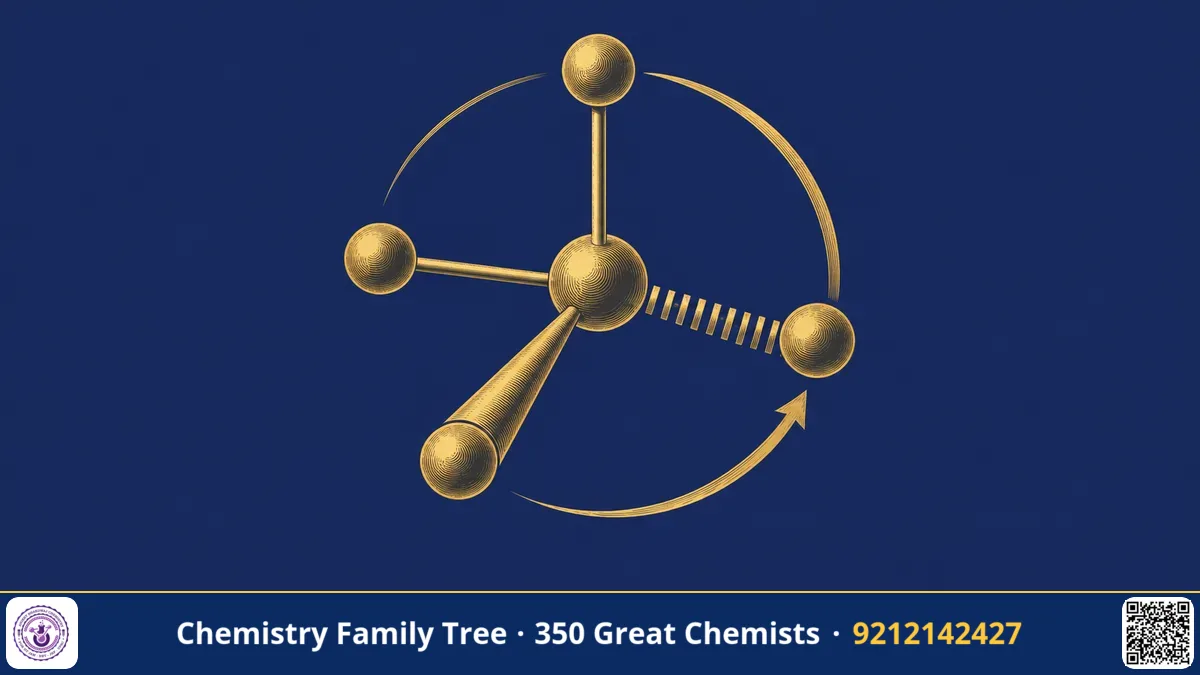
Look at the name (R)-2-hydroxypropanoic acid or (S)-ibuprofen. The letters R and S tell you the exact three-dimensional arrangement around a stereocentre, no matter who wrote the name or in which country. This language was created by three chemists: R. S. Cahn, Christopher Ingold and Vladimir Prelog. Their CIP priority rules are the standard method to specify configuration, and every student of organic chemistry must master them. Prelog, a Croatian-Swiss chemist at ETH Zurich, also received the 1975 Nobel Prize in Chemistry (shared with John Cornforth) for his research on the stereochemistry of organic molecules and reactions.
The Scientific Problem Before the Discovery
After van 't Hoff and Le Bel proposed the tetrahedral carbon in 1874, chemists knew that molecules could be chiral. But how should configuration be described? The older D/L system, based on Emil Fischer's convention using glyceraldehyde as the reference, worked well for sugars and amino acids. But it was relative, not absolute, and it could not be applied easily to molecules without any obvious link to glyceraldehyde. Chemists needed a system that would work for every stereocentre and could be applied by anyone to any structure on paper. The system also had to handle double bonds, where the older cis/trans labels failed for tri- and tetra-substituted alkenes.
The Discovery: Step by Step
- Cahn and Ingold (1951): Robert Cahn and Christopher Ingold proposed a method to describe chirality using a sequence of priorities of the groups around a stereocentre.
- Prelog joins (1956): Prelog was working on the stereochemistry of natural products, medium rings and enzyme reactions, and he found the sequence rule very useful. He joined Cahn and Ingold in a paper published in 1956, and in 1966 they published the complete, revised version in Angewandte Chemie.
- Result: The R/S system became the international standard, adopted by IUPAC for naming stereoisomers.
The Chemistry Behind It
Rules for assigning priority (the sequence rules)
- Atomic number: Look at the atoms directly attached to the stereocentre. The atom with the higher atomic number gets higher priority (I > Br > Cl > S > P > F > O > N > C > H).
- Isotopes: If the atoms are identical, the one with higher mass number gets higher priority (T > D > H).
- Go further out: If there is a tie, compare the atoms attached to them, one set at a time, in order of priority, until a first point of difference is found.
- Multiple bonds: A double bond is treated as if the atom were bonded twice to the same atom (duplicate atoms). So C=O counts as C bonded to (O, O).
Assigning R or S
- Assign priorities 1 to 4 to the four substituents.
- Orient the molecule so that the lowest priority group (4) points away from you.
- Trace the path 1 → 2 → 3. Clockwise = R (Latin rectus, right). Anticlockwise = S (Latin sinister, left).
- If the lowest priority group points toward you, reverse the answer.
Worked examples
Lactic acid, CH3-CH(OH)-COOH:   priorities:  OH (1) > COOH (2) > CH3 (3) > H (4)
(S)-lactic acid = L-(+)-lactic acid (muscle lactic acid)

Glyceraldehyde, HOCH2-CH(OH)-CHO:   OH (1) > CHO (2) > CH2OH (3) > H (4)
D-(+)-glyceraldehyde = (R)
Common group priority order (high to low):
-SH > -OH > -NH2 > -COOH > -CHO > -CH2OH > -C6H5 > -CH=CH2 > -CH(CH3)2 > -CH2CH3 > -CH3 > -H
Note: -CH=CH2 (vinyl) outranks -CH(CH3)2, because the duplicated carbon on the vinyl group breaks the tie at the second sphere. Isopropyl (C,C,H) outranks ethyl (C,H,H).
E/Z for alkenes
For each carbon of the double bond, assign priority to the two substituents using the same rules. If the two higher-priority groups are on the same side, the alkene is Z (German zusammen); if on opposite sides, it is E (entgegen).
Important point
R and S do not tell the direction of optical rotation. (R)-compounds can be dextrorotatory (+) or levorotatory (-). Optical rotation has to be measured in the laboratory.
Prelog's other stereochemical contributions
- Prelog's rule (1953): A model to predict the stereochemistry of addition of Grignard reagents to α-keto esters bearing a chiral alcohol group, such as menthyl benzoylformate. It was one of the first rules for asymmetric induction.
- Medium rings: Prelog studied 8- to 11-membered rings and found "transannular" reactions between atoms across the ring, and "Prelog strain" caused by crowding of hydrogens inside the ring.
- Microbial reduction rule: Reduction of ketones by yeast and some enzymes typically delivers hydride to one face of the carbonyl, giving (S)-alcohols in a predictable way (the "Prelog rule").
Applications Today
- Pharmaceutical industry: Drug names and patents specify R or S enantiomers, for example (S)-naproxen and (S)-omeprazole (esomeprazole).
- Regulatory documents: Pharmacopoeias and safety documents use CIP descriptors to define the exact drug molecule.
- Chemical databases: Software such as ChemDraw assigns CIP labels automatically, and databases index compounds by them.
- Asymmetric synthesis and catalysis: Researchers report the enantiomer formed using R/S nomenclature.
- Education: Questions on R/S and E/Z nomenclature are the most common in stereochemistry sections of JAM, NET, GATE and school exams.
Exam Corner
- CIP priority: higher atomic number first; if tied, go outward; multiple bonds are duplicated.
- Order: -COOH > -CHO > -CH2OH > -C6H5 > -CH3. Vinyl > isopropyl > ethyl.
- Lowest priority group away from viewer: clockwise 1→2→3 = R; anticlockwise = S.
- Swapping two substituents on a stereocentre inverts the descriptor.
- R/S is not related to (+)/(-) or D/L.
Common Misconceptions
- "R means dextrorotatory." No. R/S describes geometry; (+)/(-) describes optical rotation.
- "A group with more atoms has higher priority." No. Only atomic number at the first point of difference matters, not the size of the group.
- "If the lowest priority group is on a wedge, the label is the same." When the lowest priority group points toward you, the apparent direction must be reversed.
Quick Revision Box
- CIP rules: Cahn, Ingold and Prelog (1956, revised 1966).
- Step 1: rank by atomic number; step 2: view with lowest priority at the back; step 3: clockwise = R, anticlockwise = S.
- Duplicate atoms for double and triple bonds.
- Z = higher priorities on same side; E = opposite sides.
- Prelog won the 1975 Nobel Prize in Chemistry (with John Cornforth).
FAQ
What does CIP stand for?
Cahn-Ingold-Prelog, the three chemists who developed the sequence rules for specifying stereochemistry.
Is R/S the same as D/L?
No. D/L is an older system based on the configuration of glyceraldehyde. For example, L-amino acids are mostly (S), but L-cysteine is (R) because of the sulfur atom's priority.
What if the two groups look the same in the first sphere?
You move outwards to the next sphere of atoms and compare them in order, until a difference is found.
What was Prelog's Nobel Prize for?
"For his research into the stereochemistry of organic molecules and reactions", shared with John Cornforth in 1975.
Published by ABC Chemistry — IIT-JAM | CSIR-NET | GATE Chemistry Coaching. Visit abcchemistry.com

About the chemist
Vladimir Prelog
1906-1998 · Croatia/Switzerland · Nobel Chemistry 1975
Stereochemistry; CIP rules