Biography · Chemist no. 77 of 350
Wallace Carothers: The Brilliant Mind Behind Nylon
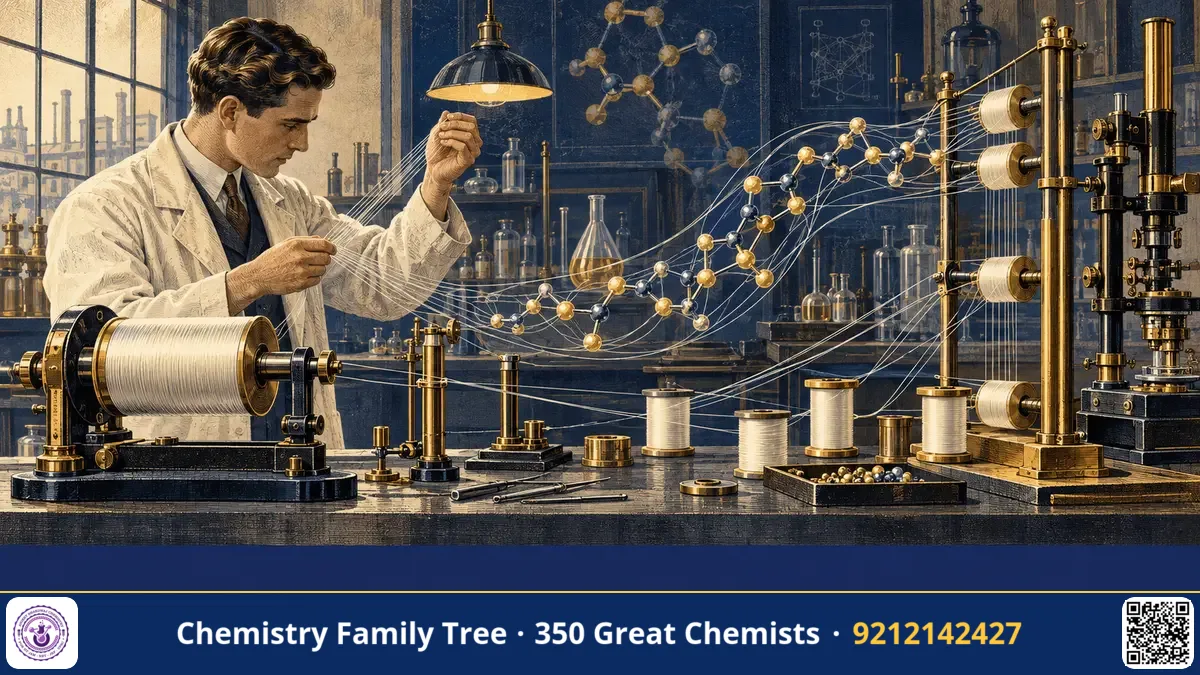
Wallace Hume Carothers (1896-1937) was an American organic chemist who led research at DuPont that created nylon and neoprene. He is regarded as one of the founders of modern polymer science, and his theory of step-growth polymerisation is still taught in every polymer course. His life was short and ended in tragedy only a few years after his greatest triumph. His legacy in one line: he proved that long-chain molecules can be designed and built from simple chemicals, and gave the world its first fully synthetic fibre.
Early Life and Family
Wallace Carothers was born on 27 April 1896 in Burlington, Iowa, in the American Midwest, the eldest of four children. His father, Ira Hume Carothers, was a teacher and later vice-president of Capital City Commercial College in Des Moines, where Wallace spent much of his childhood. As a boy, he was fascinated by tools and instruments and was good at mathematics and science. Later, he also showed a taste for literature and music. Despite his interest in chemistry, he first studied accounting and secretarial subjects at his father's college, and then entered Tarkio College in Missouri.
Education and Mentors
At Tarkio College, Carothers earned a degree in chemistry in 1920, and he was also asked to teach after the chemistry head left for war service. He studied for a master's degree at the University of Illinois at Urbana-Champaign, finishing in 1921, and then took a short position at the University of South Dakota. Then he returned to Illinois for his PhD, which he completed in 1924 under Roger Adams, one of the great American organic chemists. He worked as an instructor at Illinois and then at Harvard from 1926, where he taught organic chemistry.
Career Timeline
| Year | Event |
|---|---|
| 1896 | Born in Burlington, Iowa |
| 1920 | Graduates from Tarkio College |
| 1924 | PhD at the University of Illinois under Roger Adams |
| 1926 | Joins Harvard University as instructor |
| 1928 | Joins DuPont Experimental Station, Wilmington, Delaware |
| 1930 | Team discovers neoprene; cold drawing of polyester noticed |
| 1931 | Neoprene is announced to the public |
| 1935 | Nylon 6,6 is first made (28 February) |
| 1936 | Elected to the National Academy of Sciences |
| 1937 | Dies in Philadelphia on 29 April |
Major Scientific Contributions
Carothers' work at DuPont had three main outcomes. First, he built long-chain molecules step by step from bifunctional monomers and showed that they are true macromolecules, supporting Staudinger's theory. Second, he developed the theory of condensation (step-growth) polymerisation, including the Carothers equation, Xn = 1/(1 – p), which links the degree of polymerisation to the extent of reaction. Third, his group produced two commercial materials: neoprene (polychloroprene) and nylon 6,6. He also performed early work on aliphatic polyesters and on cyclic compounds with large rings, such as large-ring lactones and musk-like substances. The chemistry is covered in detail in our discovery post.
Awards, Honours and Nobel Prize
- Elected to the US National Academy of Sciences in 1936, a remarkable honour for an industrial chemist.
- Received the Leo Hendrik Baekeland Award from the North Jersey Section of the American Chemical Society (1931).
- He did not win a Nobel Prize. He died in 1937, and many historians of science believe that his early death prevented him from receiving the recognition his work deserved.
Personality, Struggles and Lesser-Known Facts
- Pure research in industry: DuPont created a fundamental research division in which scientists could study basic questions without immediate commercial pressure. Carothers was among the first hired for it.
- Intensely private: Colleagues described him as brilliant, witty and widely read, but he struggled with depression throughout his adult life, and felt that his work was not good enough.
- Great loss: The death of his sister Isobel in January 1936 deeply affected him. She had been close to him and was a radio personality.
- Tragic end: He died by suicide on 29 April 1937 at the age of 41. He did not live to see the commercial success of nylon, which went on sale in 1938-1940.
- Family: He married Helen Sweetman in February 1936, and their daughter, Jane, was born after his death.
- Team scientists: His group included Julian Hill, Gerard Berchet, Paul Flory (who joined DuPont in 1934 and later won the Nobel Prize in Chemistry in 1974) and others.
Legacy and Influence on Modern Chemistry
Carothers' work started the age of synthetic fibres and plastics designed by chemists. Nylon was followed by polyesters, acrylics and spandex, and the principle of building materials from monomers is now a basic idea in chemistry and materials science. His mathematical treatment of polymerisation was expanded by Paul Flory, who developed the statistical theory of polymers. Today the Carothers equation is a standard topic for IIT-JAM, CSIR-NET and GATE. His life story also reminds us that scientists need support for mental health, and that success does not shield anyone from struggle. Reaching out to friends, teachers or professionals is a sign of strength.
Lessons for Students
- Start with a fundamental question; practical results often follow.
- Mathematics and chemistry work best together.
- Take mental health seriously and talk to someone you trust when you are struggling.
- Do not measure yourself only by your own harsh standards; others may see the value of your work more clearly.
Quick Facts Box
- Born: 27 April 1896, Burlington, Iowa, USA
- Died: 29 April 1937, Philadelphia, USA
- Nationality: American
- Field: Organic and polymer chemistry
- Famous for: Nylon 6,6; neoprene; step-growth polymerisation theory
- Nobel: None
FAQ
When was nylon first made?
Nylon 6,6 was first made on 28 February 1935 at the DuPont Experimental Station.
Did Carothers win a Nobel Prize?
No. He died in 1937 at the age of 41. He was elected to the National Academy of Sciences in 1936.
What is the Carothers equation?
Xn = 1/(1 – p), where Xn is the number-average degree of polymerisation and p is the fraction of functional groups that have reacted.
What was neoprene?
It is polychloroprene, the first commercially successful synthetic rubber, developed by his group at DuPont.
Published by ABC Chemistry — IIT-JAM | CSIR-NET | GATE Chemistry Coaching. Visit abcchemistry.com
About the chemist
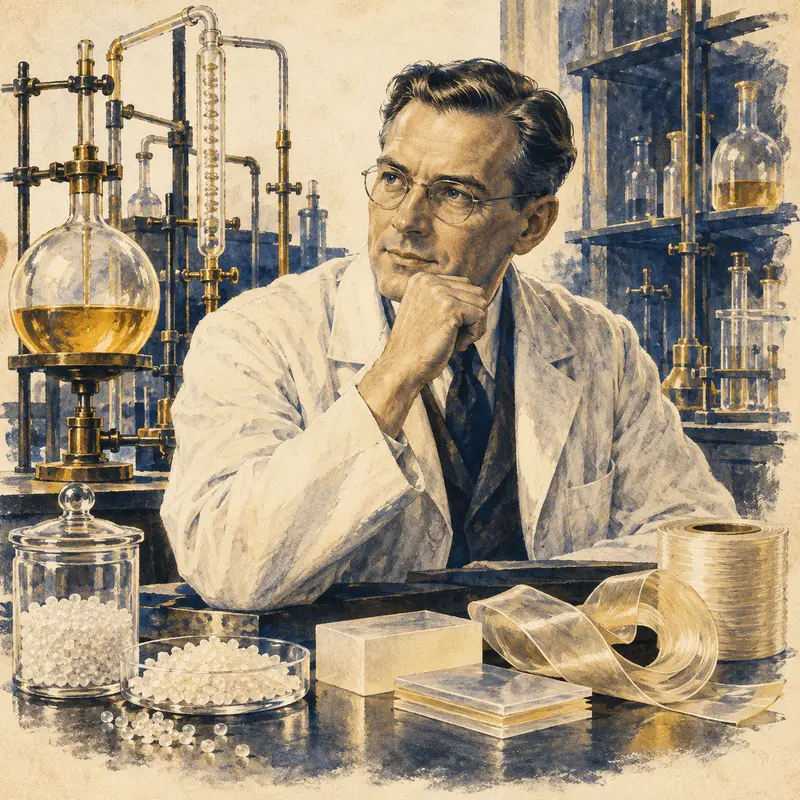
Wallace Carothers
1896-1937 · United States
Nylon and neoprene