The discovery, explained · Chemist no. 77 of 350
Wallace Carothers and Nylon: How a Fibre Was Built Molecule by Molecule
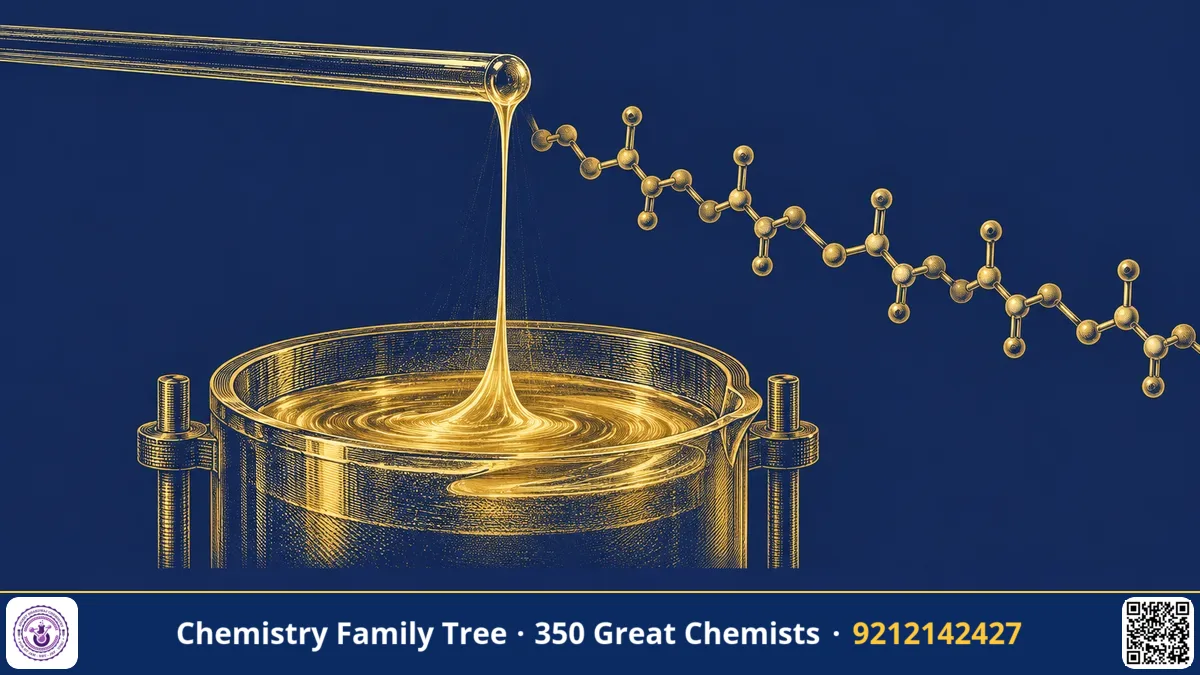
In 1935 a chemist at the DuPont Experimental Station in Wilmington, Delaware, made a polymer from two simple chemicals that could be melted and drawn into strong, silky threads. That polymer was nylon 6,6, and the chemist was Wallace Hume Carothers. Nylon was the first fully synthetic fibre made from simple chemicals and not from natural materials such as cellulose. It was used in toothbrush bristles, stockings, parachutes and ropes, and it showed that chemists could design materials by choosing the right monomers. Carothers also led the work that produced neoprene, the first commercially successful synthetic rubber. His polymer research also gave us the theory of step-growth polymerisation.
The Scientific Problem Before the Discovery
When Carothers joined DuPont in 1928, the idea of macromolecules was still being debated. Hermann Staudinger had argued that polymers are long chains held by covalent bonds, but many chemists still believed in the association theory. Carothers wanted to settle the matter by building large molecules step by step, using well-known organic reactions, and showing that the product behaves as a long covalent chain. In the textile industry, there was a strong commercial need for a silk substitute, since silk came from Japan and prices were high. Rayon, made from cellulose, was available but not a complete answer.
The Discovery: Step-by-Step
- Esterification to long chains (1929-30). Carothers and his team reacted dicarboxylic acids with diols to make polyesters. By removing the water formed continuously, using a device called a molecular still, they made chains with molecular weights of 10,000 to 25,000. Aliphatic polyesters were obtained, but they melted at too low a temperature and dissolved in water or solvents, so they were not good fibres.
- Cold drawing. A co-worker, Julian Hill, noticed that a molten polyester could be pulled into a fibre, and that the fibre became stronger and silkier when stretched further. This process, cold drawing, aligns the chains along the fibre axis.
- Switch to polyamides (1934-35). Amides have strong hydrogen bonds between chains, giving higher melting points and better strength than esters. Carothers' group tried several diamines and diacids.
- Nylon 6,6 (28 February 1935). Gerard Berchet, a member of the team, made the polymer from hexamethylenediamine and adipic acid, each with six carbon atoms. This became the choice for commercial production.
- Development. DuPont built a large plant at Seaford, Delaware, and nylon products entered the market from 1938 (nylon bristles) and nylon stockings in 1939-40.
The Chemistry Behind It
Nylon 6,6 is a condensation polymer, formed by repeated amide formation with the loss of water:
n H2N–(CH2)6–NH2 + n HOOC–(CH2)4–COOH
   → [–NH–(CH2)6–NH–CO–(CH2)4–CO–]n + (2n–1) H2O
The name "6,6" means that the diamine and the diacid each have six carbon atoms. In practice, the two monomers first form a 1:1 salt (nylon salt), which ensures the exact stoichiometric balance necessary for high molar mass. The salt is then heated under pressure and water is removed, giving the polymer.
Carothers worked out the theory of such step-growth polymerisation. Any two molecules with functional groups can react, so dimers, trimers and larger chains all form, and high molar mass only appears at very high conversion. The Carothers equation relates the number-average degree of polymerisation Xn to the extent of reaction p:
Xn = 1 / (1 – p)
For example, at 98% conversion (p = 0.98), Xn = 50; at 99.5% conversion, Xn = 200. This explains why the reaction must be driven nearly to completion by removing water, and why exact stoichiometry and high purity are essential. If the monomers are imbalanced by a ratio r, the modified equation is Xn = (1 + r)/(1 + r – 2rp).
The high strength of nylon comes from the amide groups. The N–H of one chain forms hydrogen bonds with the C=O of its neighbour, and the regular chain structure allows crystalline regions. Cold drawing aligns the chains and increases crystallinity. Nylon's water absorption is relatively low compared to cotton but higher than polyester because the amide groups can hydrogen-bond with water.
Neoprene (polychloroprene) came from the chemistry of acetylene. Following the work of Father Julius Nieuwland on acetylene, Carothers' team made chloroprene (2-chloro-1,3-butadiene) from vinylacetylene and HCl, which then polymerises by addition polymerisation:
n CH2=C(Cl)–CH=CH2 → [–CH2–C(Cl)=CH–CH2–]n
Applications Today
- Textiles: Stockings, sportswear, carpets, ropes and nets.
- Engineering plastics: Nylon 6,6 gears, bearings and automotive parts.
- Safety: Parachutes, airbags, seat belts and tyre cord.
- Neoprene: Wetsuits, gaskets, cable jackets and adhesives.
- India: Nylon filament yarn is widely made in India for fishing nets, fabrics and industrial uses.
Exam Corner
- Nylon 6,6 is made from hexamethylenediamine and adipic acid by condensation polymerisation (a polyamide).
- Nylon 6 is made from caprolactam by ring-opening polymerisation.
- Carothers equation: Xn = 1/(1 – p).
- Neoprene is polychloroprene, an addition polymer.
- Hydrogen bonding between amide groups gives nylon its high strength and melting point.
Common Misconceptions
- "Nylon 6 and nylon 6,6 are made from the same monomers." Nylon 6 is made from a single monomer, caprolactam, while nylon 6,6 uses two monomers.
- "Nylon is natural." It is fully synthetic, based on petrochemicals.
- "Polymerisation proceeds only in the final stage." In step-growth polymerisation, all monomers react early to form small oligomers, and high molar mass is reached late.
Quick Revision Box
- Nylon 6,6: hexamethylenediamine + adipic acid, losing water.
- First made on 28 February 1935 at DuPont.
- Carothers equation: Xn = 1/(1–p).
- Cold drawing aligns chains and boosts strength.
- Neoprene (polychloroprene) was the first commercial synthetic rubber.
- Amide hydrogen bonds give strength.
FAQ
Why is it called nylon 6,6?
Both starting materials, the diamine and the diacid, have six carbon atoms.
What is a condensation polymer?
A polymer formed by joining monomers with the loss of a small molecule such as water at each step.
Why must the monomers be in exact balance?
Because any excess of one monomer leaves chain ends with the same group, which stops further growth and limits molar mass.
What is cold drawing?
Stretching a solid fibre far below its melting point so that polymer chains align and the fibre becomes stronger.
Published by ABC Chemistry — IIT-JAM | CSIR-NET | GATE Chemistry Coaching. Visit abcchemistry.com
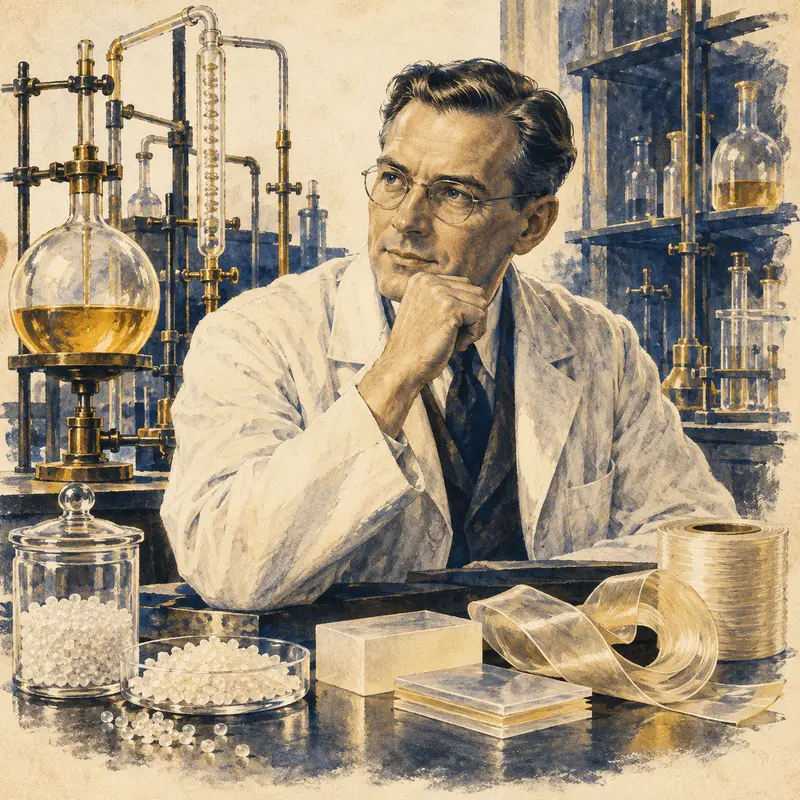
About the chemist
Wallace Carothers
1896-1937 · United States
Nylon and neoprene