The discovery, explained · Chemist no. 149 of 350
Walter Gilbert: Reading the Letters of DNA with Chemistry
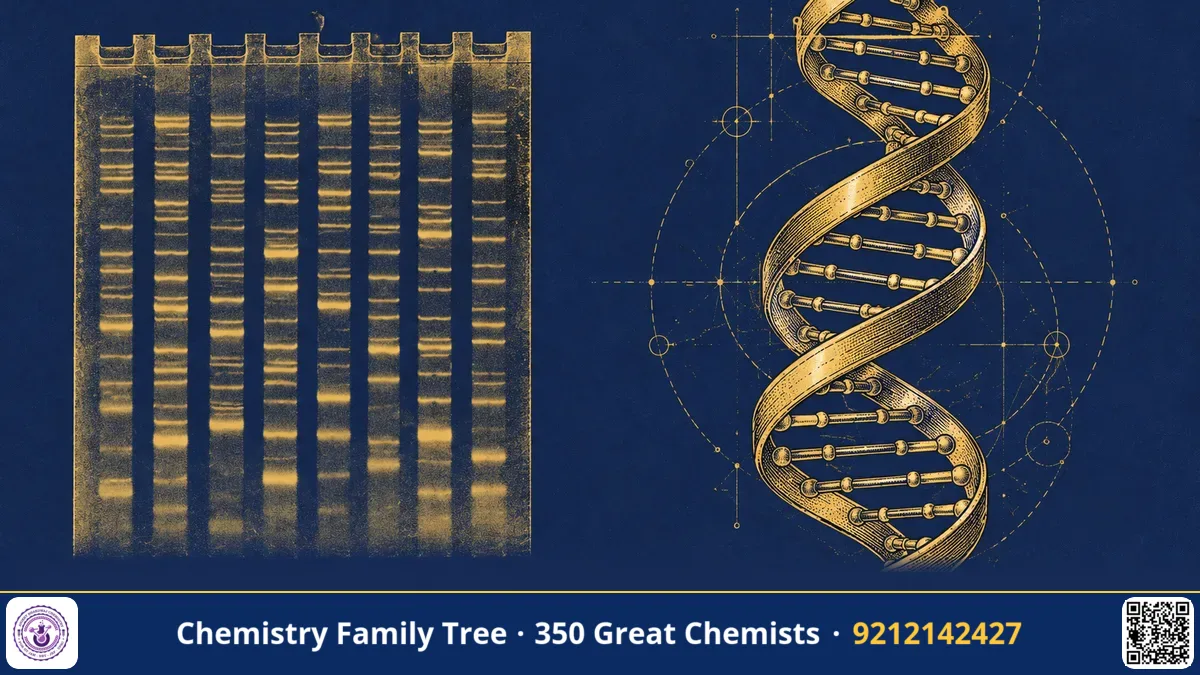
The human genome contains about three billion base pairs. Reading such a text became possible because, in the 1970s, two independent groups worked out how to determine the exact order of the bases A, T, G and C in a piece of DNA. In Cambridge, Frederick Sanger used enzymes and chain-terminating dideoxynucleotides. At Harvard, Walter Gilbert and his student Allan Maxam used pure chemistry: they broke the DNA at specific bases using selective reagents. The Maxam-Gilbert method was the first widely used DNA sequencing technique, and in 1980 Gilbert and Sanger shared one half of the Nobel Prize in Chemistry for their contributions concerning the determination of base sequences in nucleic acids. Gilbert had earlier isolated the first gene regulatory protein, the lac repressor.
The Scientific Problem Before the Discovery
In the early 1970s, scientists knew that genetic information is written in the sequence of bases in DNA, but there was no quick way to read it. RNA could be sequenced in small pieces, and Sanger had done so for tRNA and small viral RNAs, but the process was slow and laborious; reading a few dozen bases took months. DNA is much longer, and it has only four chemically similar bases. Moreover, because the double helix is so uniform, there was no easy way to distinguish one stretch from another.
Gilbert also wanted to understand how genes are switched on and off. In 1961, Jacob and Monod had proposed that a repressor protein binds to a DNA operator and blocks transcription of the lac operon genes in E. coli. But no one had isolated the repressor, and its binding site on DNA had not been seen. To read the operator sequence, he needed a sequencing method, which is part of the reason he developed one.
The Discovery and Experiments
- Isolating the lac repressor (1966). With Benno Müller-Hill, Gilbert used radioactive IPTG, a gratuitous inducer, which binds tightly to the repressor, to track the protein through purification. The repressor was found to be a protein which binds specifically to the lac operator DNA.
- Protecting the operator. Gilbert and colleagues treated the repressor-DNA complex with DNase and isolated the protected operator fragment, only about 24 base pairs long, which they then sequenced. This foreshadowed the technique of DNA footprinting.
- Chemical sequencing (1977). With Allan Maxam, Gilbert devised a method in which a DNA fragment is labelled at one end with 32P, divided into four portions, and each portion is treated with a reagent that modifies one or two types of bases. A second chemical step then breaks the DNA chain at the modified sites.
- Reading the gel. The fragments are separated by size on a high-resolution polyacrylamide gel, and the radioactive bands are made visible on X-ray film (autoradiography). The sequence is read from the ladder of bands.
The Chemistry Behind It
Base-specific reactions
| Reaction | Reagent | Cleaves at |
|---|---|---|
| G | Dimethyl sulfate (DMS) | Guanine |
| G + A | Formic acid (acid depurination) | Purines (A and G) |
| C + T | Hydrazine | Pyrimidines (C and T) |
| C | Hydrazine in 1.5 M NaCl | Cytosine only |
Guanine reaction
DMS, (CH3)2SO4, methylates the N7 position of guanine, the most nucleophilic site in the major groove. Methylation makes the glycosidic bond labile and weakens the ring. Heating with piperidine removes the modified base and, by beta-elimination, breaks the sugar-phosphate backbone at that position:
G (N7) + (CH3)2SO4 → 7-methyl-G + CH3OSO3-
7-methyl-G → (heat, piperidine) → base loss → strand scission
Purine reaction
Acid (formic acid) protonates purines, and the glycosidic bond is broken (depurination). Adenine is lost, and the guanine is lost as well. After piperidine treatment, the chain is cut at both A and G. The A band is found by comparing this lane with the G lane.
Pyrimidine reactions
Hydrazine (N2H4) attacks the pyrimidine rings of C and T, opening them. Piperidine then removes the fragments and cuts the DNA. In high salt (1.5 M NaCl), the reaction with thymine is suppressed, so that only cytosine is cleaved.
Reading the sequence
Every labelled fragment begins at the labelled end, and each ends at a position where one of the reactions took place. Four lanes (G, A+G, C+T, C) are loaded side by side. For a given band position, the lane or lanes with a band identify the base: G only in G lane, A in the A+G lane but not in G, C in both C and C+T lanes, T in C+T only. The smallest fragment at the bottom of the gel corresponds to the base nearest the labelled end. Reading from bottom to top gives the sequence from the labelled end (5' to 3' if the 5' end is labelled).
Comparison with Sanger's method
Sanger's dideoxy method uses DNA polymerase to copy a template in the presence of ddNTPs, which lack the 3'-OH and terminate the chain. It needed fewer toxic chemicals and was easy to automate with fluorescent labels, so it became the dominant method. The Maxam-Gilbert method, though, had the advantage of working on the original DNA, allowing studies of methylated bases and protein-DNA contacts.
Applications Today
- Genomics. The principle of sequencing led to the Human Genome Project, and today's next-generation sequencers have made the cost of reading a genome very low. India's genome projects and diagnostic labs use sequencing every day.
- Medicine. Sequencing is used to identify cancer mutations, hereditary diseases and pathogens, including the SARS-CoV-2 variants tracked in India.
- Footprinting. Chemical and enzymatic footprinting, which comes from Gilbert's methods, is used to show where proteins bind DNA.
- Biotechnology. Gilbert co-founded the biotechnology company Biogen in 1978, which produced recombinant interferon and later other drugs.
- Evolution studies. Gilbert proposed the "RNA world" name for an early stage of life and the exon-shuffling theory of genes in pieces.
Exam Corner
- Maxam-Gilbert sequencing is a chemical cleavage method; Sanger sequencing is enzymatic chain termination.
- DMS methylates N7 of guanine; formic acid depurinates A and G; hydrazine acts on C and T; hydrazine plus 1.5 M NaCl acts on C only; piperidine breaks the strand.
- The DNA is labelled with 32P at one end using polynucleotide kinase and gamma-32P-ATP.
- Lac repressor binds the lac operator and is released by allolactose or IPTG.
- The 1980 Nobel Prize in Chemistry: Gilbert and Sanger (half), Berg (half).
Common Misconceptions
- "Gilbert sequenced DNA using enzymes." That is Sanger's method. Gilbert's was chemical.
- "Piperidine modifies the bases." It cleaves the sugar-phosphate backbone at the modified sites after the first reagent has acted.
- "Gilbert's prize was in Medicine." It was the Nobel Prize in Chemistry.
Quick Revision Box
- Maxam-Gilbert sequencing, 1977: base-specific chemical cleavage.
- Lanes: G (DMS), A+G (acid), C+T (hydrazine), C (hydrazine + NaCl).
- End-labelled with 32P; read by autoradiography.
- Gilbert isolated the lac repressor in 1966 with Müller-Hill.
- Nobel Prize in Chemistry, 1980 (shared with Sanger and Berg).
- Co-founded Biogen (1978).
FAQ
What is the Maxam-Gilbert method?
It is a DNA sequencing method that uses chemical reactions to break end-labelled DNA at specific bases, producing fragments of different lengths that are separated on a gel.
Why did Sanger's method replace it?
Sanger's method was easier to automate, used fewer hazardous chemicals and gave longer reads.
What is the lac repressor?
It is a protein that binds the operator of the lac operon and prevents transcription until lactose (as allolactose) is available.
Is this topic useful for CSIR-NET?
Yes. Methods of DNA sequencing and gene regulation form regular questions in the chemical and life sciences papers.
Published by ABC Chemistry — IIT-JAM | CSIR-NET | GATE Chemistry Coaching. Visit abcchemistry.com

About the chemist
Walter Gilbert
1932- · United States · Nobel Chemistry 1980
DNA sequencing method