Biography · Chemist no. 20 of 350
Walther Nernst: The Brilliant Mind Behind the Third Law
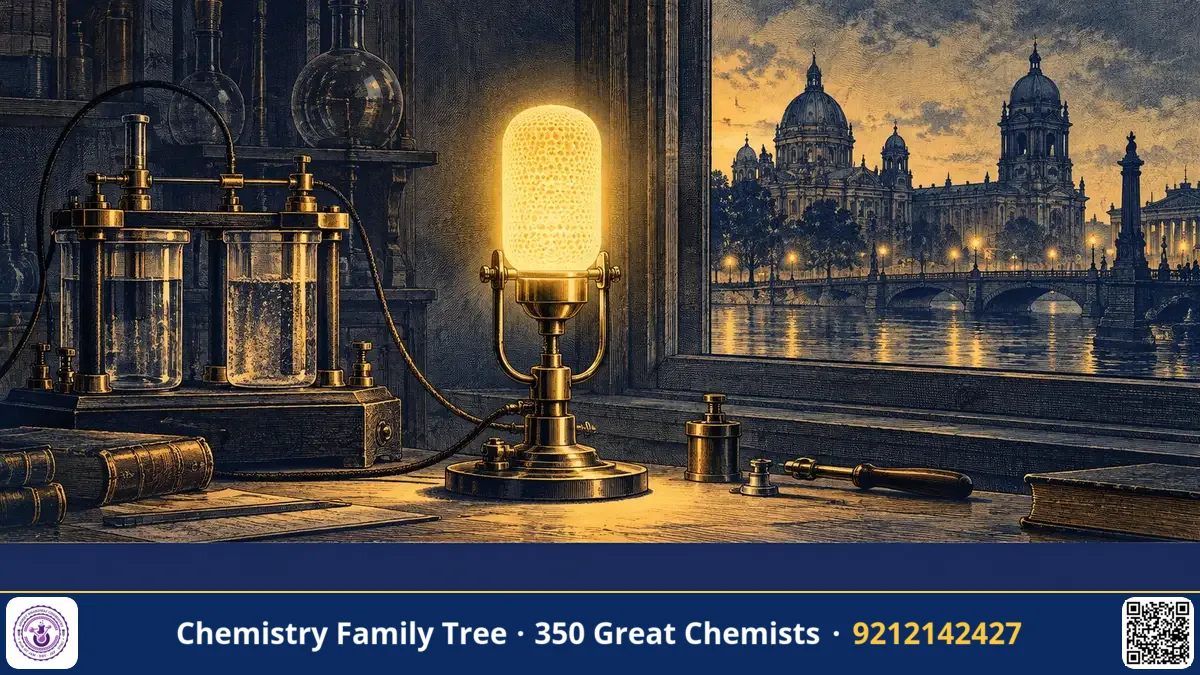
Walther Hermann Nernst (1864–1941) was a German physical chemist and physicist. He gave chemistry the Nernst equation, the heat theorem that became the third law of thermodynamics, the distribution law and the Nernst lamp. He won the 1920 Nobel Prize in Chemistry and was one of the most influential scientists in Berlin before 1933. His legacy: whenever a student calculates a cell potential at non-standard conditions, Nernst's name appears on the page.
Early Life and Family
Nernst was born on 25 June 1864 in Briesen, West Prussia (now Wąbrzeźno in Poland). His father, Gustav Nernst, was a district judge, and the family was comfortable and respected. Walther went to school in Graudenz and showed an early interest in literature and science.
In 1892 he married Emma Lohmeyer, the daughter of a Göttingen surgeon. They had five children, two sons and three daughters. Both sons were killed fighting in the First World War, a heavy personal loss. Nernst was known to be fond of fishing, cars and farming, and he later purchased an estate at Zibelle in Upper Lusatia where he bred carp.
Education and Mentors
Nernst studied physics and mathematics at several universities, which was a common route at the time: Zurich, Berlin, Graz and Würzburg. At Graz he met Ludwig Boltzmann, and at Würzburg he worked under Friedrich Kohlrausch, the expert on electrolytic conductivity. He earned his doctorate at Würzburg in 1887. In the same year he became an assistant to Wilhelm Ostwald at Leipzig, where he joined the circle that included Svante Arrhenius and soon founded the field of physical chemistry. In Leipzig he worked out his equation for electrode potentials, and after Ostwald's recommendation he obtained a post in Göttingen.
Career Timeline
| Year | Event |
|---|---|
| 1864 | Born in Briesen, West Prussia, 25 June |
| 1887 | Doctorate at Würzburg; becomes Ostwald's assistant at Leipzig |
| 1889 | Nernst equation for electrode potential |
| 1891 | Moves to Göttingen; distribution law |
| 1895 | Becomes professor and founds an Institute of Physical Chemistry and Electrochemistry at Göttingen |
| 1897 | Patents the Nernst lamp |
| 1905 | Becomes professor at the University of Berlin |
| 1906 | Announces the heat theorem (third law) |
| 1911 | Helps organise the first Solvay Conference |
| 1920 | Awarded the Nobel Prize in Chemistry (announced in 1921) |
| 1922–1924 | President of the Physikalisch-Technische Reichsanstalt |
| 1933 | Retires after the Nazi takeover |
| 1941 | Dies at Zibelle, 18 November |
Major Scientific Contributions
- The Nernst equation (1889). It relates electrode potential to ion concentration.
- The Nernst distribution law (1891). A solute distributes between two immiscible solvents so that the ratio of concentrations is constant at constant temperature.
- Nernst heat theorem and the third law. Entropy changes approach zero as T approaches 0 K. See our discovery post on the Nernst equation and third law for worked points.
- Solubility product ideas. He explained the common-ion effect using ionic equilibria.
- Photochemical chain reaction. In 1918 he proposed a chain mechanism for the reaction of hydrogen with chlorine,
H₂ + Cl₂ → 2HCl, that became a model for later chain-reaction studies. - The Nernst lamp. A glower of ceramic oxides that conducts when hot, used as a bright electric light source before the tungsten filament lamp took over.
Awards, Honours and Nobel Prize
Nernst received the Nobel Prize in Chemistry for 1920, awarded in 1921, "in recognition of his work in thermochemistry". He served as Rector of the University of Berlin and received many honorary degrees and memberships of scientific academies. He was a member of the Prussian Academy of Sciences and a Foreign Member of the Royal Society. The Nernst equation, Nernst effect, Nernst potential and the Nernst–Einstein relation all carry his name, and a crater on the Moon is named after him.
Personality, Struggles and Lesser-Known Facts
- A fortune from a lamp. Nernst sold the rights of his lamp to the company AEG for a large sum, reported to be about one million marks. The money gave him financial independence.
- A scientific rival of Haber. In 1907 Nernst disputed Fritz Haber's measurements of the ammonia equilibrium, and this pushed Haber to work more carefully. The criticism eventually helped to refine the data.
- Organiser of science. With the industrialist Ernest Solvay, Nernst organised the first Solvay Conference in Brussels in 1911, attended by Einstein, Planck, Marie Curie, Rutherford and others.
- An electric piano. In the 1930s Nernst worked on an electric piano with the company Bechstein, the "Neo-Bechstein", which used electromagnetic pickups, a hint of his late interest in acoustics.
- War work and sorrow. Nernst supported the German war effort in 1914 and worked on military research. He lost both his sons in the war.
- Einstein's supporter. Nernst recognised the importance of Einstein's early work on specific heats, and visited him in Zurich in 1910.
Legacy and Influence on Modern Chemistry
The Nernst equation is used each day in electrochemical laboratories, from the pH meters in school labs to industrial electrolysis. The third law supports the modern tables of standard molar entropies and is the foundation of low-temperature physics. His students and associates included Irving Langmuir, Frederick Lindemann and Francis Simon. His textbook Theoretische Chemie ran into many editions and trained generations of chemists. After the rise of Nazism in 1933 he withdrew from the University of Berlin, and with the departure of many Jewish scientists Berlin lost its leading position in science.
Lessons for Students
- Great ideas can come early. The Nernst equation was formulated when he was 25.
- Combine theory with experiment: Nernst built the apparatus to test his heat theorem at low temperatures.
- Learn from debates. The ammonia equilibrium argument with Haber improved science.
- Have interests outside the laboratory. Nernst's hobbies of fishing and driving helped him to relax.
Quick Facts Box
- Born: 25 June 1864, Briesen, West Prussia (now Wąbrzeźno, Poland)
- Died: 18 November 1941, Zibelle, Germany (now in Poland)
- Nationality: German
- Field: Physical chemistry, electrochemistry, thermodynamics
- Famous for: Nernst equation, third law of thermodynamics, Nernst lamp
- Nobel: Chemistry, 1920
FAQ
Why did Nernst receive the Nobel Prize in 1921 if it was the 1920 prize?
The 1920 chemistry prize was reserved and awarded a year later, in 1921, so it is called the 1920 prize presented in 1921.
What is the Nernst distribution law?
For a solute distributed between two immiscible liquids at constant temperature, the ratio of its concentrations in the two layers is constant (the partition coefficient).
Who organised the first Solvay Conference?
It was funded by Ernest Solvay and organised with the help of Walther Nernst, in 1911.
Was Nernst connected to the Nazi government?
He did not support it. After 1933 he left his university position and lived on his estate until his death in 1941.
Published by ABC Chemistry — IIT-JAM | CSIR-NET | GATE Chemistry Coaching. Visit abcchemistry.com
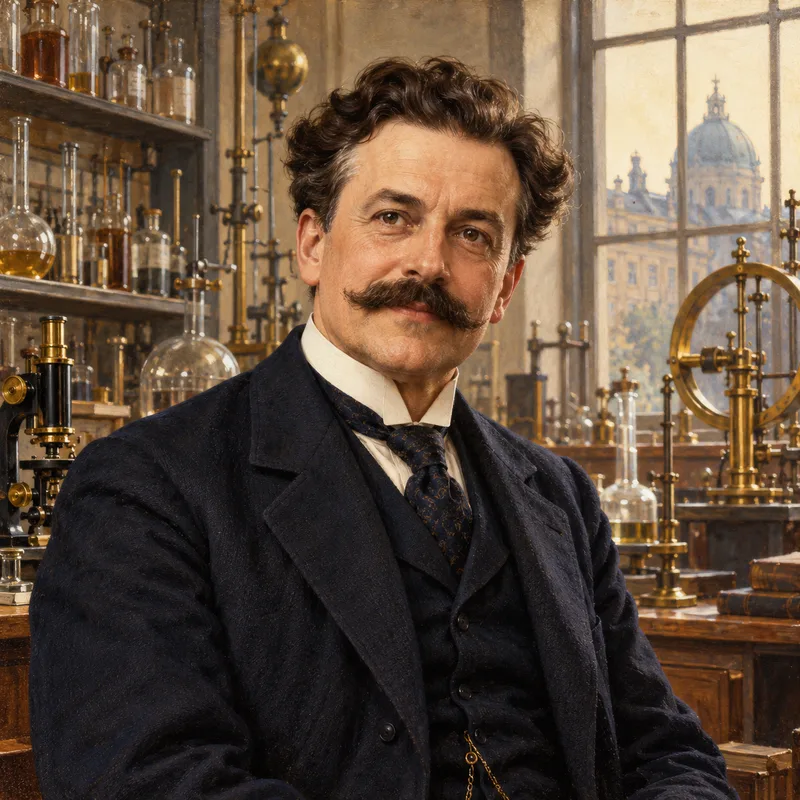
About the chemist
Walther Nernst
1864-1941 · Germany · Nobel Chemistry 1920
Third law of thermodynamics; Nernst equation