The discovery, explained · Chemist no. 20 of 350
Walther Nernst: From Electrode Potentials to the Third Law
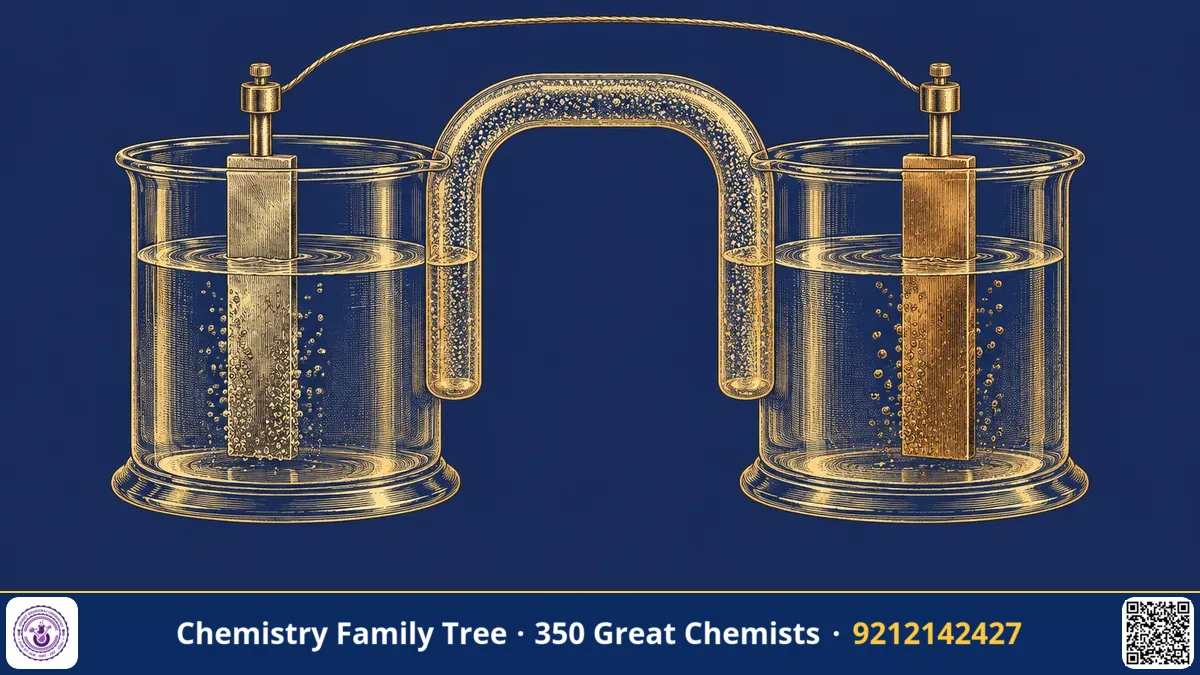
If you have ever solved a numerical on cell potential at non-standard concentrations, you have used the Nernst equation. Walther Nernst, a German physical chemist, derived it in 1889 when he was only 25. Seventeen years later, in 1906, he announced his heat theorem, which became the third law of thermodynamics and made it possible to calculate chemical equilibrium from heat measurements alone. For this thermochemical work he received the 1920 Nobel Prize in Chemistry. Between them, these two ideas form the backbone of electrochemistry and chemical thermodynamics in your syllabus.
The Scientific Problem Before the Discovery
By 1880 chemists could build galvanic cells and measure their voltages, but did not know why the voltage of a cell changed when the concentration of its solutions changed. Earlier workers such as Helmholtz and Gibbs had shown that cell voltage is connected to free energy. Arrhenius had proposed that salts exist as ions in solution, and van 't Hoff had shown that dilute solutions behave like gases in terms of osmotic pressure. What was missing was a quantitative rule linking the electrode potential to the concentration of ions.
The second problem was larger. A chemist wished to know whether a reaction would go forward, and how far, using ΔG = ΔH − TΔS. The enthalpy ΔH can be measured by calorimetry, but the entropy term required knowledge of equilibrium, which meant long experiments for each reaction. In 1884 Berthelot's rule, that the reaction with the largest heat release always proceeds, was known to be wrong. A theory that could predict equilibria from thermal data was needed.
The Discovery: Two Great Results
1. The Nernst equation (1889). Working in Ostwald's laboratory at Leipzig, Nernst applied osmotic-pressure ideas to electrodes. For an electrode reaction Mⁿ⁺ + ne⁻ → M, he proposed that the electrode potential depends on the concentration of ions:
E = E° − (RT/nF) ln Q
Here R is the gas constant, T is temperature, F is Faraday's constant (96485 C/mol), n is number of electrons and Q is the reaction quotient. At 298 K, converting to base-10 logarithms, the equation becomes:
E = E° − (0.0592/n) log Q
2. The Nernst heat theorem (1906). While studying reactions at low temperatures in Berlin, Nernst noticed that as T approaches absolute zero, the free energy change ΔG and the enthalpy change ΔH approach each other not just in value but in slope. He concluded:
lim (T→0) ΔS = 0
Max Planck extended this to say that the entropy of a perfect crystalline substance is zero at absolute zero. This is the third law. Nernst also showed that it is impossible to reach absolute zero in a finite number of steps, called the principle of unattainability.
The Chemistry Behind It
Using the Nernst equation. Consider the Daniell cell, Zn | Zn²⁺ || Cu²⁺ | Cu, with E° = 1.10 V. The overall reaction is:
Zn + Cu²⁺ → Zn²⁺ + Cu, E = 1.10 − (0.0592/2) log([Zn²⁺]/[Cu²⁺])
If [Zn²⁺] = 1 M and [Cu²⁺] = 0.01 M, then E = 1.10 − 0.0296 × log(100) = 1.10 − 0.0592 = 1.04 V. When the cell reaches equilibrium, E = 0 and Q = K, so:
E° = (0.0592/n) log K and ΔG° = −nFE° = −RT ln K
| Quantity | Relation |
|---|---|
| Free energy and EMF | ΔG = −nFE |
| Standard free energy and K | ΔG° = −RT ln K |
| Half-cell potential | E = E° − (0.0592/n) log (1/[Mⁿ⁺]) at 298 K |
| pH link (hydrogen electrode) | E = −0.0592 pH (volts) |
Using the third law. Since S = 0 at 0 K for a perfect crystal, we can find the absolute entropy at any temperature by measuring heat capacities down to near 0 K and integrating:
S(T) = ∫ (Cp/T) dT (from 0 to T, plus terms for phase changes)
Combining these absolute entropies with ΔH gives ΔG and hence K without any equilibrium experiment. Substances with residual entropy at 0 K, such as CO and ice, show that disorder can be frozen into the crystal.
Applications Today
- pH meters: the glass electrode potential changes by about 59 mV per pH unit at 25 °C, exactly as the Nernst equation predicts.
- Batteries and fuel cells: the voltage of lead-acid, lithium-ion and hydrogen fuel cells changes with concentration and pressure according to the Nernst equation.
- Biology: the resting potential across nerve cell membranes is estimated by the Nernst equation; for K⁺ it is about −90 mV. ECG and nerve signalling are studied in this way.
- Corrosion and metallurgy: predicting whether a metal will corrode and designing electrodeposition and electrorefining, such as of copper in Indian smelters.
- Low-temperature physics: the third law guides cryogenics, liquefaction of gases and research on superconductors.
- Sensors: ion-selective electrodes for fluoride, nitrate or potassium in water analysis.
Exam Corner
- Nernst equation: E = E° − (RT/nF) ln Q; at 298 K, E = E° − (0.0592/n) log Q.
- At equilibrium E = 0 and E° = (0.0592/n) log K.
- Concentration cell: E° = 0, and E = (0.0592/n) log (C₂/C₁) with the concentrated solution at the cathode side.
- Third law: the entropy of a perfectly crystalline substance is zero at 0 K; this gives absolute entropy values.
- Absolute zero cannot be reached by a finite number of operations (unattainability).
Common Misconceptions
- "E° changes with concentration." No. E° is a standard value. It is E (the actual cell potential) that changes.
- "Entropy of every substance is zero at 0 K." Only for perfect crystals. Glasses and some crystals have residual entropy.
- "The 0.0592 factor is universal." It holds only at 298 K and for base-10 logarithms.
Quick Revision Box
- Nernst equation, 1889: E = E° − (RT/nF) ln Q.
- At 298 K: E = E° − (0.0592/n) log Q.
- ΔG = −nFE and ΔG° = −RT ln K.
- Nernst heat theorem (1906): ΔS → 0 as T → 0; this leads to the third law.
- Nobel Prize in Chemistry: 1920 (awarded 1921) for thermochemistry.
- Planck gave the form S = 0 for a perfect crystal at 0 K.
FAQ
What does Q stand for in the Nernst equation?
Q is the reaction quotient, the ratio of product to reactant activities (or concentrations) raised to their stoichiometric powers at any moment.
Why is the third law important?
It allows absolute entropies to be calculated, and hence equilibrium constants from calorimetric data.
Is the Nernst equation valid for gases?
Yes. For gaseous species, we use partial pressures in Q, for example in the hydrogen electrode with H₂ at pressure p.
What is the Nernst lamp?
It was an early electric lamp invented by Nernst, using a heated ceramic rod. It is described in his biography post.
Published by ABC Chemistry — IIT-JAM | CSIR-NET | GATE Chemistry Coaching. Visit abcchemistry.com

About the chemist
Walther Nernst
1864-1941 · Germany · Nobel Chemistry 1920
Third law of thermodynamics; Nernst equation