The discovery, explained · Chemist no. 123 of 350
Wendell Stanley and the Crystals of a Virus: When Chemistry Met Life
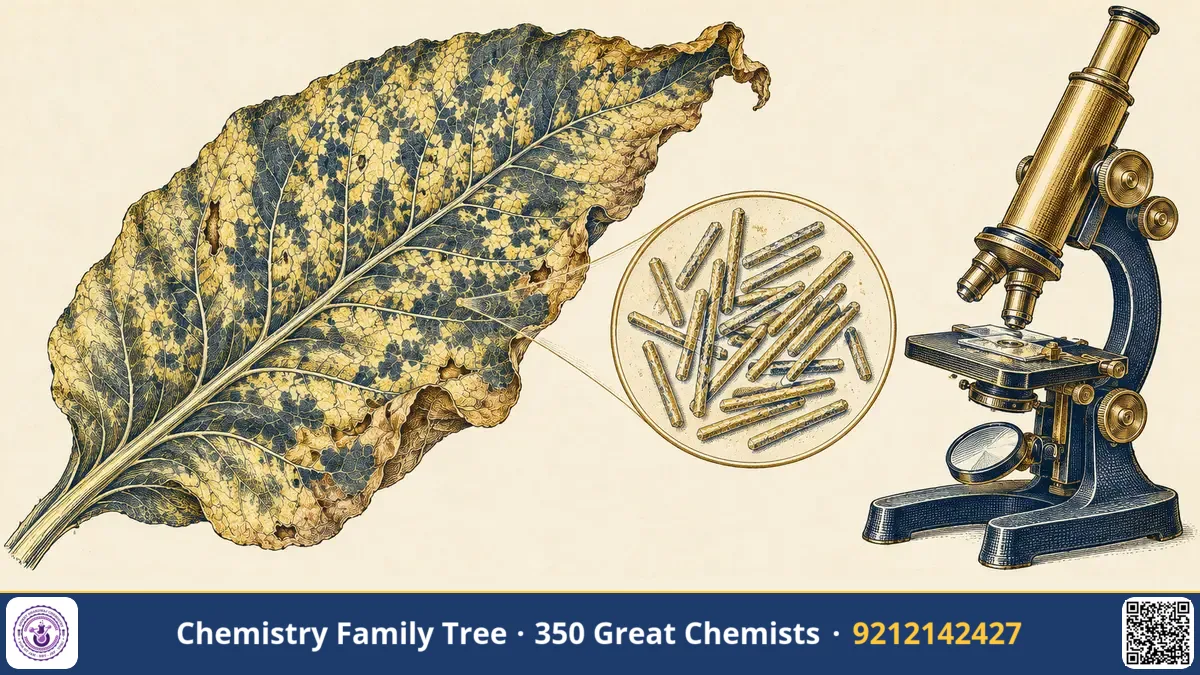
Crystals belong to chemistry: salt, sugar, copper sulfate. Viruses belong to biology, because they infect living cells and multiply. In 1935 the American biochemist Wendell Meredith Stanley announced that he had obtained crystals of tobacco mosaic virus (TMV), and that the crystals were still able to infect plants. This result blurred the sharp line between living and non-living matter and gave virus research a chemical basis. For his work on the preparation of enzymes and virus proteins in pure form, Stanley shared half of the Nobel Prize in Chemistry for 1946 with John Howard Northrop, while the other half was awarded to James Sumner.
The Scientific Problem Before the Discovery
The story of viruses began in the 1890s. The Russian scientist Dmitri Ivanovsky showed that the sap of diseased tobacco plants could still cause disease after passing through a filter fine enough to hold back bacteria. Martinus Beijerinck in the Netherlands confirmed this in 1898, and he suggested the cause was a "contagious living fluid". Later, Walter Reed showed that yellow fever is also caused by a filterable agent. Still, in the 1930s nobody knew what a virus was.
- Was a virus a tiny living organism, a toxin, or an enzyme-like chemical?
- Viruses could not be grown on artificial media, only in living hosts, and so only crude preparations were available.
- Success with crystalline enzymes made it possible to think of purifying a virus with similar tools, but nobody knew whether it would work.
The Discovery: Step by Step
Stanley began his virus work at the Rockefeller Institute, in its laboratory in Princeton, New Jersey. He chose tobacco mosaic virus because it is stable and infected plants produce large amounts of it. His plan was to apply the methods of protein chemistry that he had learned from the work of Northrop on enzymes.
- Infect and harvest. Tobacco plants were infected with TMV. After a few weeks, the diseased leaves were collected. Stanley used about a ton of infected leaves for his first preparations.
- Extract the juice. The leaves were ground and pressed to give a sap, which was clarified by filtration.
- Precipitate. He used ammonium sulfate to salt out the proteins, and acid or other precipitants to separate the virus from the rest.
- Purify. Repeated precipitation and redissolution gave a clean preparation. Later, ultracentrifugation was used as a further purification.
- Crystallise. Under proper conditions, the solution gave fine needle-like crystals, and a second form of paracrystalline material. In 1935 Stanley reported these in the journal Science.
- Test infectivity. Even after repeated recrystallisation, the crystals were highly infectious. A tiny quantity, around a millionth of a gram or less, was enough to cause disease when rubbed on leaves of healthy plants, and the infectivity per unit weight stayed constant, as one would expect for a pure substance.
Stanley first concluded that TMV was a protein, because it gave the usual protein tests and was inactivated by agents that denature protein. In 1936 the British workers Frederick Bawden and Norman Pirie showed that purified TMV also contains about 5% ribonucleic acid. Stanley's group confirmed this, and TMV was recognised as a nucleoprotein.
The Chemistry Behind It
Structure of TMV. TMV is a rod about 300 nm long and 18 nm wide, with a hollow core. It consists of 2130 identical protein subunits (each of 158 amino acids) arranged in a right-handed helix around one molecule of single-stranded RNA of about 6400 nucleotides. The RNA lies in a groove inside the protein coat, with three nucleotides bound to each coat protein subunit. Rosalind Franklin and Aaron Klug later worked out the helical structure by X-ray diffraction.
Why crystals form. All the virus particles are identical in size and shape, so they pack neatly into a lattice, just like molecules of a salt. This would not be true of a cell. In the end, this uniformity is what shows that a virus is a large molecular assembly and not an organism.
Self-assembly. In 1955 Heinz Fraenkel-Conrat and Robley Williams at Berkeley showed that separated TMV RNA and TMV protein, mixed together in solution, reassemble spontaneously into infectious virus. This demonstrated that all the information for assembly is in the components. It also gave direct proof that the RNA carries the genetic information: Fraenkel-Conrat made hybrid viruses and showed that the progeny follow the RNA and not the protein.
Fixing the interpretation. Stanley's view that a virus was a pure protein was corrected. It is a nucleoprotein, and the nucleic acid is the genetic material. Yet his basic result stands: a virus can be purified and crystallised like any chemical, and its properties can be studied by physical and chemical methods. In 1944 Avery, MacLeod and McCarty had shown that DNA carries genetic information in bacteria, and the Hershey-Chase experiment on bacteriophage in 1952 added more proof.
Applications Today
- Vaccines. During the Second World War, Stanley and his group developed methods to purify influenza virus, which helped to make vaccines. Today, purified viral proteins and inactivated virus are used in many vaccines.
- Structural virology. X-ray crystallography and cryo-electron microscopy of viruses, such as those of polio, hepatitis and coronaviruses, follow from the idea of virus crystals.
- Plant protection. TMV and related viruses are studied in agriculture. India grows tobacco, tomato, chilli and potato, all affected by plant viruses.
- Nanotechnology. TMV rods are used as templates for building nanomaterials, since they are rigid, uniform and can be modified chemically.
- Molecular biology. TMV was a model system for studying protein-RNA interaction, and the first virus to be seen by electron microscopy (1939).
Exam Corner
- Stanley crystallised tobacco mosaic virus in 1935; the crystals remained infectious.
- TMV is a nucleoprotein: helical protein coat (2130 subunits) and one strand of RNA (about 6400 nucleotides); the RNA is the genetic material.
- Ivanovsky (1892) and Beijerinck (1898) discovered the filterable infectious agent of tobacco mosaic disease.
- Bawden and Pirie (1936) showed that TMV contains RNA.
- Stanley, 1946 Nobel Prize in Chemistry (shared with Northrop; Sumner received the other half).
Common Misconceptions
- "Crystallised virus is dead." Crystals of TMV remain infective when put back on a plant, because the particle is intact.
- "Viruses are living cells." They have no metabolism of their own and replicate only inside host cells.
- "Stanley proved viruses are only protein." That was his first conclusion, but later work showed that nucleic acid is the genetic material.
Quick Revision Box
- TMV crystallised 1935 by Wendell Stanley.
- Rod-shaped virus, 300 nm by 18 nm; single-stranded RNA.
- 2130 identical coat protein subunits in a helix.
- Bawden and Pirie found nucleic acid in 1936.
- Reconstitution of TMV from RNA and protein: 1955.
- Nobel Prize in Chemistry 1946.
FAQ
Why was the crystallisation of a virus so surprising?
Because crystals are a feature of pure chemicals, while viruses were considered to be living things. It suggested that a virus is a molecular assembly that can be handled like a chemical.
Is TMV dangerous to humans?
No. It infects plants such as tobacco and tomato and does not infect humans.
What is a nucleoprotein?
A complex of nucleic acid (DNA or RNA) with protein, like TMV, chromatin and ribosomes.
Was the prize in Medicine?
No, it was the Nobel Prize in Chemistry for 1946, for the preparation of virus proteins and enzymes in pure form.
Published by ABC Chemistry — IIT-JAM | CSIR-NET | GATE Chemistry Coaching. Visit abcchemistry.com
About the chemist
Wendell Meredith Stanley
1904-1971 · United States · Nobel Chemistry 1946
Crystallization of tobacco mosaic virus