Biography · Chemist no. 23 of 350
Wilhelm Ostwald: The Organiser Who Made Physical Chemistry a Science
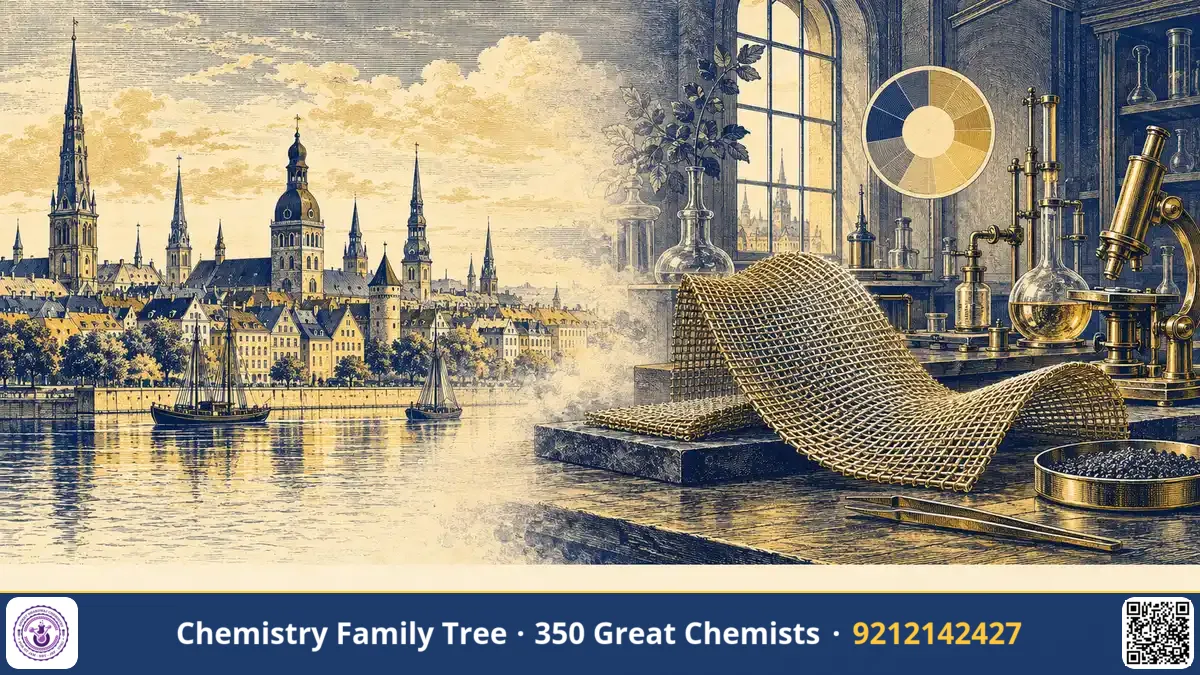
Friedrich Wilhelm Ostwald (1853–1932) was a Baltic-German chemist who worked in Riga and Leipzig. He is regarded as one of the founders of physical chemistry, together with van 't Hoff and Arrhenius. He gave catalysis its modern definition, formulated the dilution law, developed the Ostwald process for nitric acid, and received the Nobel Prize in Chemistry in 1909. He was also a gifted teacher, editor, philosopher and painter, and he helped to create a whole generation of scientists.
Early Life and Family
Ostwald was born on 2 September 1853 in Riga, then part of the Russian Empire (now the capital of Latvia). He was the middle of three sons. His father, Gottfried Wilhelm Ostwald, was a master cooper (barrel maker), and his mother was Elisabeth Leuckel, whose family were bakers. The family was of German descent and spoke German. As a child, Ostwald loved reading, experiments, painting and music. He built simple chemical apparatus at home, and even made fireworks and gunpowder as a boy.
In 1880 he married Helene von Reyher, and they had five children. His son Wolfgang Ostwald became a well-known colloid chemist.
Education and Mentors
After school in Riga, Ostwald entered the University of Dorpat (now Tartu in Estonia) in 1872. There he studied chemistry under Carl Schmidt and physics under Arthur von Oettingen. He obtained his master's degree in 1875 and his doctorate in 1878 with a thesis on chemical affinity, studying the effect of acids on reactions using volume changes. After that he worked as an assistant in Dorpat, and in 1881 he became Professor of Chemistry at the Riga Polytechnic. It was in Riga that he carried out the large series of measurements on the strength of acids that made his name.
Career Timeline
| Year | Event |
|---|---|
| 1853 | Born in Riga, 2 September |
| 1872 | Enters the University of Dorpat |
| 1878 | Doctorate at Dorpat |
| 1881 | Professor at the Riga Polytechnic |
| 1887 | Becomes Professor of Physical Chemistry at Leipzig; co-founds the Zeitschrift für physikalische Chemie |
| 1888 | Dilution law |
| 1894–1895 | Modern definition of catalysis |
| 1902 | Patents the ammonia-oxidation (Ostwald) process |
| 1904–1905 | Exchange professor at Harvard |
| 1906 | Retires from Leipzig and moves to his country house "Energie" at Großbothen |
| 1909 | Awarded the Nobel Prize in Chemistry |
| 1932 | Dies at Großbothen, 4 April |
Major Scientific Contributions
- Dilution law. A law for the ionisation of weak electrolytes: Ka = Cα²/(1 − α).
- Catalysis. He studied acid catalysis and autocatalysis and gave the modern definition of a catalyst. A catalyst changes the speed but not the equilibrium of a reaction.
- The Ostwald process. Catalytic oxidation of ammonia to nitric acid over platinum. Details are in our discovery post on the Ostwald process.
- Textbooks and journals. His Lehrbuch der allgemeinen Chemie was a standard text, and with van 't Hoff he started a journal which gave physical chemistry its voice.
- The mole. He introduced the term "Mol" in the 1890s for the amount of substance corresponding to the molecular weight in grams.
- Colour theory. In later life he developed a colour system, the Ostwald colour system, and wrote on colour harmony. His work was used by painters and designers.
Awards, Honours and Nobel Prize
The Royal Swedish Academy of Sciences awarded Ostwald the Nobel Prize in Chemistry in 1909 "in recognition of his work on catalysis and for his investigations into the fundamental principles governing chemical equilibria and rates of reaction". He also received the Davy Medal of the Royal Society in 1904, along with honorary degrees and memberships of many academies. The Wilhelm Ostwald Park in Großbothen preserves his house and papers as a museum of his work.
Personality, Struggles and Lesser-Known Facts
- A doubt about atoms. For many years Ostwald supported "energetics", the view that energy is the basic reality and that atoms are only a convenient fiction. Around 1908, after the experiments of Jean Perrin on Brownian motion, he accepted that atoms are real, and he said so openly in a later edition of his textbook. This change of mind is a model of scientific honesty.
- A gifted organiser. His Leipzig laboratory attracted students from many countries, including Walther Nernst, who was his assistant, and visitors such as Svante Arrhenius and G. N. Lewis. He helped promote Arrhenius's ideas at a time when they were doubted.
- Retirement at 53. He left his professorship early, in 1906, to devote his time to writing, philosophy and painting. He produced many paintings, and wrote on the philosophy of science, art and education.
- Energetic imperative. He summarised his social philosophy in a slogan that told people not to waste energy but to use it well.
- International language. Ostwald supported the creation of an international auxiliary language, and was for some time an advocate of Ido, a modified form of Esperanto.
- Writer to the end. In his retirement at Großbothen he wrote on a very wide range of subjects, from chemistry and its history to education and the organisation of knowledge, and he also wrote an autobiography, Lebenslinien.
Legacy and Influence on Modern Chemistry
Ostwald's textbook, journal and laboratory trained leaders such as Nernst and Lewis, and his thinking on catalysis shaped the modern chemical industry. The Ostwald process is still the main route to nitric acid, and nitric acid is the starting point for fertilisers and explosives. His dilution law is a cornerstone of acid–base equilibria in the Class 11–12 curriculum, and in university physical chemistry. Ostwald ripening is a basic concept in crystal growth and nanoscience. He also showed how science can be organised by building networks of journals, societies and institutes.
Lessons for Students
- Change your mind when the evidence is strong. Ostwald accepted atoms despite earlier doubts.
- Build communities: journals, laboratories and teaching create progress.
- Combine science with art and philosophy. Ostwald's painting and colour studies show that creativity is broad.
- Measure carefully. His systematic measurements of acid strengths made the theory of ions credible.
Quick Facts Box
- Born: 2 September 1853, Riga, Russian Empire (now Latvia)
- Died: 4 April 1932, Großbothen near Leipzig, Germany
- Nationality: Baltic German (Russian Empire-born, later German citizen)
- Field: Physical chemistry, catalysis, chemical kinetics
- Famous for: Ostwald dilution law, definition of catalysis, Ostwald process
- Nobel: Chemistry, 1909
FAQ
Where did Ostwald spend most of his career?
He worked in Riga from 1881 to 1887, and then in Leipzig from 1887 to 1906.
Did Ostwald believe in atoms?
He doubted atoms for a long time, but around 1908 he accepted their reality after Perrin's work.
What is "Energie" in Großbothen?
It is the name of the country estate to which Ostwald retired in 1906, and where he worked until his death.
What is the connection between Ostwald and Arrhenius?
Ostwald supported Arrhenius's theory of ionic dissociation, invited him to Riga, and the two helped found physical chemistry.
Published by ABC Chemistry — IIT-JAM | CSIR-NET | GATE Chemistry Coaching. Visit abcchemistry.com
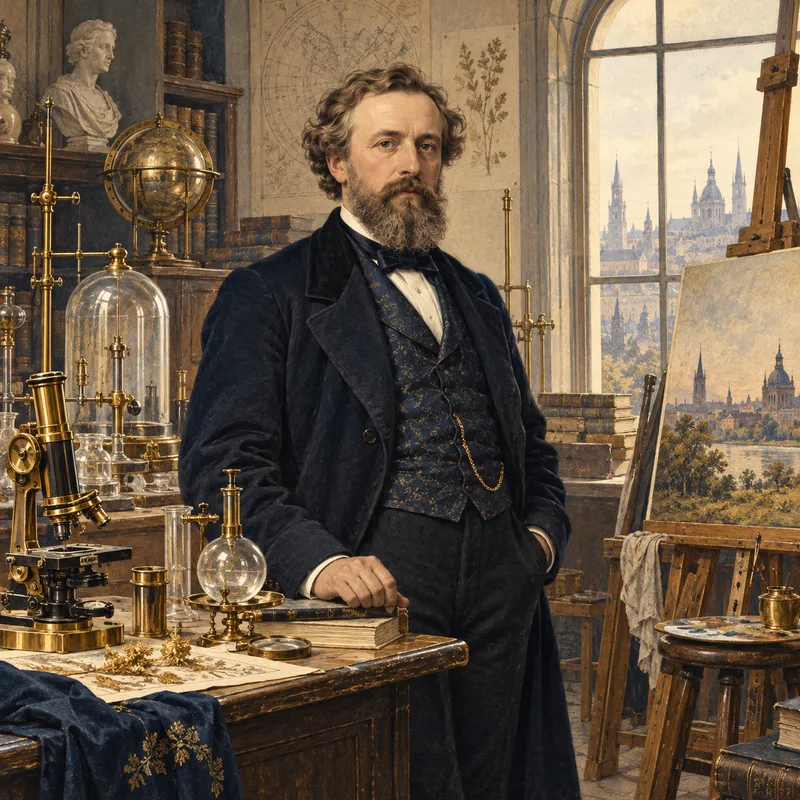
About the chemist
Wilhelm Ostwald
1853-1932 · Latvia/Germany · Nobel Chemistry 1909
Catalysis; Ostwald process; dilution law