The discovery, explained · Chemist no. 23 of 350
Wilhelm Ostwald: Catalysis, Dilution Law and Nitric Acid from Ammonia
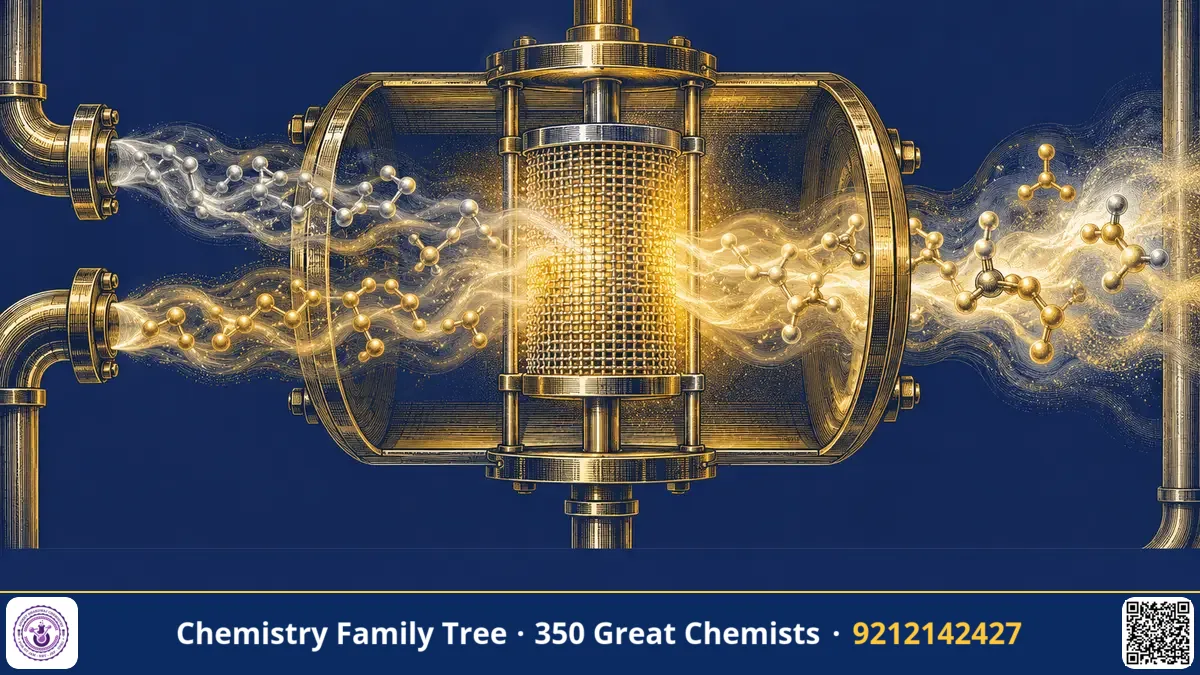
Wilhelm Ostwald was one of the founders of physical chemistry. He studied how fast reactions run, how weak electrolytes ionise and how catalysts work. His definition of a catalyst is the one we still use. His dilution law gives the degree of dissociation of weak acids, and the Ostwald process turns ammonia into nitric acid, which is the basis of modern fertilisers and explosives. In 1909 he received the Nobel Prize in Chemistry "in recognition of his work on catalysis and for his investigations into the fundamental principles governing chemical equilibria and rates of reaction".
The Scientific Problem Before the Discovery
In the 1870s and 1880s, chemistry was mostly descriptive. Chemists could make and analyse compounds but did not have a good quantitative theory of why reactions occur and at what speed. Jöns Jacob Berzelius had used the word "catalysis" in 1835 for reactions helped by substances that seemed to act by a mysterious "catalytic force". Nobody had a clear definition, and there was no firm way to measure acid strength.
Another difficulty was nitrogen. As discussed in the posts on Haber and others, farmers needed nitrates and the explosives industry needed nitric acid. The main source was Chilean saltpetre, and the supply was expected to be exhausted. Ammonia could be made from coal gas and later by the Haber process, but a good method to turn ammonia into nitric acid on a large scale was needed.
The Discovery: Step by Step
1. Measuring acid strength (1880s). In Riga and Leipzig, Ostwald measured the electrical conductivity of many acids at different dilutions. He also measured the speed of acid-catalysed reactions such as the hydrolysis of methyl acetate and the inversion of cane sugar. He found that the catalytic power of an acid was proportional to its conductivity, which supported Arrhenius's theory of ions.
2. Dilution law (1888). Applying the law of mass action to the dissociation of a weak electrolyte, such as acetic acid, he derived a simple relation. For CH₃COOH ⇌ CH₃COO⁻ + H⁺, with initial concentration C and degree of dissociation α:
Ka = Cα² / (1 − α)
For a weak electrolyte α is small, so Ka ≈ Cα² and α = √(Ka/C). This explains why the degree of dissociation rises with dilution.
3. Definition of catalyst (1894–1895). Ostwald defined a catalyst as a substance that changes the rate of a chemical reaction without appearing in the final products and without being used up. He insisted that a catalyst cannot start a reaction that is thermodynamically impossible, and cannot change the position of equilibrium. It only speeds up how fast equilibrium is reached.
4. The Ostwald process (patented 1902). Ostwald, with his assistant Eberhard Brauer, developed the catalytic oxidation of ammonia on hot platinum gauze to produce nitric acid.
The Chemistry Behind It
The Ostwald process has three main steps:
| Step | Reaction | Conditions |
|---|---|---|
| 1. Catalytic oxidation of ammonia | 4NH₃ + 5O₂ → 4NO + 6H₂O (ΔH = −905 kJ) | Pt–Rh gauze catalyst, about 800–900 °C, about 1–10 atm |
| 2. Oxidation of nitric oxide | 2NO + O₂ → 2NO₂ | Cooling to below about 150 °C |
| 3. Absorption in water | 3NO₂ + H₂O → 2HNO₃ + NO | Absorption towers; NO is recycled |
The platinum–rhodium catalyst gives NO with high selectivity. Without a catalyst, ammonia burns to N₂ and water instead: 4NH₃ + 3O₂ → 2N₂ + 6H₂O. This is a good example of selectivity: the catalyst directs the reaction toward one of several possible products. The reaction is very exothermic, so once started, the gauze remains hot without outside heating. The nitric acid obtained is about 50–68% concentrated and can be further concentrated by distillation with sulphuric acid.
Catalyst concepts. A catalyst lowers the activation energy by giving an alternative route. It does not change ΔH, ΔG or K. In homogeneous catalysis the catalyst is in the same phase (for example H⁺ in ester hydrolysis); in heterogeneous catalysis it is in a different phase (Pt gauze with gaseous reactants). In autocatalysis, a product acts as a catalyst, as Mn²⁺ in the oxidation of oxalic acid by permanganate.
Ostwald ripening. In a solution containing small and large crystals, the small ones dissolve and the larger ones grow, because small particles have higher solubility. This is known as Ostwald ripening and is important in nanoparticle and precipitate preparation.
Applications Today
- Fertilisers: nitric acid reacts with ammonia to give ammonium nitrate:
HNO₃ + NH₃ → NH₄NO₃. Combined with the Haber process, this connects air, water and natural gas with crop nutrition. India has several large fertiliser plants that produce nitric acid and nitrates. - Explosives and mining: ammonium nitrate-based explosives are used for mining coal and limestone in India and elsewhere.
- Chemical industry: nitric acid is a raw material for nylon intermediates (adipic acid), dyes, pharmaceuticals and nitrated products such as nitrobenzene.
- Catalysis in general: the same ideas apply to catalytic converters in vehicles, hydrogenation in food processing and petroleum refining.
- Weak acid analysis: the dilution law is used in conductometric titrations and in estimating the pKa values of acids.
- Laboratory tools: the Ostwald viscometer, designed by him, is still used for measuring viscosity.
Exam Corner
- Ostwald dilution law: Ka = Cα²/(1 − α); α = √(Ka/C) for weak acids; α increases as C decreases.
- Ostwald process: NH₃ → NO → NO₂ → HNO₃; Pt–Rh gauze catalyst at about 800 °C.
- A catalyst does not alter ΔG, K or the final yield; it changes only the rate by lowering Ea.
- Haber–Ostwald route: N₂ + H₂ → NH₃ (Haber) → HNO₃ (Ostwald).
- Ostwald ripening: larger particles grow at the expense of smaller ones; Ostwald coined the word "mole" (mol) around 1893.
Common Misconceptions
- "A catalyst is not involved in the reaction." It takes part in intermediate steps, but is regenerated at the end.
- "Dilution increases the number of ions per litre." The fraction dissociated (α) increases, but the concentration of ions per litre usually falls.
- "The Ostwald process makes ammonia." It makes nitric acid from ammonia. Ammonia is made by the Haber process.
Quick Revision Box
- Nobel Prize in Chemistry, 1909, for catalysis and rates and equilibria.
- Dilution law (1888): Ka = Cα²/(1 − α).
- Ostwald process patented 1902: 4NH₃ + 5O₂ → 4NO + 6H₂O over Pt–Rh.
- 2NO + O₂ → 2NO₂; 3NO₂ + H₂O → 2HNO₃ + NO.
- Catalyst: changes rate, not equilibrium; consumed? No, regenerated.
- Co-founded the Zeitschrift für physikalische Chemie (1887) with van 't Hoff.
FAQ
Why is a Pt–Rh gauze used?
The alloy is catalytically active for NO formation and is more resistant to loss by evaporation at high temperature than pure platinum.
Is the Ostwald dilution law valid for strong electrolytes?
No. For strong electrolytes, Kohlrausch's law and the Debye–Hückel theory apply. The dilution law works for weak electrolytes.
Who gave the first definition of a catalyst?
Berzelius coined the term in 1835, but Ostwald gave the modern definition in the 1890s.
What is the relation between Haber and Ostwald processes?
The Haber process makes ammonia from nitrogen and hydrogen. The Ostwald process then oxidises ammonia to nitric acid.
Published by ABC Chemistry — IIT-JAM | CSIR-NET | GATE Chemistry Coaching. Visit abcchemistry.com
About the chemist
Wilhelm Ostwald
1853-1932 · Latvia/Germany · Nobel Chemistry 1909
Catalysis; Ostwald process; dilution law