Biography · Chemist no. 73 of 350
Willard Libby: From a Colorado Farm to the Nobel Prize for Radiocarbon Dating
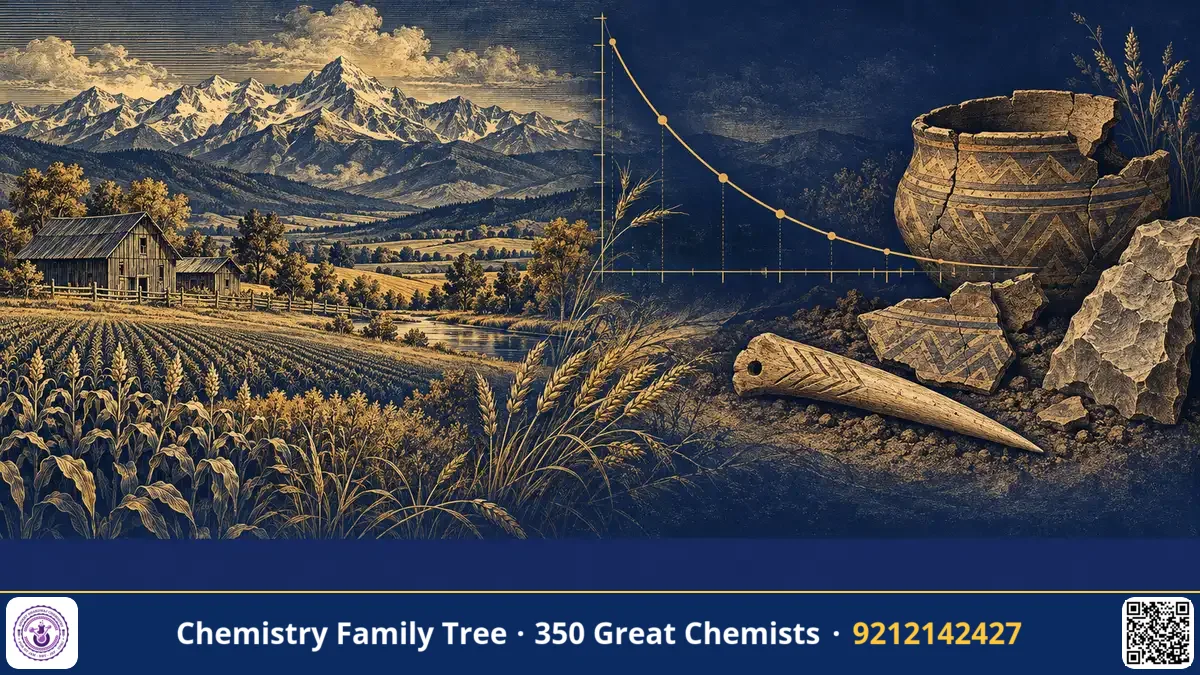
Willard Frank Libby (1908-1980) was an American physical chemist who invented radiocarbon dating, a method that allows scientists to measure the age of organic remains up to about 50,000 years old. He received the Nobel Prize in Chemistry in 1960. His legacy in one line: he gave archaeology and earth science a reliable clock for the recent past, based on the decay of carbon-14.
Early Life and Family
Willard Libby was born on 17 December 1908 in Grand Valley (now Parachute), Colorado, USA. He grew up on a farm, and when he was about five years old the family moved to Sebastopol, California, where his parents worked as farmers growing apples. Like many farm children, he learned practical skills and developed a love for science through a hands-on life. He attended local schools and later said that farm life, with its dependence on weather, soil and plants, helped him think about natural processes.
Education and Mentors
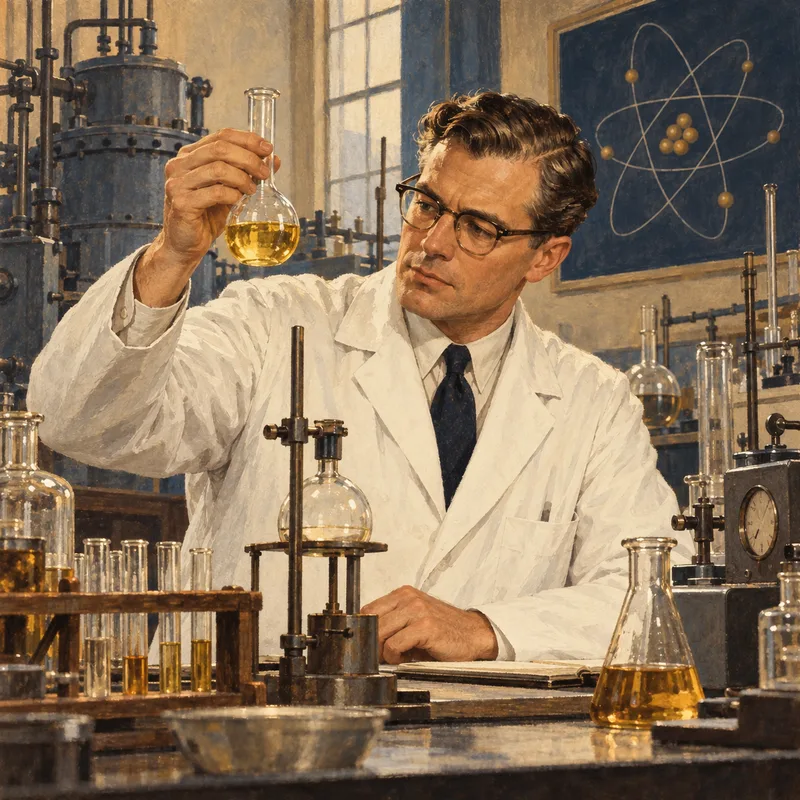
Libby studied at the University of California, Berkeley, where he received his Bachelor's degree in 1931 and his PhD in 1933. His research supervisor was the distinguished physical chemist Wendell Latimer, and he also came into contact with the famous Berkeley physicists, including Ernest Lawrence. At Berkeley he built a sensitive Geiger counter for measuring weak radioactivity, a skill that later became vital. He stayed there as an instructor and rose to assistant professor, working on natural radioactivity and the detection of very weak beta particles.
Career Timeline
| Year | Event |
|---|---|
| 1908 | Born in Grand Valley, Colorado |
| 1933 | PhD at the University of California, Berkeley |
| 1941 | Guggenheim Fellowship; moves to Princeton |
| 1941-45 | Works on the Manhattan Project at Columbia University on isotope separation |
| 1945 | Joins the University of Chicago as professor |
| 1946-49 | Develops the radiocarbon dating method |
| 1954-59 | Serves as a commissioner of the US Atomic Energy Commission |
| 1959 | Joins the University of California, Los Angeles (UCLA) |
| 1960 | Nobel Prize in Chemistry |
| 1980 | Dies in Los Angeles |
Major Scientific Contributions
Libby's greatest contribution is radiocarbon dating. He predicted that cosmic rays would produce carbon-14 in the atmosphere, showed that it is incorporated in living things, and demonstrated that its decay can serve as a clock. He and his students tested the method on samples of known age, such as tree rings and Egyptian wood. He also developed a similar method using tritium (hydrogen-3) to date water and wine, and studied the distribution of natural radioactivity and fallout from nuclear weapons. During the Second World War, he worked on gaseous diffusion methods to separate uranium isotopes. Our discovery post gives the reactions and calculations.
Awards, Honours and Nobel Prize
- Nobel Prize in Chemistry, 1960, "for his method to use carbon-14 for age determination in archaeology, geology, geophysics, and other branches of science". He received the prize alone.
- Elected to the US National Academy of Sciences (1950).
- Willard Gibbs Award and the Priestley Medal of the American Chemical Society.
- Member of the US Atomic Energy Commission, 1954-1959.
Personality, Struggles and Lesser-Known Facts
- Low-background counting: To measure the very weak activity of 14C, he shielded his counters with a ring of other Geiger tubes and thick steel and lead. This clever design cut out cosmic ray background and made the method possible.
- Early scepticism: Many archaeologists doubted that a physics-chemistry method could give accurate dates, until tests with objects of known age showed good agreement.
- Scientist in public service: As a member of the Atomic Energy Commission, he spoke on fallout and nuclear policy and supported peaceful uses of atomic energy.
- Family: He married Leona Woods, a physicist who had worked with Enrico Fermi on the first nuclear reactor in Chicago. He had two daughters from an earlier marriage.
- Hands-on scientist: He continued to prefer designing instruments and experimenting even as a senior professor.
Legacy and Influence on Modern Chemistry
Radiocarbon dating transformed archaeology from a mostly relative science into one with absolute dates. It allows researchers to compare the timing of events in different parts of the world, such as the spread of farming or the end of the last ice age. Modern developments, such as accelerator mass spectrometry and calibration against tree rings and corals, have extended its precision. It is a favourite topic in physical chemistry and nuclear chemistry courses, because it is a real-world application of first-order kinetics. Indian laboratories continue to use radiocarbon dating to understand ancient settlements and climate change in the subcontinent.
Libby also believed that scientists should test their own assumptions. His method rested on the assumption that the amount of carbon-14 in the atmosphere had stayed constant for tens of thousands of years. He knew that this might not be exactly true, and he checked it using samples of known age. Later work did show small variations, and calibration curves were introduced to correct them. This shows how a scientific method improves over time: the first version gives a good answer, and later scientists refine it with better data and better instruments.
Lessons for Students
- Basic ideas in physics and chemistry can solve problems in other fields such as history.
- Good instrument design is as valuable as good theory.
- Test new methods on samples of known answers to build trust.
- Scientists have a duty to explain their work to the public.
Quick Facts Box
- Born: 17 December 1908, Grand Valley, Colorado, USA
- Died: 8 September 1980, Los Angeles, USA
- Nationality: American
- Field: Nuclear and physical chemistry
- Famous for: Radiocarbon dating
- Nobel: Chemistry, 1960
FAQ
Where did Libby invent radiocarbon dating?
At the University of Chicago, in the late 1940s.
Was Libby part of the Manhattan Project?
Yes, he worked on isotope separation at Columbia University during the Second World War.
Did Libby win the Nobel Prize alone?
Yes. The 1960 Nobel Prize in Chemistry was awarded to him alone.
What other dating method did he develop?
Tritium dating, which is used to estimate the age of water and some beverages.
Published by ABC Chemistry — IIT-JAM | CSIR-NET | GATE Chemistry Coaching. Visit abcchemistry.com
About the chemist
Willard Libby
1908-1980 · United States · Nobel Chemistry 1960
Radiocarbon dating