The discovery, explained · Chemist no. 73 of 350
Willard Libby and Radiocarbon Dating: The Atomic Clock Inside Every Living Thing
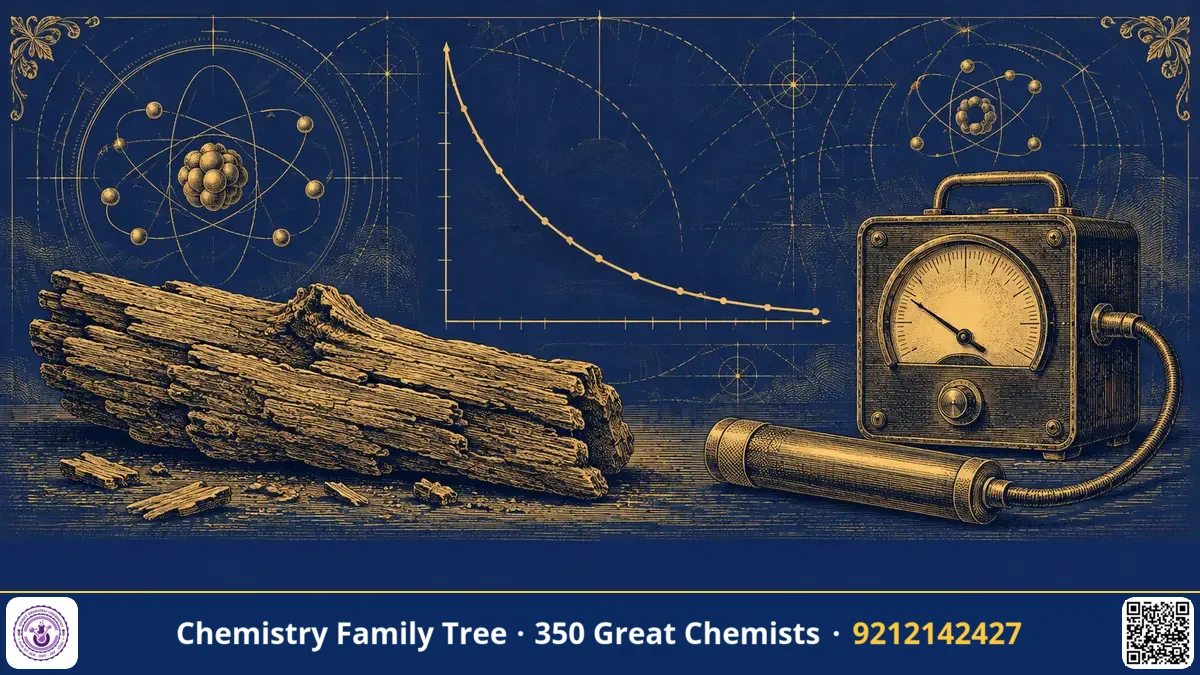
How do archaeologists know that a wooden tool is 5,000 years old, or that a bone belongs to an animal that lived 20,000 years ago? The answer lies in a radioactive isotope of carbon, carbon-14, and a method invented in the late 1940s by the American chemist Willard Frank Libby. He realised that every living organism takes in a tiny, constant fraction of radioactive carbon, and that after death this fraction falls at a known rate. By measuring what is left, one can calculate how long ago the organism died. This radiocarbon dating method opened the door to dating the human past and brought Libby the Nobel Prize in Chemistry in 1960.
The Scientific Problem Before the Discovery
Before radiocarbon dating, archaeologists relied on relative methods. Layers of earth (stratigraphy) show which objects are older, and styles of pottery or tools can be arranged in sequence. Written records, such as Egyptian king lists, gave dates only for a few cultures and a few thousand years. For prehistoric periods there was no reliable clock at all. Geologists could date rocks by uranium decay, but those methods work for millions of years, not for the last 50,000 years of human history. A technique was needed that could measure ages from a few hundred to tens of thousands of years, and use organic remains such as wood, charcoal, bone and cloth.
The Discovery: Step-by-Step
- The production of 14C. Cosmic rays strike the upper atmosphere and release neutrons. These neutrons collide with nitrogen-14 atoms:
¹⁴N + n → ¹⁴C + p
- Oxidation and mixing. The 14C atoms are quickly oxidised to 14CO2, which mixes with ordinary CO2 throughout the atmosphere and oceans.
- Uptake by life. Plants absorb CO2 by photosynthesis, and animals eat plants. As long as an organism is alive, its ratio of 14C to 12C is the same as the atmosphere, about one atom of 14C per trillion atoms of carbon.
- Death stops the intake. When the organism dies, no more fresh carbon enters. The 14C decays by beta emission:
¹⁴C → ¹⁴N + e⁻ + antineutrino
- Measurement. Libby and his students at the University of Chicago converted samples to pure carbon and measured their weak radioactivity using very sensitive Geiger counters shielded from background radiation.
- Testing the method. They tested it on objects of known age, such as samples of wood from ancient Egyptian tombs and tree rings, and found good agreement. The first results were published around 1949.
The Chemistry Behind It
Radioactive decay follows first-order kinetics. If N is the number of atoms (or activity A) at time t, and N0 the initial value, then:
N = N0 e^(−λt)
t½ = 0.693 / λ
t = (1/λ) ln(N0/N) = (t½/0.693) ln(N0/N)
The half-life of carbon-14 is about 5,730 years (Libby originally used a value near 5,568 years, which is still used as a convention in "conventional radiocarbon age").
Worked example. A piece of charcoal shows 25% of the activity of living wood. Since 25% means two half-lives (100% → 50% → 25%), the age is about 2 × 5,730 = 11,460 years.
Another example: if the activity is 60% of the modern value, then t = (5730/0.693) × ln(1/0.6) = 8268 × 0.511 ≈ 4,225 years.
The method has limits. After about 50,000 years (roughly 8 to 9 half-lives), too little 14C remains to be measured reliably. Atmospheric 14C has not been perfectly constant. It varies with changes in cosmic ray flux and the Earth's magnetic field, and fossil fuel burning dilutes it (the Suess effect), while nuclear weapon tests in the 1950s and 1960s added extra 14C (the bomb peak). Therefore, radiocarbon ages are calibrated against tree-ring records and other archives. Modern laboratories also use accelerator mass spectrometry (AMS), which counts 14C atoms directly and needs only milligram samples.
Applications Today
- Archaeology: Dating of charcoal, wood, seeds, bones, textiles and shells from sites across the world, including Indian sites of the Indus Valley and Gangetic plains.
- Geology and climate: Dating of lake and ocean sediments, peat and glacier ice to study past climates.
- Art and forensics: Detecting forged works and dating historical manuscripts; the bomb peak helps in forensic dating of recent material.
- Environmental science: Tracing carbon sources, such as distinguishing fossil-fuel carbon from biological carbon.
- Indian research: Laboratories such as those at the Physical Research Laboratory in Ahmedabad and the Birbal Sahni Institute of Palaeosciences in Lucknow carry out radiocarbon dating.
Exam Corner
- 14C is formed by the reaction ¹⁴N(n,p)¹⁴C in the upper atmosphere.
- Decay is a first-order process with a half-life of about 5,730 years.
- Age formula: t = (2.303/λ) log(N0/N).
- Radiocarbon dating applies to organic material up to about 50,000 years old.
- Libby won the Nobel Prize in Chemistry in 1960 for the method of using carbon-14 for age determination.
Common Misconceptions
- "Radiocarbon dating can date dinosaur fossils." No. Dinosaurs are far older than the 50,000-year limit; other isotopes, such as uranium-lead, are used for such ages.
- "It dates rocks." It dates only material that was once part of a living organism and contains carbon.
- "The ratio of 14C in the atmosphere is perfectly constant." It varies slightly, so calibration is required.
Quick Revision Box
- ¹⁴N + n → ¹⁴C + p (cosmic-ray neutrons).
- ¹⁴C → ¹⁴N + β⁻; half-life 5,730 years.
- Living organisms maintain constant 14C/12C ratio.
- Useful range: up to about 50,000 years.
- Calibration with tree rings is needed.
- Nobel Prize in Chemistry 1960.
FAQ
Why does the clock start at death?
While alive, an organism constantly replaces its carbon, so the 14C level stays equal to that of the atmosphere. After death replacement stops and decay lowers the level.
What is the half-life of carbon-14?
About 5,730 years, although Libby's original value was 5,568 years.
Can any old object be dated by this method?
Only material containing carbon from living things, such as wood, charcoal, bone or cloth, and younger than about 50,000 years.
What is AMS?
Accelerator mass spectrometry counts individual 14C atoms and allows dating of very small samples with high accuracy.
Published by ABC Chemistry — IIT-JAM | CSIR-NET | GATE Chemistry Coaching. Visit abcchemistry.com
About the chemist
Willard Libby
1908-1980 · United States · Nobel Chemistry 1960
Radiocarbon dating