The discovery, explained · Chemist no. 126 of 350
William Giauque: Getting Close to Absolute Zero and Testing the Third Law
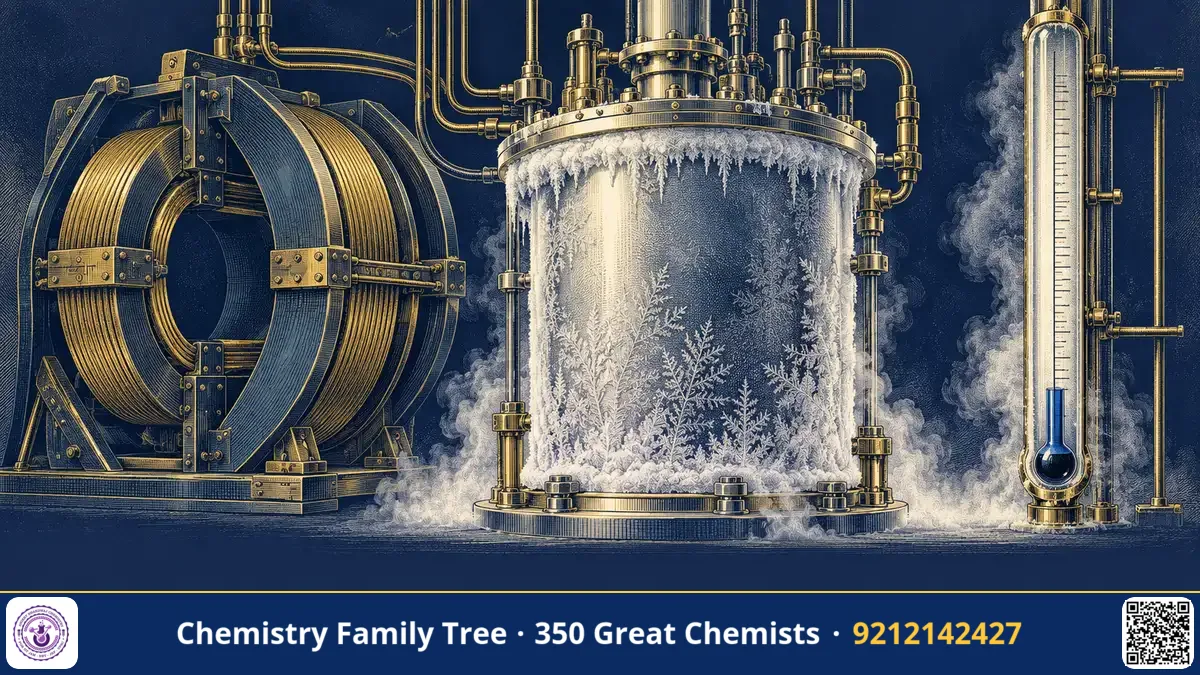
What is the lowest temperature in the universe, and can we reach it? Absolute zero, 0 K or −273.15 °C, is the lower limit set by thermodynamics. The American chemist William Francis Giauque did more than any other chemist to approach it. In 1933, with his student D. P. MacDougall, he cooled a paramagnetic salt to about a quarter of a degree above absolute zero by a method called adiabatic demagnetization. He also used extremely low-temperature heat capacity measurements to test the third law of thermodynamics, and he discovered the oxygen isotopes ¹⁷O and ¹⁸O. He received the Nobel Prize in Chemistry for 1949 "for his contributions in the field of chemical thermodynamics, particularly concerning the behaviour of substances at extremely low temperatures".
The Scientific Problem Before the Discovery
By 1900 several gases had been liquefied. Liquid air, liquid hydrogen (about 20 K) and, in 1908, liquid helium (about 4.2 K, by Heike Kamerlingh Onnes) had been obtained. Helium could be cooled further, to about 1 K, by pumping away its vapour to lower the pressure, but this method could not go much lower. Below 1 K, there was no known liquid with enough vapour pressure, so a new idea was needed.
- Thermodynamics predicts that properties of matter at the lowest temperatures have deep significance. Walther Nernst proposed in 1906 that the entropy change of any process goes to zero as T goes to 0 (the Nernst heat theorem, the basis of the third law).
- To test this experimentally, one needs accurate heat capacities down to very low temperatures, and these were not available.
- The atomic weight of oxygen was the standard of the chemists' scale, but nobody knew whether oxygen was a single isotope or not.
The Discovery: Step by Step
Adiabatic demagnetization
In 1926 Giauque at Berkeley, and independently the Dutch-German physical chemist Peter Debye proposed a new way to cool below the temperature of liquid helium. It uses a paramagnetic salt, in which each ion carries a magnetic moment.
- Pre-cool. The salt (Giauque used gadolinium sulfate octahydrate, Gd₂(SO₄)₃·8H₂O, which has Gd³⁺ ions with seven unpaired electrons) is cooled with liquid helium to about 1.5 K.
- Magnetise isothermally. A strong magnetic field is applied while the salt is in thermal contact with the liquid helium bath. The magnetic moments line up with the field, which lowers their entropy (more order). The heat released is taken away by the helium, so the temperature stays constant.
- Isolate. The salt is thermally isolated from the bath by removing the exchange gas that connected them.
- Demagnetise adiabatically. The field is switched off slowly. The entropy of the salt cannot change in a reversible adiabatic process, but the magnetic moments become random again, taking up entropy from the vibrations of the lattice. The lattice entropy falls, and therefore the temperature falls sharply.
The first successful experiment was carried out in 1933 by Giauque and MacDougall, and it reached 0.25 K. Using the same salt later, they went to lower values, to around 0.1 K and lower. At about the same time, de Haas and others in Leiden worked on the same idea. Later, nuclear adiabatic demagnetization reached microkelvin temperatures.
Entropy of a paramagnetic ion (spin S):  S = R ln(2S + 1)   (field off, spins disordered)
For Gd³⁺ (S = 7/2):  S = R ln 8 = 17.3 J K⁻¹ mol⁻¹
Testing the third law
The third law says that the entropy of a perfect crystal is zero at 0 K. Giauque used the integral of heat capacity to calculate the absolute entropy of substances:
S(T) = ∫₀ᵀ (C_p / T) dT + Σ (ΔH_transition / T_transition)
He measured C_p of many substances from very low temperatures to room temperature and compared the calorimetric entropy with the value found by statistical mechanics from spectroscopic data. For most substances, the two values agreed, which supported the third law. For some, such as carbon monoxide, nitrous oxide and ice, the calorimetric value was lower. For ice, Giauque and Stout (1936) found a difference of about 3.4 J K⁻¹ mol⁻¹. This residual entropy was explained by Linus Pauling in 1935: in ice, each oxygen has two near and two far hydrogens, and there are many ways of arranging them, giving W = (3/2)ⁿ configurations, so S₀ = R ln(3/2) ≈ 3.4 J K⁻¹ mol⁻¹. In CO the molecules can freeze in either orientation, CO or OC, giving about R ln 2 of residual entropy, which is nearly seen in experiments.
Oxygen isotopes
In 1929, Giauque and Herrick Johnston found weak extra lines in the absorption spectrum of atmospheric oxygen, which showed that oxygen contains the isotopes ¹⁷O and ¹⁸O besides ¹⁶O. The abundances are about 99.76% for ¹⁶O, 0.04% for ¹⁷O and 0.20% for ¹⁸O. This led to a mismatch between chemists, who defined atomic mass with natural oxygen taken as 16, and physicists, who set ¹⁶O as 16. The matter was finally resolved in 1961 when both agreed to use carbon-12 as the standard.
The Chemistry Behind It
Entropy and order. The entropy is S = k ln W, where W is the number of microstates. Aligning magnetic moments reduces W and entropy. In demagnetisation, the system takes entropy from the lattice vibrations, which cools it.
Curie law. For paramagnets, the magnetisation M is proportional to B/T, so cooling and a strong field both increase the order. This is why the effect requires both low starting temperature and a high field.
Third law consequences. The third law means that absolute zero cannot be reached in a finite number of steps. Each cooling step removes a smaller amount of entropy as T decreases. It also allows the calculation of absolute entropies and equilibrium constants from calorimetric data: ΔG° = ΔH° − TΔS°, with S° values being absolute.
Heat capacity at low T. For non-metallic crystals, the Debye T³ law holds, C_v = aT³ at low temperatures, so the entropy at low T is S = C_v/3.
Applications Today
- Cryogenics. Adiabatic demagnetisation refrigerators (ADRs) are used to cool detectors in space telescopes and X-ray instruments to a fraction of a kelvin.
- Quantum technology. Superconducting quantum computers run at around 10-20 millikelvin, in dilution refrigerators. The science of ultra-low temperatures began with this work.
- Medicine and industry. Liquid helium cools the superconducting magnets in MRI scanners; helium is also used in the semiconductor industry.
- Thermodynamic data. Absolute entropies in tables used for calculating the equilibrium constants of reactions come from low-temperature calorimetry.
- Isotope chemistry. ¹⁸O is used in tracer studies, in medical PET production of ¹⁸F, and in paleoclimate studies from ice cores.
Exam Corner
- Adiabatic demagnetisation: isothermal magnetisation then adiabatic demagnetisation of a paramagnetic salt gives temperatures below 1 K.
- Third law: the entropy of a perfect crystalline substance is zero at 0 K; absolute zero is unattainable.
- Residual entropy of ice ≈ R ln(3/2) = 3.4 J K⁻¹ mol⁻¹; for CO ≈ R ln 2 = 5.76 J K⁻¹ mol⁻¹ (theoretical).
- Absolute entropy: S = ∫(C_p/T) dT plus transition terms.
- Giauque, with Johnston, discovered ¹⁷O and ¹⁸O in 1929; Nobel Prize in Chemistry 1949.
Common Misconceptions
- "Absolute zero has been reached." Scientists have reached nanokelvin temperatures, but never exactly 0 K, and the third law says it is impossible.
- "Residual entropy violates the third law." It does not. The law applies to perfect crystals. Ice and CO are not perfectly ordered at 0 K.
- "Demagnetisation heats the sample." Magnetisation releases heat to the bath. The adiabatic demagnetisation step is what cools the sample.
Quick Revision Box
- Proposed 1926 (Giauque and Debye); achieved 1933 (Giauque and MacDougall), 0.25 K.
- Working substance: Gd₂(SO₄)₃·8H₂O.
- S₀(ice) = R ln(3/2), explained by Pauling.
- Oxygen isotopes ¹⁷O and ¹⁸O found in 1929.
- Nobel Prize in Chemistry 1949.
- Third law: T = 0 K cannot be reached in a finite number of steps.
FAQ
Why does demagnetisation cool the sample?
The magnetic moments become disordered and absorb entropy from the lattice vibrations. As the process is adiabatic, the sample cools.
Why is ice's entropy not zero at 0 K?
Hydrogen atoms in ice can be arranged in many ways that obey the ice rules, and they are frozen in a disordered state, so there is residual entropy.
Is Giauque's prize in Physics?
No, it is the Nobel Prize in Chemistry for 1949, for chemical thermodynamics at extremely low temperatures.
What is the role of the third law in chemistry?
It lets us define absolute entropy and calculate Gibbs energy changes and equilibrium constants from thermal data.
Published by ABC Chemistry — IIT-JAM | CSIR-NET | GATE Chemistry Coaching. Visit abcchemistry.com
About the chemist
William Giauque
1895-1982 · United States · Nobel Chemistry 1949
Chemical thermodynamics at very low temperatures