Biography · Chemist no. 126 of 350
William Francis Giauque: The Chemist of the Coldest Temperatures
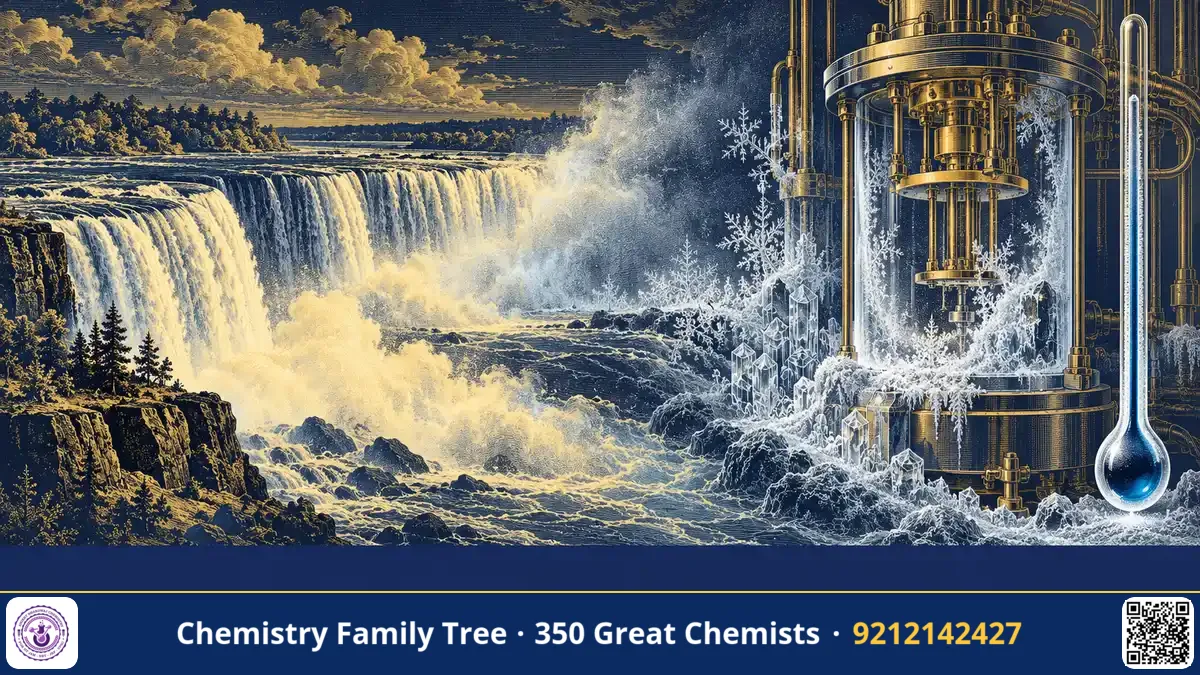
William Francis Giauque (1895-1982) was a Canadian-born American physical chemist who spent his working life at the University of California, Berkeley. He explained how to reach temperatures far below that of liquid helium by adiabatic demagnetisation, and he used low-temperature measurements to verify the third law of thermodynamics. With Herrick Johnston he discovered the oxygen isotopes ¹⁷O and ¹⁸O. He received the Nobel Prize in Chemistry for 1949. His legacy is the measurement of absolute entropy and the technology of ultra-low temperatures.
Early Life & Family
Giauque was born on 12 May 1895 in Niagara Falls, Ontario, Canada. His parents were American citizens, which meant that he was an American citizen by descent, although born in Canada. His father died when he was a small child, and he grew up in Michigan and then California, in modest circumstances, before entering university.
In 1932 he married Muriel Frances Ashley, and the couple had two sons.
Education & Mentors
Giauque entered the University of California, Berkeley, in 1916 with the intention of becoming a chemical engineer. During his studies, he took a course in chemistry and was drawn to research, and his interest turned to physical chemistry. The most important influence on him was Gilbert Newton Lewis, the Dean of the College of Chemistry, who taught chemical thermodynamics and encouraged students to measure thermodynamic quantities with high precision. Giauque obtained his Bachelor's degree in 1920 and his PhD in 1922, working in the thermodynamics tradition of the Lewis school. He was also influenced by the work of Lewis and Merle Randall, whose book Thermodynamics became a standard.
He joined the Berkeley faculty as an instructor soon after the doctorate and remained there. He stayed at Berkeley until his retirement in 1962.
Career Timeline
| Year | Event |
|---|---|
| 1895 | Born in Niagara Falls, Ontario, Canada |
| 1920 | Bachelor's degree in chemistry, University of California, Berkeley |
| 1922 | PhD at Berkeley under Gilbert N. Lewis; joins the faculty |
| 1926 | Proposes cooling by adiabatic demagnetisation (independently of Debye) |
| 1929 | With Herrick Johnston, discovers oxygen-17 and oxygen-18 |
| 1932 | Marries Muriel Ashley |
| 1933 | With D. P. MacDougall, reaches about 0.25 K by adiabatic demagnetisation |
| 1936 | With Stout, measures the residual entropy of ice |
| 1949 | Awarded the Nobel Prize in Chemistry |
| 1962 | Retires from active teaching |
| 1982 | Dies in Berkeley, California |
Major Scientific Contributions
Giauque's life work was in low-temperature thermodynamics. The main contributions, explained in our discovery post, are:
- Adiabatic demagnetisation. Proposed in 1926 and demonstrated in 1933 with gadolinium sulfate, a method that opened the region below 1 K to experiment.
- Verification of the third law. Precise heat capacity measurements from near 0 K to room temperature for many substances, comparing calorimetric entropy with entropy from spectroscopy.
- Residual entropy. The discovery that ice, carbon monoxide and nitrous oxide retain entropy at 0 K, leading to the explanation by Pauling that hydrogen atoms in ice are disordered.
- Oxygen isotopes. The discovery of ¹⁷O and ¹⁸O from the absorption spectrum of atmospheric oxygen.
- Hydrogen and other gases. Studies of the low-temperature properties of hydrogen, including the ortho and para forms, and of other gases and compounds.
Awards, Honours & Nobel Prize
Giauque won the Nobel Prize in Chemistry for 1949 "for his contributions in the field of chemical thermodynamics, particularly concerning the behaviour of substances at extremely low temperatures". It was an award for chemistry, and not for physics, since it concerned thermodynamic properties of substances. He was elected to the United States National Academy of Sciences in 1936 and received honorary degrees and other honours.
Personality, Struggles & Lesser-Known Facts
- Early hardship. His father died when he was young, and his family had limited means.
- From engineering to science. He planned to become a chemical engineer, and the course in chemistry changed his career.
- Years of patience. The path from the 1926 proposal to the 1933 experiment took seven years, since it needed liquid helium, a strong electromagnet and careful experimental development.
- Teacher at Berkeley. He was known as a dedicated teacher of thermodynamics.
- Loyal to one university. He worked at Berkeley for about four decades and was a leading figure in the College of Chemistry, where Lewis, Latimer and others built a strong school of thermodynamics.
Legacy & Influence on Modern Chemistry
Giauque's measurements gave us a reliable table of absolute entropies, which are used in textbooks and industry to calculate free energy changes and equilibrium constants. His demonstration of the residual entropy of ice and the explanation of its origin are now standard examples in statistical thermodynamics. The technique of adiabatic demagnetisation led to modern cryogenic cooling in space instruments and in physics, as well as to the approach to temperatures within a millionth of a degree of absolute zero using nuclear magnetic cooling. His discovery of oxygen isotopes affected atomic weight scales for decades. In India, this legacy appears in the chapters on the third law, entropy, residual entropy and magnetism in JAM, NET and GATE chemistry.
Lessons for Students
- Be precise. Careful, repeatable measurements of heat capacity are the basis of thermodynamic tables.
- Think about the limits. Asking "how cold can we go?" led to a new technique and a new law.
- Stay curious about small differences. A mismatch of 3.4 J K⁻¹ mol⁻¹ in the entropy of ice led to a deep insight about structure.
- Be patient. The work took years of development before it gave results.
Quick Facts Box
- Born: 12 May 1895, Niagara Falls, Ontario, Canada
- Died: 28 March 1982, Berkeley, California, USA
- Nationality: American (born in Canada)
- Field: Physical chemistry, chemical thermodynamics
- Famous for: Adiabatic demagnetisation; test of the third law; oxygen-17 and oxygen-18
- Nobel: Chemistry, 1949
FAQ
Who was Giauque's doctoral supervisor?
Gilbert N. Lewis, the great physical chemist of Berkeley.
What temperature did Giauque reach in 1933?
About 0.25 K, with D. P. MacDougall, using adiabatic demagnetisation of gadolinium sulfate.
What is residual entropy?
It is the entropy that remains at 0 K in a solid that has some frozen disorder, such as ice or carbon monoxide.
Was the Nobel Prize in Physics?
No. It was the Nobel Prize in Chemistry for 1949.
Published by ABC Chemistry — IIT-JAM | CSIR-NET | GATE Chemistry Coaching. Visit abcchemistry.com
About the chemist
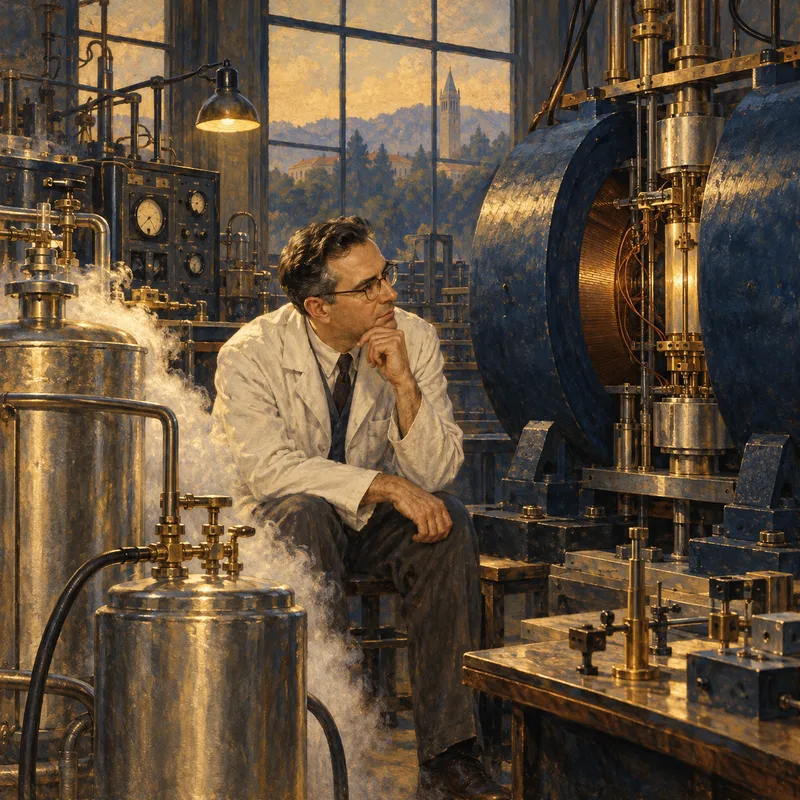
William Giauque
1895-1982 · United States · Nobel Chemistry 1949
Chemical thermodynamics at very low temperatures