Biography · Chemist no. 241 of 350
William Hyde Wollaston: The Physician Who Discovered Two Metals and Made Platinum Useful
William Hyde Wollaston (1766–1828) was an English physician, chemist and physicist, a man who worked quietly on a small scale but with remarkable precision. He discovered palladium and rhodium, invented methods of making malleable platinum, showed that the spectrum of sunlight contains dark lines, and invented the camera lucida. His one-line legacy: a scientist whose tiny, exact experiments yielded large results.
Early Life and Family
He was born on 6 August 1766 in East Dereham, Norfolk, England, one of a large family. His father, Francis Wollaston, was a clergyman and an amateur astronomer who was a Fellow of the Royal Society. Several of his brothers were also scholars; the family was a scientific one. William grew up in an environment where learning, experiment and discussion were normal, and where scientific instruments were present in the house. Details about his boyhood are limited.
Education and Mentors
He studied at Charterhouse School in London and then at Gonville and Caius College, Cambridge, where he studied medicine and became a fellow. He took his medical degree in 1793. At Cambridge he met Smithson Tennant, a chemist who became his closest friend and later his partner in the platinum venture. Wollaston began to practise as a physician, first in Bury St Edmunds, and then in London, but he had trouble building a clientele.
Career Timeline
| Year | Event |
|---|---|
| 1766 | Born in East Dereham, Norfolk. |
| 1793 | Takes his medical degree at Cambridge. |
| 1793–1800 | Practises as a physician in Bury St Edmunds and later in London. |
| 1793 | Elected a Fellow of the Royal Society. |
| 1800 | Leaves medicine after losing a competition for a hospital post, and turns to chemistry and the platinum business. |
| 1801 | Studies ultraviolet radiation by observing the darkening of silver chloride. |
| 1802 | Observes dark lines in the solar spectrum. |
| 1803 | Discovers palladium. |
| 1804 | Discovers rhodium. |
| 1806 | Patents the camera lucida. |
| 1820 | Serves briefly as President of the Royal Society after the death of Sir Joseph Banks. |
| 1828 | Dies in London on 22 December. |
Major Scientific Contributions
- Palladium and rhodium: discovered in 1803–04 from crude platinum; see our discovery blog.
- Malleable platinum: a powder metallurgy method of making platinum into ingots, sheets and wire. The process was kept secret for years and made him wealthy.
- Dark lines in the solar spectrum (1802): he noticed dark lines in the spectrum of sunlight, which Fraunhofer later mapped in detail, and which became the basis of spectroscopy.
- Chemical equivalents: in 1814 he published a scale of chemical equivalents, which was a tool for practical chemistry, and supported Dalton's atomic ideas by pointing out the law of multiple proportions in the oxalates of potassium.
- Camera lucida: an optical drawing aid using a prism; it is used in microscopy and art.
- Medical chemistry: he analysed urinary and gouty calculi, showing that they contain uric acid and other substances such as cystic oxide (cystine), which he named.
- Reflecting goniometer: an instrument for measuring crystal angles precisely, which advanced crystallography.
Awards, Honours and Nobel Prize
There was no Nobel Prize in his time. Wollaston received the Royal Society's Copley Medal in 1802 for his work on chemistry, and later a Royal Medal. He served as a Secretary of the Royal Society and, after Banks died in 1820, as its President for a few months until Humphry Davy was elected. He was also a member of several continental academies. The mineral wollastonite, calcium silicate CaSiO₃, honours him; it is widely used in ceramics and as an additive in plastics and paints.
Personality, Struggles and Lesser-Known Facts
- Preference for small scale. Wollaston used very small amounts of materials and tiny apparatus, a style that resembles today's microchemistry. A famous anecdote says he once showed a visitor his entire laboratory, which was a tray with a few small items; reports vary and the story is likely embellished.
- Secrecy. He kept his platinum technique secret until near the end of his life, only revealing it in a paper in 1829, published after his death.
- Quiet and private. He never married and was considered reserved, sometimes seen as cold. Colleagues respected his accuracy and impartial judgment.
- Anonymous palladium. His sale of palladium as "New Silver" was a puzzling episode that caused debate, until he finally announced his discovery.
- The final illness. He developed a brain tumour, and it is reported that he dictated his last scientific observations. He remained clear-minded about his own condition. This account appears in standard biographies.
Legacy and Influence on Modern Chemistry
Palladium and rhodium are now among the most important catalytic metals in industry. Wollaston's habit of using minimal quantities anticipated the micro-methods of modern analysis. His observation of dark lines in sunlight prepared the ground for the spectroscopy of Fraunhofer, Kirchhoff and Bunsen, who identified elements in the Sun and in flames. His platinum technique created a market for platinum crucibles, which were used by chemists such as Berzelius for accurate work. He also served as a bridge between the older gentleman-scientists and the rising professional chemists.
Lessons for Students
- Small experiments can matter. Careful, minimal-scale work saves materials and reveals detail.
- Keep your notebook thorough. His observations of dark lines needed later interpretation.
- Collaborate. His partnership with Tennant was productive.
- Be open about your results. The secrecy around palladium led to doubt that could have been avoided.
Quick Facts Box
- Born: 6 August 1766, East Dereham, Norfolk
- Died: 22 December 1828, London
- Nationality: British (English)
- Field: Chemistry, physics, medicine
- Famous for: Palladium, rhodium, malleable platinum, camera lucida
- Nobel Prize: None (pre-dates the prize)
FAQ
Who was Wollaston's partner in the platinum business?
Smithson Tennant, who worked with him on refining platinum and who discovered osmium and iridium in the residue.
What is wollastonite?
It is a calcium silicate mineral, CaSiO₃, named after him.
Did he discover the lines in the solar spectrum?
He observed them in 1802, but Fraunhofer studied them systematically and measured them, so they are called Fraunhofer lines.
Why did he leave medicine?
After failing to obtain a position at St George's Hospital, he gave up medicine around 1800 to focus on science and business.
Published by ABC Chemistry — IIT-JAM | CSIR-NET | GATE Chemistry Coaching. Visit abcchemistry.com
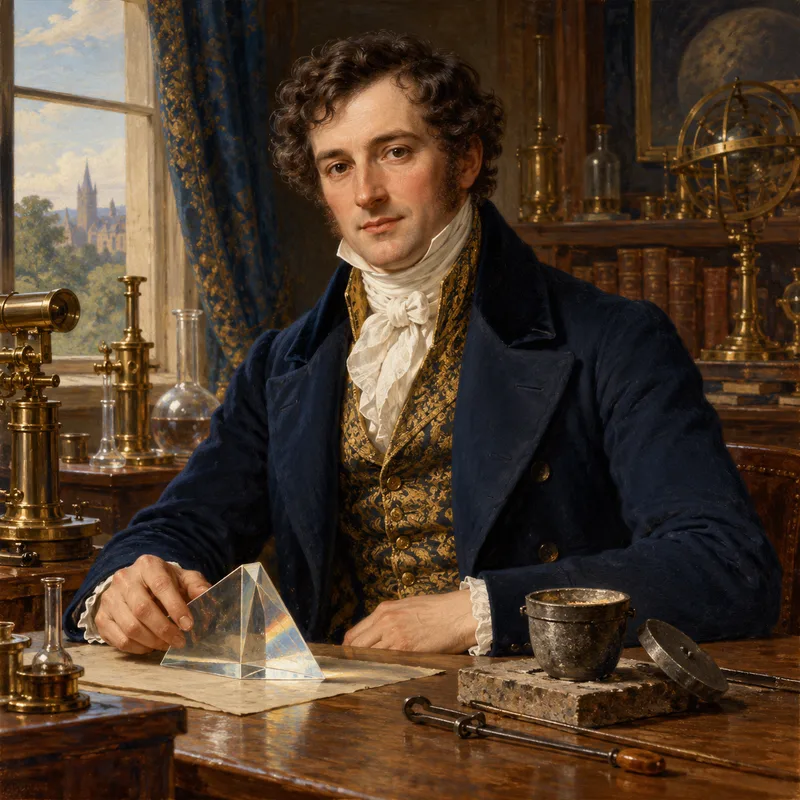
About the chemist
William Hyde Wollaston
1766-1828 · United Kingdom
Discovered palladium and rhodium