The discovery, explained · Chemist no. 241 of 350
William Hyde Wollaston: Two New Metals and the Secret of Malleable Platinum
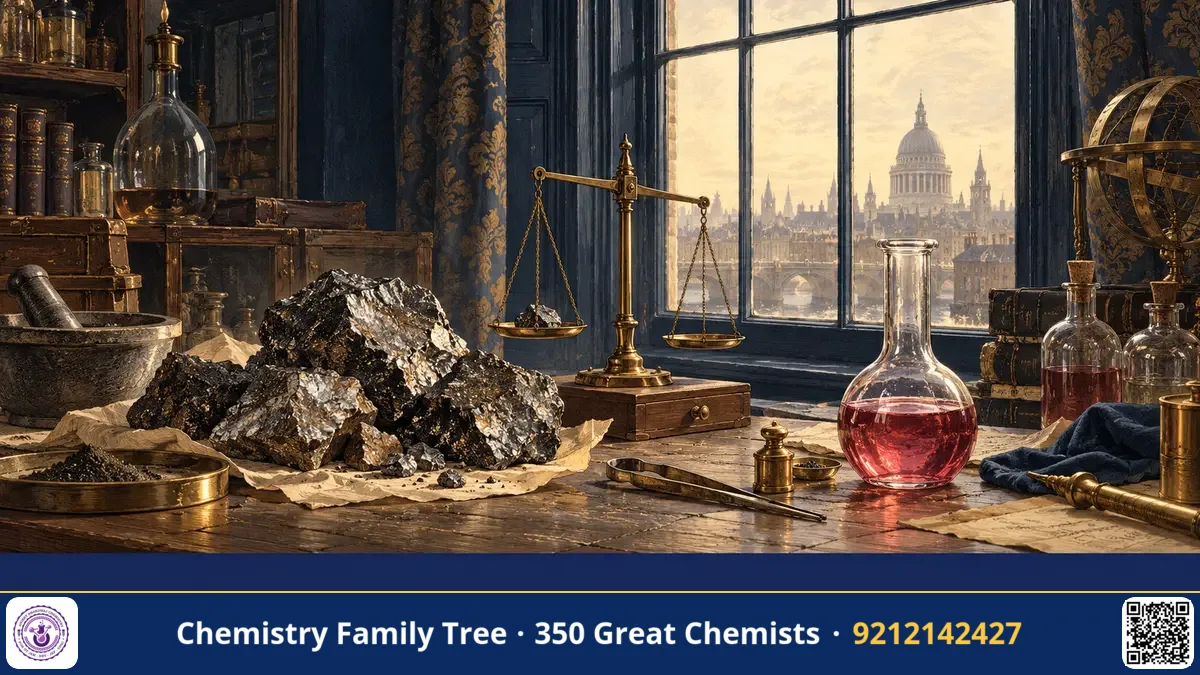
Palladium sits inside your car's catalytic converter and in the Suzuki coupling reaction you study in organic chemistry. Rhodium coats jewellery and also catalyses industrial acetic acid and hydroformylation. Both metals were discovered in London within about a year of each other, in 1803 and 1804, by William Hyde Wollaston, a physician who left medicine for chemistry. He also devised a way of making pure platinum into a workable metal, which made him wealthy. In this post, we follow his experiments and explain the chemistry in the way you need for exams.
The Scientific Problem Before the Discovery
Platinum was brought to Europe from South America in the 18th century. It was valued for its high melting point (about 1768 °C) and resistance to acids. But the crude platinum contained impurities, including gold, iron, copper, lead and a black insoluble residue. No furnace of the time could melt platinum, and in its impure form it was brittle. Chemists in Europe had tried to analyse the black residue left when platinum was dissolved in aqua regia, and Smithson Tennant would soon show that it contains osmium and iridium. The dissolved portion, most believed, was platinum alone. Wollaston suspected that more was hidden in it.
The Discovery: Step by Step
Step 1: Dissolving crude platinum
Wollaston dissolved crude platinum in aqua regia (a mixture of concentrated HCl and HNO₃):
3Pt + 4HNO₃ + 18HCl → 3H₂PtCl₆ + 4NO + 8H₂O
Gold and platinum dissolve, while the black residue (osmium, iridium and others) stays behind.
Step 2: Removing platinum
He added ammonium chloride. Platinum precipitates as yellow ammonium hexachloroplatinate, leaving other metals in solution:
H₂PtCl₆ + 2NH₄Cl → (NH₄)₂PtCl₆↓ + 2HCl
Step 3: Palladium (1803)
From the remaining solution, he removed the excess acid and precipitated the other metals with mercury(II) cyanide. This gave a new metal, which he named palladium after the asteroid Pallas, discovered in 1802. The ammonium chloroplatinate step and the cyanide step are the heart of the process. Wollaston first offered palladium for sale anonymously as "Palladium, or New Silver" in a London shop in 1803, and the unusual manner led to a controversy: Richard Chenevix claimed it was an alloy of platinum and mercury. Wollaston eventually revealed himself as the discoverer and confirmed that it was a new element.
Pd²⁺ + Hg(CN)₂ → Pd(CN)₂↓ + Hg²⁺
Heating palladium cyanide gives the metal: Pd(CN)₂ → Pd + (CN)₂.
Step 4: Rhodium (1804)
From the residual solution after palladium removal, he obtained a dark red precipitate and a beautiful rose-red salt (sodium hexachlororhodate, Na₃RhCl₆). The Greek word for rose is rhodon, so he named the element rhodium. The metal was obtained by heating the salt in a hydrogen atmosphere.
Step 5: Malleable platinum (about 1800–1805)
To make workable platinum, he precipitated purified platinum as ammonium chloroplatinate, heated it to give a spongy platinum, then ground it to a fine powder and pressed it while hot to give a solid compact, which could be forged. This is an early form of powder metallurgy:
(NH₄)₂PtCl₆ → Pt + 2NH₄Cl↑ + 2Cl₂↑ (on heating)
The Chemistry Behind It
- Aqua regia: HNO₃ oxidises, and Cl⁻ forms stable chloro complexes, which together dissolve noble metals. Au + HNO₃ + 4HCl → H[AuCl₄] + NO + 2H₂O.
- Platinum group metals (PGMs): Ru, Rh, Pd, Os, Ir, Pt. They are noble, have high melting points, and are good catalysts. Their typical configuration is d⁸ for Pd(II), Pt(II), and Rh(I).
- Square planar d⁸ complexes: [PtCl₄]²⁻ and [PdCl₄]²⁻ are square planar, due to large crystal field splitting. Cisplatin, cis-[Pt(NH₃)₂Cl₂], is the well-known anti-cancer drug.
- Palladium and hydrogen: Pd absorbs large volumes of H₂, forming palladium hydride PdHₓ. This is used in hydrogenation catalysis and hydrogen purification.
- Catalysis: Wilkinson's catalyst [RhCl(PPh₃)₃] for alkene hydrogenation; Pd(PPh₃)₄ for Heck and Suzuki cross-coupling reactions (Nobel Prize 2010).
Applications Today
Three-way catalytic converters in cars use Pt, Pd and Rh to convert CO, hydrocarbons and NOₓ into CO₂, H₂O and N₂. In India, Bharat Stage emission norms have made these catalysts a necessity. Palladium is used in electronics, dentistry and hydrogen purification membranes; rhodium plating gives jewellery a bright, hard finish; platinum goes into jewellery, laboratory crucibles, thermocouples and anti-cancer drugs. Palladium-catalysed coupling reactions are central to the manufacture of pharmaceuticals and organic electronic materials. The powder metallurgy method used for platinum is the ancestor of modern sintering processes for tungsten, ceramics and metal parts.
Exam Corner
- Palladium was discovered by Wollaston in 1803 and named after the asteroid Pallas; rhodium (1804) was named from the Greek rhodon, rose, because of its rose-red salts.
- Aqua regia (3 HCl : 1 HNO₃ by volume) dissolves gold and platinum: HNO₃ oxidises, Cl⁻ complexes.
- Pt(II) and Pd(II) are d⁸ and form square planar complexes; cisplatin is cis-[Pt(NH₃)₂Cl₂].
- Wilkinson's catalyst is [RhCl(PPh₃)₃]; Pd(0) catalyses C–C coupling in the Heck, Suzuki and Negishi reactions.
- Platinum separation: ammonium hexachloroplatinate (NH₄)₂PtCl₆ is sparingly soluble and is the classic way to separate platinum.
Common Misconceptions
- "Aqua regia dissolves metals because it is a very strong acid." The key is the combination of oxidant and complexing ligand.
- "Palladium was always accepted as a new element." Its anonymous sale triggered a dispute, and tests by other chemists settled the matter.
- "Platinum can be melted easily." Its melting point is high; Wollaston avoided melting by sintering a powder.
Quick Revision Box
- Wollaston: palladium (1803), rhodium (1804) from crude platinum.
- Pd named after the asteroid Pallas; Rh from the Greek for rose.
- Aqua regia dissolves Pt; (NH₄)₂PtCl₆ precipitates.
- Powder metallurgy gave malleable platinum.
- Pt(II)/Pd(II): d⁸, square planar.
- Catalytic converters use Pt, Pd, Rh.
FAQ
Why did Wollaston sell palladium anonymously?
The reasons are debated. One suggestion is that he wished to keep his process secret, and the platinum business protected his commercial interest.
What did Smithson Tennant discover?
Tennant, Wollaston's friend and collaborator, found osmium and iridium in the black residue of crude platinum in 1803.
Is rhodium rare?
Yes. It is among the rarest and most expensive of the precious metals and mostly recovered as a by-product of platinum and nickel mining.
Why is palladium a good catalyst?
It can adsorb hydrogen and alkenes on its surface and readily change between Pd(0) and Pd(II), which is the basis of cross-coupling.
Published by ABC Chemistry — IIT-JAM | CSIR-NET | GATE Chemistry Coaching. Visit abcchemistry.com
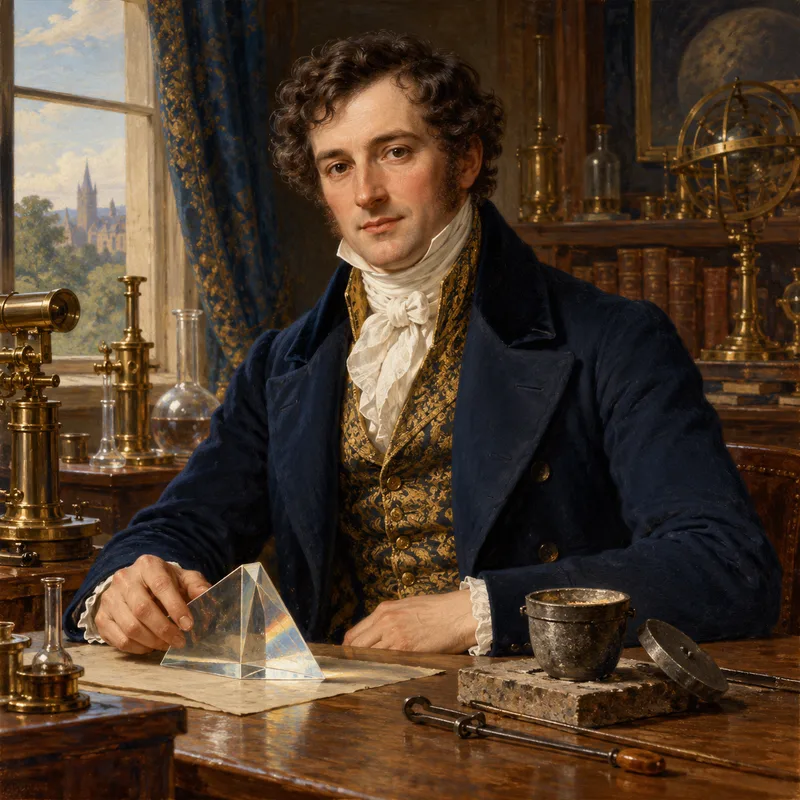
About the chemist
William Hyde Wollaston
1766-1828 · United Kingdom
Discovered palladium and rhodium