The discovery, explained · Chemist no. 175 of 350
William Knowles and Asymmetric Hydrogenation: The Birth of Industrial Chiral Catalysis
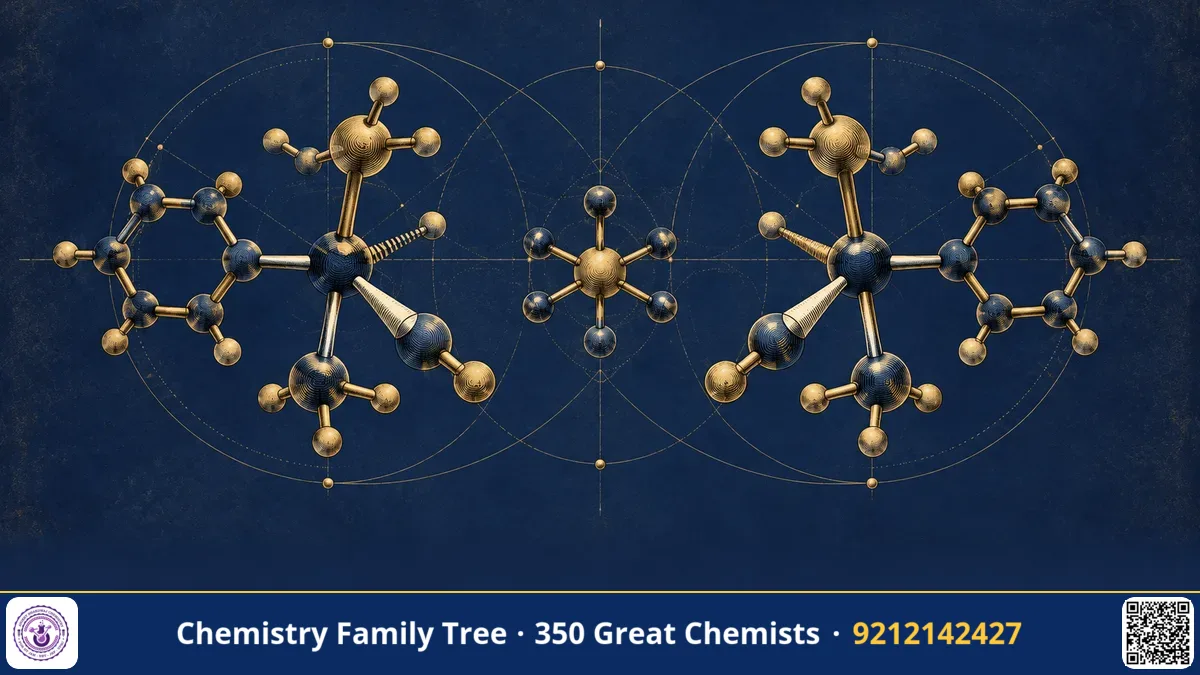
Many molecules in our bodies are chiral, meaning that they exist in two mirror-image forms, like left and right hands. One form can be a life-saving drug while the other is useless or even harmful. In the late 1960s and early 1970s, William S. Knowles, an American chemist at the Monsanto Company in St. Louis, showed that a small amount of a chiral transition-metal catalyst could convert a flat, achiral molecule into predominantly one mirror-image product using hydrogen gas. He used this to produce L-DOPA, a drug for Parkinson's disease, on an industrial scale. For this, Knowles shared the 2001 Nobel Prize in Chemistry with Ryoji Noyori (the other half of the prize went to K. Barry Sharpless for oxidation reactions).
The Scientific Problem Before the Discovery
Chirality matters in biology because enzymes, receptors and DNA are themselves chiral. A tragic example is thalidomide in the 1960s. Drug makers needed ways to prepare single enantiomers. The common methods were:
- Resolution: make a racemic mixture (50:50) and separate the enantiomers, which wastes at least half of the material.
- Chiral pool: start from natural chiral compounds like amino acids or sugars, which limits the structures available.
- Enzymes: useful but limited to certain reactions and conditions.
Chemists dreamed of asymmetric catalysis, where a tiny amount of a chiral catalyst generates a large amount of one enantiomer. Wilkinson's catalyst, RhCl(PPh3)3, discovered in 1965 by Geoffrey Wilkinson, could hydrogenate alkenes homogeneously, which suggested a possible route. If the triphenylphosphine ligands could be replaced with chiral phosphines, perhaps the hydrogenation would be enantioselective.
The Discovery: Step by Step
- Idea (1968). Knowles and his colleagues at Monsanto planned to use a chiral phosphine in the Wilkinson-type catalyst. Around the same time, Leopold Horner in Germany was also testing chiral phosphines.
- First chiral phosphine. Knowles used a P-chiral phosphine, in which the phosphorus atom itself is the stereocentre: methylpropylphenylphosphine. Rhodium complexes of such ligands gave asymmetric hydrogenation of an alkene, but with low enantiomeric excess (about 15% ee) in the first experiment.
- Improving the ligand. Knowles and co-workers (including Sabacky and Vineyard) found that bidentate ligands improved results. They developed the ligand DIPAMP, a chelating diphosphine with chirality at the phosphorus atoms, which was prepared in a few steps.
- The L-DOPA route. The key step was the hydrogenation of a prochiral enamide, a derivative of a substituted dehydroamino acid, with the Rh–DIPAMP catalyst. This gave the protected amino acid in about 95% ee. Hydrolysis then gave L-DOPA.
- Scale-up. Monsanto began producing L-DOPA by this process in about 1974, one of the first industrial uses of asymmetric catalysis.
The Chemistry Behind It
The reaction
Enamide (prochiral alkene) + H₂  --[Rh(DIPAMP)]⁺-->  N-acyl amino acid (S, ~95% ee)
Hydrolysis  →  L-DOPA (3,4-dihydroxyphenylalanine)
The substrate has a C=C double bond with a coordinating amide group. The two faces of the double bond are different (enantiotopic). Which face meets the metal hydride decides the configuration of the new stereocentre.
Enantiomeric excess
ee (%) = |[R] − [S]| / ([R] + [S]) × 100
For example, a product mixture with 97.5% S and 2.5% R has ee = 95%.
Mechanism
- The substrate binds to the Rh centre through both the C=C and the amide C=O, forming a chelate.
- H2 adds oxidatively to rhodium to give a dihydride.
- One hydride transfers to the alkene (migratory insertion), forming an alkyl–rhodium intermediate.
- Reductive elimination gives the product and regenerates the catalyst.
A surprising finding from later mechanistic studies, by Halpern and others, was that the major product does not come from the more abundant catalyst–substrate complex. The minor diastereomeric complex reacts much faster with H2, and this decides the stereochemical outcome. This is called the "anti-lock-and-key" or Curtin–Hammett type behaviour and is a favourite topic of advanced courses.
Why L-DOPA?
L-DOPA (levodopa) is converted in the brain by DOPA decarboxylase to dopamine, which is low in Parkinson's disease. Dopamine itself cannot cross the blood–brain barrier, but L-DOPA can. The D-isomer is not useful, so only the L-form is needed.
Applications Today
- Parkinson's disease: L-DOPA is a standard drug, usually combined with carbidopa, which stops its premature decarboxylation outside the brain.
- Pharmaceutical industry: Asymmetric hydrogenation is used to manufacture many chiral drugs and intermediates. Later systems, including Noyori's BINAP catalysts, extended the idea to many other substrates.
- Agrochemicals and fragrances: Single-isomer products such as the herbicide (S)-metolachlor use asymmetric hydrogenation steps, and menthol production uses related catalysis.
- Green chemistry: A small amount of catalyst makes a large amount of product, and H2 is atom-economical, with no by-products.
- India context: Indian pharmaceutical companies and research laboratories, which make generic drugs including L-DOPA, work with asymmetric catalysis in process chemistry and CSIR laboratories.
Exam Corner
- Knowles used a Rh complex of a chiral phosphine ligand (DIPAMP) for asymmetric hydrogenation of a prochiral enamide, giving L-DOPA with about 95% ee.
- Wilkinson's catalyst is RhCl(PPh3)3; replacing PPh3 by a chiral phosphine gives enantioselectivity.
- Steps in the cycle: oxidative addition of H2, migratory insertion, reductive elimination.
- ee = (major − minor)/(major + minor) × 100.
- 2001 Nobel Prize in Chemistry: half shared by Knowles and Noyori (hydrogenation); other half to Sharpless (oxidation).
Common Misconceptions
- "Asymmetric catalysis creates chirality from nothing." The chirality comes from the chiral ligand, which is used in small amounts and transferred to many product molecules.
- "The most abundant intermediate gives the main product." In Rh-catalysed hydrogenation, the minor intermediate is more reactive.
- "Knowles invented Wilkinson's catalyst." No. Wilkinson made the achiral catalyst; Knowles modified it with chiral ligands.
Quick Revision Box
- Knowles worked at Monsanto, St. Louis; process for L-DOPA started in about 1974.
- Catalyst: Rh with chiral diphosphine DIPAMP, with P-stereogenic centres.
- Substrate: prochiral enamide; product: about 95% ee.
- Mechanism: oxidative addition, insertion, reductive elimination.
- Nobel Prize in Chemistry 2001 (half, with Noyori).
- L-DOPA treats Parkinson's disease.
FAQ
What does asymmetric hydrogenation mean?
It is the addition of hydrogen to a prochiral double bond using a chiral catalyst, so that one enantiomer of the product is formed in excess.
What is DIPAMP?
It is a chiral diphosphine ligand developed by Knowles' group, with stereogenic phosphorus atoms. It binds to rhodium in a chelate.
Why is L-DOPA needed instead of dopamine?
Dopamine cannot pass the blood–brain barrier. L-DOPA can, and it is then converted into dopamine in the brain.
How did Knowles' work lead to Noyori's?
Knowles showed the principle. Noyori later developed BINAP, a more general chiral ligand that works with Rh and Ru for many types of substrates.
Published by ABC Chemistry — IIT-JAM | CSIR-NET | GATE Chemistry Coaching. Visit abcchemistry.com
About the chemist
William S. Knowles
1917-2012 · United States · Nobel Chemistry 2001
Asymmetric hydrogenation, L-DOPA process