Biography · Chemist no. 175 of 350
William S. Knowles: The Industrial Chemist Who Made Chiral Catalysis Practical
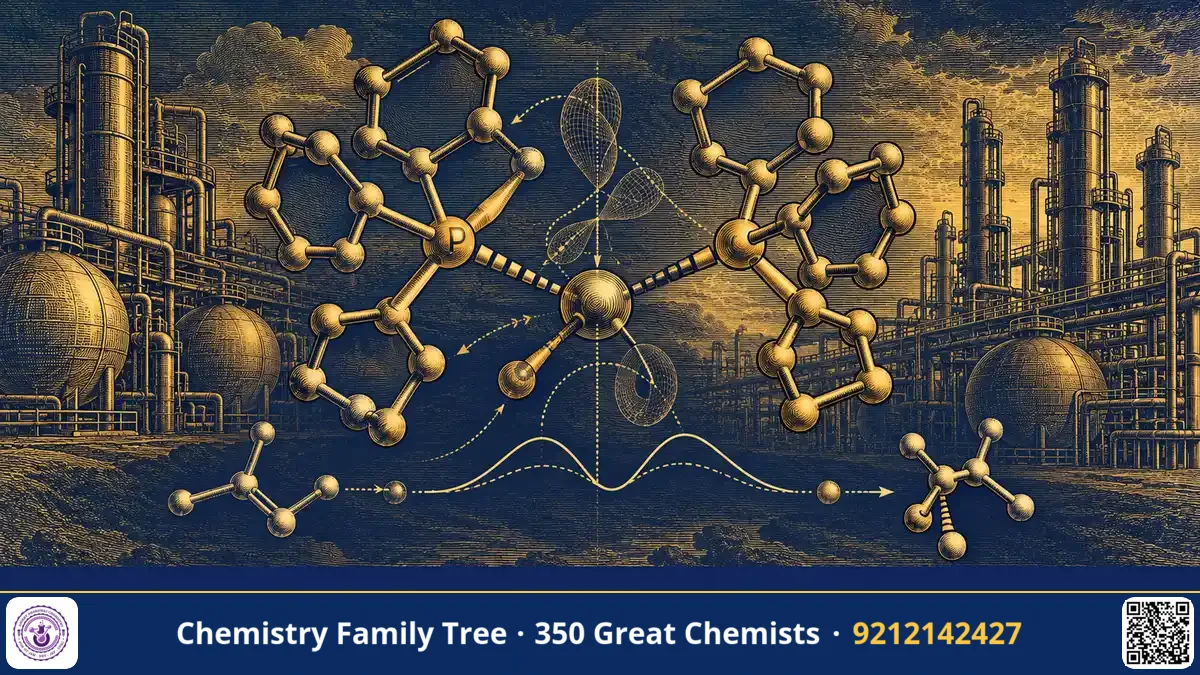
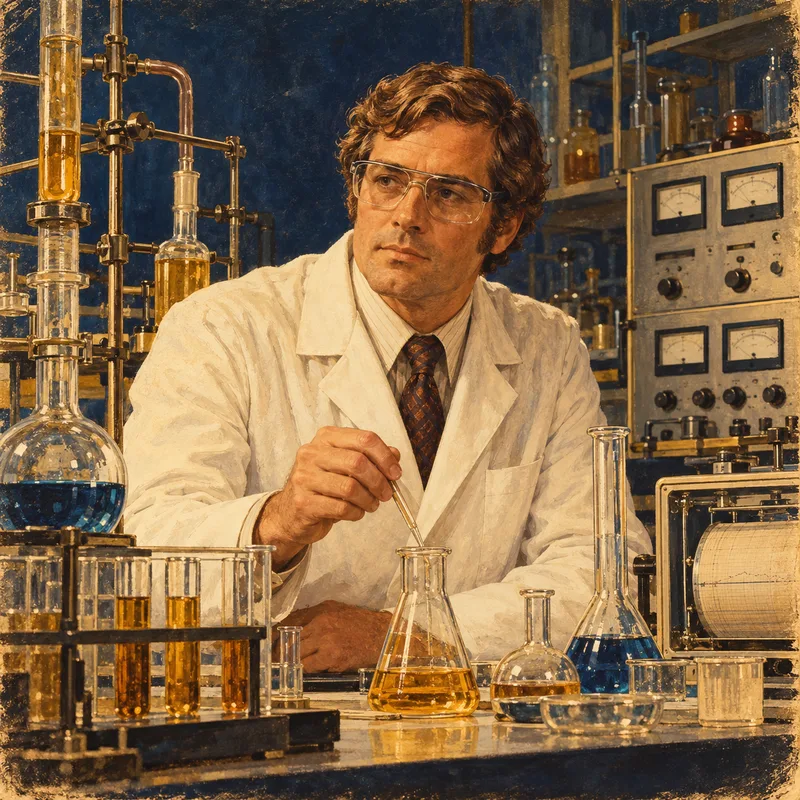
William Standish Knowles (1917–2012) was an American chemist who spent almost his whole career in industry, at the Monsanto Company in St. Louis. He developed one of the first practical asymmetric catalytic reactions, used for the production of L-DOPA, and shared the 2001 Nobel Prize in Chemistry with Ryoji Noyori. His life shows that important basic science can come from an industrial laboratory.
Early Life and Family
William Knowles was born on 1 June 1917 in Taunton, Massachusetts, USA. He grew up during the Great Depression, which affected his teenage years. He showed an early interest in science and went on to Harvard.
Education and Mentors
Knowles studied at Harvard University, where he received a bachelor's degree in chemistry in 1939. He then continued with graduate studies at Columbia University, where he obtained a PhD in organic chemistry in 1942. His doctoral advisor was Professor Thomas Ivan Taylor and he completed his thesis in organic chemistry. This training in organic chemistry formed the base of his later work in catalysis, and he soon moved into industry.
Career Timeline
| Year | Event |
|---|---|
| 1917 | Born in Taunton, Massachusetts, on 1 June |
| 1939 | Bachelor's degree, Harvard University |
| 1942 | PhD in organic chemistry, Columbia University |
| 1942 | Joined the Monsanto Company in Dayton, Ohio, and later St. Louis |
| 1965 | Wilkinson's catalyst reported, which inspired the idea of asymmetric homogeneous hydrogenation |
| 1968 | First asymmetric hydrogenation with a chiral rhodium phosphine catalyst, at Monsanto |
| Early 1970s | Developed the DIPAMP ligand and the L-DOPA process |
| 1986 | Retired from Monsanto |
| 2001 | Nobel Prize in Chemistry, shared with Ryoji Noyori and K. Barry Sharpless |
| 2012 | Died on 13 June in St. Louis, Missouri |
Major Scientific Contributions
- Chiral phosphine ligands. He designed ligands with the stereogenic centre at phosphorus. DIPAMP was the most successful.
- Asymmetric hydrogenation. He showed that a chiral Rh catalyst can hydrogenate a prochiral alkene to give a product with high enantiomeric excess.
- The L-DOPA process. He and his team applied the catalyst for the industrial production of L-DOPA for Parkinson's patients.
- Industry–academia bridge. His results encouraged academic chemists to study homogeneous asymmetric catalysis, including Henri Kagan, who developed DIOP, and Ryoji Noyori.
To understand why this mattered, remember that two enantiomers have identical boiling points, melting points and NMR spectra in an achiral environment, so they cannot be separated by simple distillation or crystallisation. They differ only in how they rotate plane-polarised light and how they interact with other chiral molecules, such as the receptors in the human body. A catalyst that makes one enantiomer directly avoids the 50 percent waste of classical resolution. The enantiomeric excess is calculated as ee = (major − minor)/(major + minor) × 100, and Knowles' catalyst reached about 95 percent for the L-DOPA precursor. Taking a laboratory curiosity to a working plant process also required solving practical problems, such as ligand synthesis, catalyst cost, recovery of the expensive rhodium and the purity of the product. Our discovery post explains the catalytic cycle, enantiomeric excess and the exam points.
Awards, Honours and the Nobel Prize
The 2001 Nobel Prize in Chemistry was divided: one half jointly to William S. Knowles and Ryoji Noyori "for their work on chirally catalysed hydrogenation reactions" and the other half to K. Barry Sharpless "for his work on chirally catalysed oxidation reactions". Knowles was 84 years old when he received the prize, one of the older Nobel laureates in chemistry. He was a member of the US National Academy of Sciences, and he received the Perkin Medal (1982) and other awards in the United States for industrial chemistry.
Personality, Struggles and Lesser-Known Facts
- Nobel for an industrial invention. Few Nobel laureates in chemistry worked entirely in industry. Knowles was proud that a company laboratory could do prize-winning work.
- Humble first result. His first asymmetric hydrogenation gave only about 15% enantiomeric excess, which is a modest result. He continued, improved the ligand, and reached about 95%.
- Parallel competition. Leopold Horner in Germany reported similar work at nearly the same time, and Henri Kagan in France developed DIOP in 1971. The idea was "in the air".
- A long industrial career. He worked for Monsanto for over four decades, from 1942 to 1986, and his Nobel Prize came fifteen years after he retired.
Legacy and Influence on Modern Chemistry
Knowles' catalyst proved that chirality can be created efficiently by a small amount of catalyst. This idea started the large field of asymmetric catalysis, with Noyori's BINAP–Ru catalysts, Sharpless's epoxidation and many other reactions. Today, a large share of new drugs are single enantiomers, and asymmetric hydrogenation is a standard industrial method. Students in India meet this topic in organic and organometallic chemistry papers of CSIR-NET and GATE, where catalysts like Wilkinson's catalyst, chiral phosphines and ee calculations are tested.
Lessons for Students
- Start small and improve. A 15% ee result became 95% after careful redesign.
- Combine ideas. He combined Wilkinson's catalyst with the concept of chiral ligands.
- Industry can do fundamental science. Look beyond university labs.
- It is never too late. Recognition may come decades after the work.
Quick Facts Box
- Born: 1 June 1917, Taunton, Massachusetts, USA
- Died: 13 June 2012, St. Louis, Missouri, USA
- Nationality: American
- Field: Organic and organometallic chemistry, asymmetric catalysis
- Famous for: Rh–DIPAMP asymmetric hydrogenation and the L-DOPA process
- Nobel: Chemistry, 2001 (half, shared with Ryoji Noyori; other half to K. Barry Sharpless)
FAQ
Where did Knowles work?
He worked for Monsanto in Dayton, Ohio and St. Louis, Missouri for about 40 years.
Why is L-DOPA important?
It is a drug used for Parkinson's disease, and the L-isomer is the biologically active form.
Who shared the prize with him?
Ryoji Noyori shared half of the prize, and K. Barry Sharpless received the other half.
Was the Nobel Prize in Chemistry?
Yes, the 2001 Nobel Prize in Chemistry.
Published by ABC Chemistry — IIT-JAM | CSIR-NET | GATE Chemistry Coaching. Visit abcchemistry.com
About the chemist
William S. Knowles
1917-2012 · United States · Nobel Chemistry 2001
Asymmetric hydrogenation, L-DOPA process