Biography · Chemist no. 145 of 350
William Lipscomb: The Chemist Who Understood Boron's Strange Bonds
Introduction
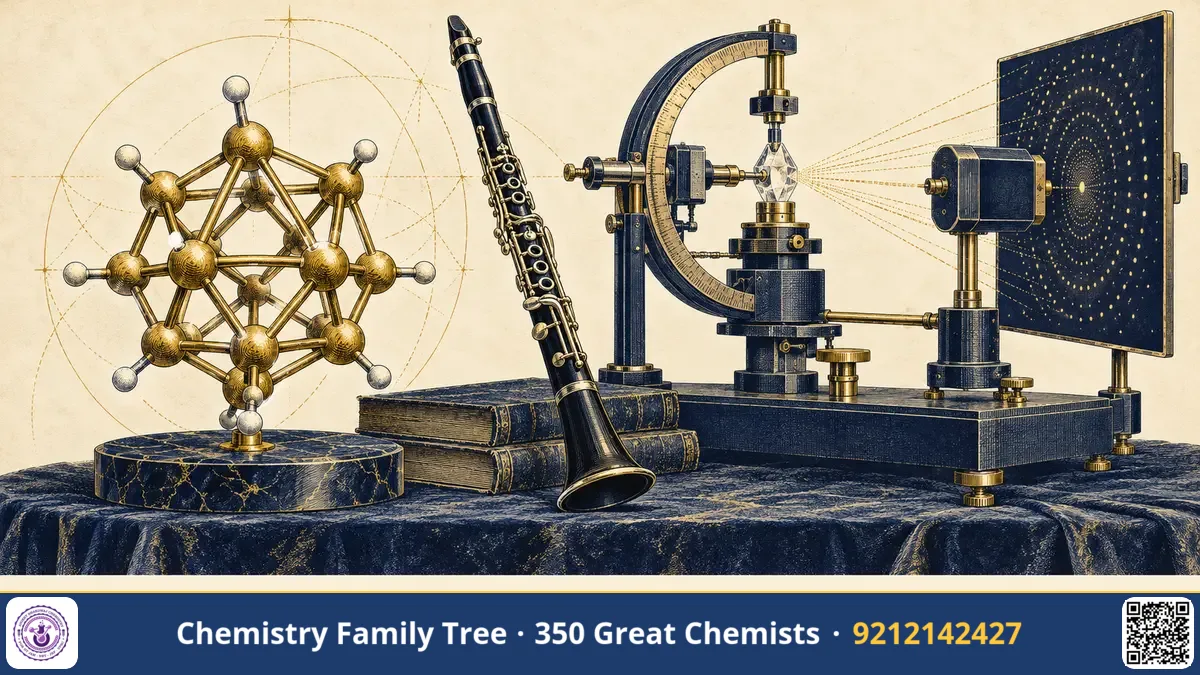
William Nunn Lipscomb Jr. (1919-2011) was an American chemist who explained the structures and bonding of the boron hydrides, a family of molecules that did not fit the ordinary rules of valence. He later turned to large biological molecules and studied enzymes by X-ray crystallography. He received the Nobel Prize in Chemistry in 1976. In one line: Lipscomb showed how electron-deficient molecules hold themselves together.
Early Life and Family
William Lipscomb was born on 9 December 1919 in Cleveland, Ohio. His family moved to Lexington, Kentucky, when he was a young child, and he grew up there. His father was a physician. Music became a lifelong interest for him; he played the clarinet and enjoyed chamber music. As a boy he developed a love of science, and a childhood chemistry set encouraged his curiosity.
Education and Mentors
Lipscomb studied at the University of Kentucky, where he graduated in 1941 with a degree in chemistry. He then went to the California Institute of Technology (Caltech) for graduate study. He earned his PhD in 1946 with Linus Pauling as his advisor, and his work there used electron diffraction to determine the structures of small molecules. In Pauling's group, he learned structural chemistry and the importance of linking structure with bonding theory, and this gave direction to everything he did later.
Career Timeline
| Year | Event |
|---|---|
| 1919 | Born in Cleveland, Ohio on 9 December |
| 1941 | Graduates from the University of Kentucky |
| 1946 | PhD, California Institute of Technology, under Linus Pauling |
| 1946 | Joins the University of Minnesota |
| 1950s | Low-temperature crystallography of boranes; structures of B2H6 to B10H14 |
| 1959 | Moves to Harvard University as professor of chemistry |
| 1960s | Turns to molecular orbital theory of boranes and then to protein crystallography |
| 1976 | Nobel Prize in Chemistry |
| 1990 | Becomes professor emeritus at Harvard |
| 2011 | Dies in Cambridge, Massachusetts on 14 April |
Major Scientific Contributions
His best-known contribution is the structural chemistry of boranes: determination of crystal structures at low temperatures, the explanation of three-centre two-electron bonding, and the styx numbering scheme. He extended the study to carboranes and to polyhedral cages. His group also developed molecular orbital methods and helped in the use of computers to calculate molecular wavefunctions. In the 1960s and 1970s, his laboratory solved the structure of the enzyme carboxypeptidase A, and studied aspartate transcarbamoylase, a regulatory enzyme in the pyrimidine biosynthesis pathway, which showed how an allosteric enzyme changes shape. Further, he worked on theoretical studies of chemical bonding in other systems. For the borane chemistry itself, see the companion discovery post.
The bonding ideas can be summed up simply. In ordinary molecules such as ethane, every bond is a pair of electrons shared between two atoms, and each atom has enough electrons to fill its valence shell. Boron has fewer valence electrons than orbitals, so boron hydrides cannot follow this pattern. Lipscomb showed that the molecule solves the problem by sharing a single pair of electrons over three atoms, as in the B-H-B bridge, or even over a triangle of three boron atoms. This idea explained the shapes of molecules from diborane to the large cage-like clusters, and it also helped to explain why the boron hydrides burn so readily and react with water.
His work had a practical side as well. During the 1950s and 1960s, boranes were studied as possible high-energy fuels, and the research also led to the development of new reagents for organic synthesis. Lipscomb's structural studies gave the fundamental information that other chemists needed.
Awards, Honours and Nobel Prize
- Nobel Prize in Chemistry, 1976, for his studies on the structure of boranes illuminating problems of chemical bonding. It was a sole award.
- Member of the United States National Academy of Sciences and foreign associate of other academies.
- Awarded honorary degrees from many universities.
Personality, Struggles and Lesser-Known Facts
- A clarinettist. Lipscomb played the clarinet and enjoyed chamber music,
- Humour and wit. He was known for his sense of humour, and for being modest about his achievements. He enjoyed the puzzle-solving nature of structural chemistry.
- Student of Pauling. He often credited Pauling's approach of asking simple but deep questions about bonding.
- Training future Nobel laureates. Among his students at Harvard were Roald Hoffmann, who shared the 1981 Nobel Prize in Chemistry, and Thomas Steitz, who shared the 2009 Nobel Prize in Chemistry.
- Willing to follow unusual ideas. He took on strange boron cage structures that other chemists had avoided.
Legacy and Influence on Modern Chemistry
The idea of multicentre bonding, born from boranes, is now part of the basic language of chemistry, from organometallic agostic interactions to cluster compounds. Boron cluster chemistry has grown into a major area, including metallaboranes and carboranes. Lipscomb's students spread his methods through universities worldwide. His structural work on enzymes helped to set standards for protein crystallography. In Indian syllabi, diborane and 3c-2e bonds are part of inorganic chemistry courses at every level from Class 12 onwards.
Lessons for Students
- Study the exceptions to the rule; boron hydrides led to an entirely new concept of bonding.
- Develop technology when needed, such as low-temperature crystal growth.
- Keep your interests broad - music, language and science feed each other.
- Be willing to change fields; he moved from small molecules to proteins.
- Be generous in training students; the best legacy is the next generation.
Quick Facts Box
- Born: 9 December 1919, Cleveland, Ohio, USA
- Died: 14 April 2011, Cambridge, Massachusetts, USA
- Nationality: American
- Field: Inorganic and structural chemistry, chemical bonding
- Famous for: Structure and bonding of boranes; 3c-2e bonds; styx numbers
- Nobel: Chemistry, 1976
FAQ
Who was Lipscomb's doctoral advisor?
Linus Pauling at the California Institute of Technology.
What did Lipscomb do apart from boranes?
He used X-ray crystallography to study enzymes such as carboxypeptidase A and aspartate transcarbamoylase.
Was the Nobel Prize in Physics or Chemistry?
It was in Chemistry, in 1976, awarded to him alone.
Which famous chemists did he teach?
Roald Hoffmann and Thomas Steitz both completed their doctoral studies in his group at Harvard.
Published by ABC Chemistry — IIT-JAM | CSIR-NET | GATE Chemistry Coaching. Visit abcchemistry.com
About the chemist
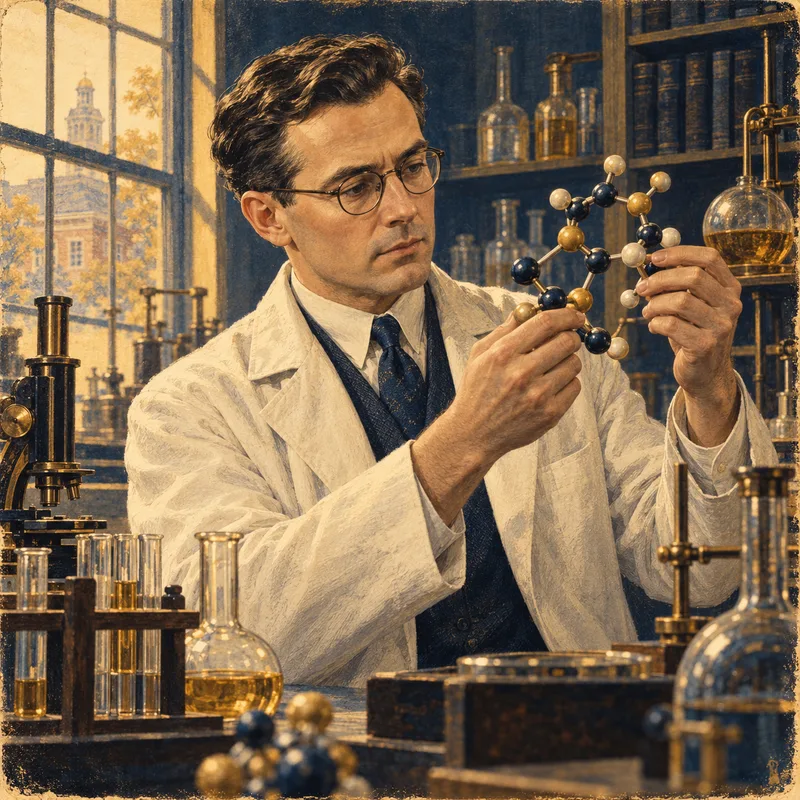
William Lipscomb
1919-2011 · United States · Nobel Chemistry 1976
Structure and bonding of boranes