The discovery, explained · Chemist no. 145 of 350
William Lipscomb: Solving the Puzzle of Electron-Deficient Boranes
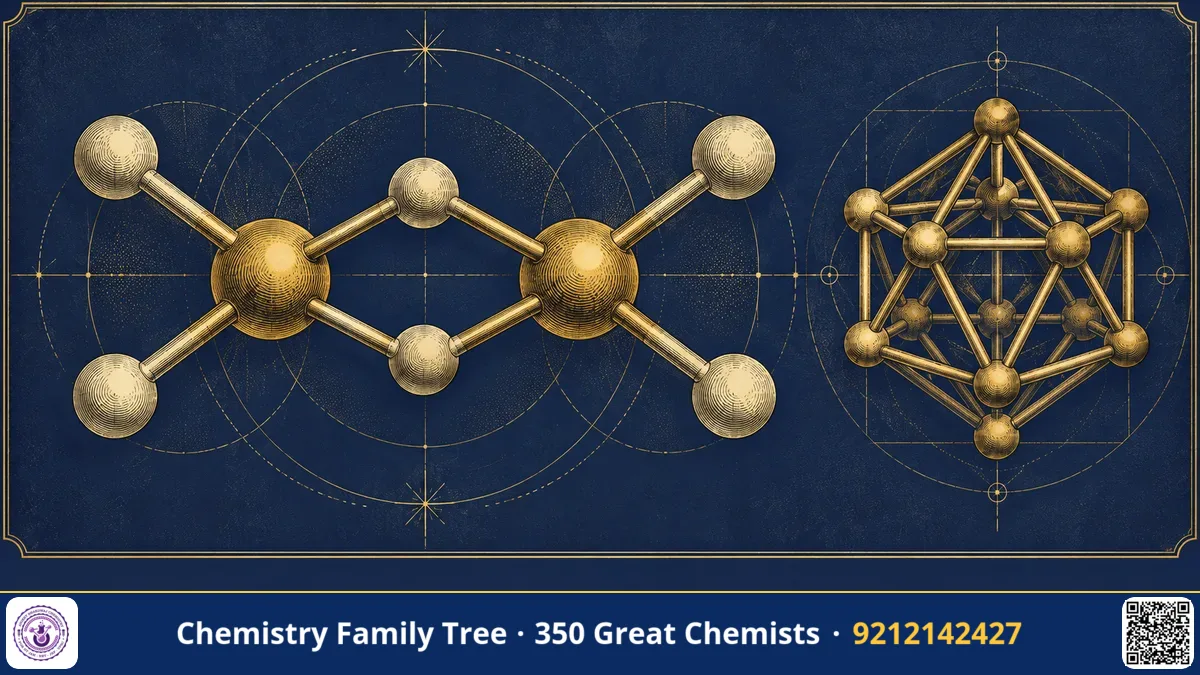
Boron is next to carbon in the periodic table, yet its hydrides behave very differently from hydrocarbons. Methane is CH4, but the simplest stable boron hydride is B2H6, diborane, with a structure that seems to break the ordinary rules of valence. William N. Lipscomb Jr. (1919-2011) spent much of his career working out how these molecules are held together. Using X-ray and low-temperature crystallography and molecular orbital theory, he explained their structures in terms of three-centre two-electron bonds and developed a simple topological scheme, the styx method, to describe them. In 1976 he received the Nobel Prize in Chemistry for his studies on the structure of boranes illuminating problems of chemical bonding.
The Scientific Problem Before the Discovery
Alfred Stock prepared the boron hydrides in Germany in the early twentieth century, using vacuum techniques to handle these air-sensitive, toxic and often spontaneously flammable compounds. He found formulas such as B2H6, B4H10, B5H9, B5H11 and B10H14. These formulas did not fit the usual valence rules. Boron has three valence electrons and four valence orbitals (one 2s and three 2p). In B2H6 there are only 12 valence electrons (2 × 3 + 6 × 1), but a structure like ethane, with seven two-centre two-electron bonds, would need 14.
Chemists suggested an ethane-like structure for diborane, but infrared and electron diffraction studies in the 1940s showed a bridged structure with two hydrogen atoms in the middle. In 1943 H. C. Longuet-Higgins, as a student, and R. P. Bell had explained the bridge in terms of molecular orbitals. The remaining challenge was to understand the larger boranes with their unusual polyhedral structures, which had not been seen before.
The Discovery and Experiments
- Low-temperature X-ray crystallography. Boranes are gases or volatile liquids at room temperature. At the University of Minnesota, Lipscomb and his students developed methods of growing crystals at very low temperatures, directly on the diffractometer, and collecting X-ray data from them.
- Determination of structures. His group determined the structures of B2H6, B4H10, B5H9, B5H11, B6H10, B10H14 and others. These showed open, nest-like and cage-like frameworks of boron atoms, with terminal and bridging hydrogens.
- Bonding theory. He applied molecular orbital methods, including early computer calculations, to explain the bonding in terms of localised multicentre bonds.
- The styx rules. He devised a four-number code that counts the types of bonds present, allowing the structures and bonding of boranes to be rationalised and predicted.
- Carboranes. He and others studied carboranes, in which carbon atoms replace boron atoms in cage structures, such as the icosahedral C2B10H12.
The Chemistry Behind It
Diborane: the three-centre two-electron (3c-2e) bond
In B2H6 there are four terminal B-H bonds, which are normal two-centre two-electron (2c-2e) bonds, and two bridging B-H-B bonds. The four terminal bonds use 8 electrons. The remaining 4 electrons occupy two B-H-B bonds, each of which is a 3c-2e bond: three atomic orbitals (one from each boron and the 1s of the bridging hydrogen) combine to give three molecular orbitals - one bonding, one non-bonding and one antibonding. The two electrons occupy the bonding orbital only.
Valence electrons in B2H6 = 2(3) + 6(1) = 12
4 terminal B-H (2c-2e) = 8 e-
2 bridging B-H-B (3c-2e) = 4 e-
These are called "banana bonds" because of their curved shape. The bridge is electron deficient: there are not enough electrons for ordinary two-centre bonds on each link, so the molecule is described as electron-deficient. The bridging B-H distance (about 1.33 angstrom) is longer than the terminal B-H distance (about 1.19 angstrom), which agrees with a weaker, delocalised bond.
Types of bonds in boranes
- 2c-2e B-H terminal bonds.
- 3c-2e B-H-B bridge bonds.
- 3c-2e B-B-B bonds (closed, in the centre of a triangle of boron atoms).
- 2c-2e B-B bonds.
The styx number
The four digits give: s = number of B-H-B bridge bonds, t = number of three-centre B-B-B bonds, y = number of two-centre B-B bonds, x = number of BH2 groups (extra terminal hydrogens). Examples:
| Borane | styx |
|---|---|
| B2H6 | 2002 |
| B4H10 | 4012 |
| B5H9 | 4120 |
Check for B5H9: one terminal H on each boron (5), plus four bridging H (total 9), so s = 4 and x = 0, consistent with 4120.
Polyhedral boranes and Wade's rules
Closo, nido and arachno boranes are named for the closed, nest-like and web-like shapes. The closo anion B12H122- is an icosahedron. Later, Kenneth Wade's electron-counting rules, based on skeletal electron pairs, extended the picture to many clusters. For a closo cluster with n boron atoms, there are n + 1 skeletal electron pairs; nido has n + 2, and arachno has n + 3.
Applications Today
- Hydroboration. Diborane and borane complexes such as BH3·THF add to alkenes in an anti-Markovnikov, syn manner, then oxidation with H2O2/NaOH gives alcohols. H. C. Brown received a Nobel Prize for this chemistry.
- Reducing agents. NaBH4 and LiAlH4, which are closely related to borane chemistry, are used daily in organic synthesis and in the pharmaceutical industry in India.
- Boron neutron capture therapy. Boron-rich carborane compounds are studied as agents for cancer treatment.
- Materials. Boron nitride, borosilicate glass and boron fibres are in use in industry.
- Cluster chemistry. The same ideas help to explain metal clusters and fullerene-type cages.
Exam Corner
- Diborane has 12 valence electrons: 4 terminal 2c-2e bonds and 2 bridging 3c-2e B-H-B bonds.
- Bridging B-H bonds are longer than terminal ones; the molecule has D2h symmetry.
- Reaction: 2NaBH4 + I2 → B2H6 + 2NaI + H2; also B2H6 + 6H2O → 2H3BO3 + 6H2.
- Diborane with NH3 gives unsymmetrical cleavage [BH2(NH3)2]+[BH4]-, while with trimethylamine, it gives symmetrical cleavage BH3·N(CH3)3.
- Closo-BnHn2- has n + 1 skeletal electron pairs; Lipscomb's Nobel Prize in Chemistry was in 1976.
Common Misconceptions
- "Diborane is like ethane." It is not; it has bridging hydrogens and no direct B-B single bond in the usual sense.
- "A 3c-2e bond has three electrons." It has two electrons shared over three atoms.
- "Lipscomb discovered boranes." Alfred Stock prepared them; Lipscomb explained their structure and bonding.
Quick Revision Box
- Nobel Prize in Chemistry, 1976: structure and bonding of boranes.
- B2H6: 12 valence electrons, 4 terminal 2c-2e and 2 bridging 3c-2e bonds.
- styx: s = B-H-B, t = B-B-B, y = B-B, x = BH2 groups.
- B2H6 = 2002; B4H10 = 4012; B5H9 = 4120.
- Closo, nido, arachno = n+1, n+2, n+3 skeletal electron pairs.
- Low-temperature X-ray crystallography made the structures possible.
FAQ
Why is diborane called electron deficient?
It has fewer valence electrons than needed to form a normal two-centre two-electron bond between every pair of bonded atoms, so some bonds have to be multicentre.
What is a banana bond?
It is a descriptive name for the bent three-centre two-electron B-H-B bond in diborane.
Did Lipscomb win the Nobel Prize in Physics?
No. He was awarded the 1976 Nobel Prize in Chemistry, alone.
Is this relevant for GATE and CSIR-NET?
Yes. Boron hydrides, 3c-2e bonds, styx numbers and Wade's rules are standard inorganic chemistry topics.
Published by ABC Chemistry — IIT-JAM | CSIR-NET | GATE Chemistry Coaching. Visit abcchemistry.com
About the chemist
William Lipscomb
1919-2011 · United States · Nobel Chemistry 1976
Structure and bonding of boranes