Biography · Chemist no. 49 of 350
Sir William Ramsay: The Chemist Who Added a New Column to the Periodic Table
Introduction
Sir William Ramsay (1852-1916) was a Scottish chemist who discovered, or co-discovered, five of the six noble gases and found the place of this family in the periodic table. He won the 1904 Nobel Prize in Chemistry, the first British chemist to win it. He was also a professor, a linguist, a well-known lecturer and a supporter of science education in India. Legacy in one line: he showed that the air we breathe contains a hidden family of elements.
Early Life & Family
William Ramsay was born on 2 October 1852 in Glasgow, Scotland. His father, William Ramsay, was a civil engineer, and his mother, Catherine Robertson, came from a family of doctors and scholars. His uncle, Sir Andrew Ramsay, was a noted geologist, and the family had a tradition of science and learning. William was an only child, who grew up in a house full of books. He was educated at Glasgow Academy, and, as a boy, he enjoyed music and languages as much as science. He is said to have been fluent in several languages as an adult.
Education & Mentors
Ramsay entered the University of Glasgow in 1866, at the early age of 14, which was common at the time. He studied under the physicist William Thomson (Lord Kelvin), and worked as an assistant in the laboratory of Thomas Anderson, professor of chemistry. He then went to Germany and joined the University of Tübingen, where he studied organic chemistry with Rudolf Fittig. He received his PhD there in 1872 with a thesis on toluic and nitrotoluic acids. The German training in rigorous laboratory methods strongly influenced his career.
Career Timeline
| Year | Event |
|---|---|
| 1852 | Born in Glasgow |
| 1872 | PhD at Tübingen under Fittig |
| 1880 | Professor of chemistry at University College, Bristol |
| 1881 | Becomes principal of University College, Bristol |
| 1887 | Professor of chemistry at University College London (UCL) |
| 1894 | Discovers argon with Lord Rayleigh |
| 1895 | Isolates helium on Earth from cleveite |
| 1898 | Discovers neon, krypton and xenon with Morris Travers |
| 1900 | Visits India at the request of J. N. Tata about the proposed research institute |
| 1902 | Knighted (KCB) |
| 1903 | With Frederick Soddy shows that helium is produced from radium emanation |
| 1904 | Nobel Prize in Chemistry |
| 1910 | Characterises radon (niton) with Whytlaw-Gray |
| 1913 | Retires from UCL |
| 1916 | Dies at High Wycombe on 23 July |
Major Scientific Contributions
- Argon and the noble gases: discovery of argon, helium on Earth, neon, krypton and xenon, and the characterisation of radon. The companion article on Ramsay and the noble gases gives the chemistry.
- Periodic table: he argued for a new group of elements between the halogens and alkali metals, which made the table complete.
- Radioactivity and transmutation: in 1903, working with Soddy, he showed that helium appears from the decay of radium emanation, giving the first experimental proof that one element can change into another.
- Physical chemistry: early in his career he studied the surface tension of liquids with John Shields and developed the Ramsay-Shields equation to estimate molecular association in liquids.
- Teaching and institutions: he led University College, Bristol, and built a school of chemistry at UCL.
Awards, Honours & Nobel Prize
Ramsay received the Nobel Prize in Chemistry in 1904 "in recognition of his services in the discovery of the inert gaseous elements in air, and his determination of their place in the periodic system." Lord Rayleigh won the Nobel Prize in Physics the same year for his investigations of the densities of gases and the discovery of argon, so both partners were honoured. Ramsay was elected a Fellow of the Royal Society in 1888, received the Davy Medal in 1895, was knighted in 1902 and held honorary degrees from many universities.
Personality, Struggles & Lesser-Known Facts
- A gifted linguist. Ramsay spoke several languages including German, French, Russian and others, and could lecture in them.
- Link to Indian science. In 1900, J. N. Tata invited him to advise on a proposed research institute in India. Ramsay recommended Bangalore as the site, and this led to the Indian Institute of Science, founded in 1909. Today IISc is one of India's leading research institutions.
- A showman of the laboratory. He was known as a lively lecturer and a vivid, sometimes bold, personality who did not hesitate to argue forcefully with colleagues.
- The cost of danger. In his final years he developed cancer of the nose, and he died at the age of 63.
- Quick to see opportunity. When Rayleigh's density puzzle appeared, Ramsay moved immediately to test and extend it, and within a few years discovered a whole new family.
- Radium experiments. In 1903 he and Frederick Soddy collected the gas from radium and, by its spectrum, saw helium appear, an experiment that supported the idea of radioactive transmutation.
Legacy & Influence on Modern Chemistry
The noble gases led to the electronic theory of valence. In 1916, Gilbert Lewis and Walther Kossel explained bonding in terms of attaining the noble gas configuration, the octet rule. Argon, helium and xenon are now widely used in industry and medicine. Ramsay's work on radioactivity helped open nuclear chemistry. The Ramsay Memorial Fellowships, funded after his death, supported young chemists and are a lasting tribute. His recommendation for Bangalore shaped a major institution of science in India.
Lessons for Students
- Take small anomalies seriously. A 0.5 per cent density difference led to a new family of elements.
- Collaborate across disciplines. The argon story combined a physicist and a chemist.
- Learn languages and read widely. Ramsay found helium partly by reading a report on cleveite.
- Support institutions. His advice helped found IISc in Bangalore.
Quick Facts Box
- Born: 2 October 1852, Glasgow, Scotland
- Died: 23 July 1916, High Wycombe, England
- Nationality: British (Scottish)
- Field: Inorganic and physical chemistry
- Famous for: Discovery of the noble gases (argon, neon, krypton, xenon; helium on Earth)
- Nobel: Chemistry, 1904
FAQ
Did Ramsay discover all the noble gases?
He discovered or co-discovered argon, neon, krypton and xenon, found helium on Earth and characterised radon. Oganesson (Og) was made much later.
What is the link between Ramsay and India?
He advised the Tata family on a research institute and recommended Bangalore, where the Indian Institute of Science was established.
Who shared the credit for argon?
Lord Rayleigh, who received the Nobel Prize in Physics in 1904.
Who were Ramsay's assistants?
Morris Travers worked with him on neon, krypton and xenon, and Robert Whytlaw-Gray on radon.
Published by ABC Chemistry — IIT-JAM | CSIR-NET | GATE Chemistry Coaching. Visit abcchemistry.com
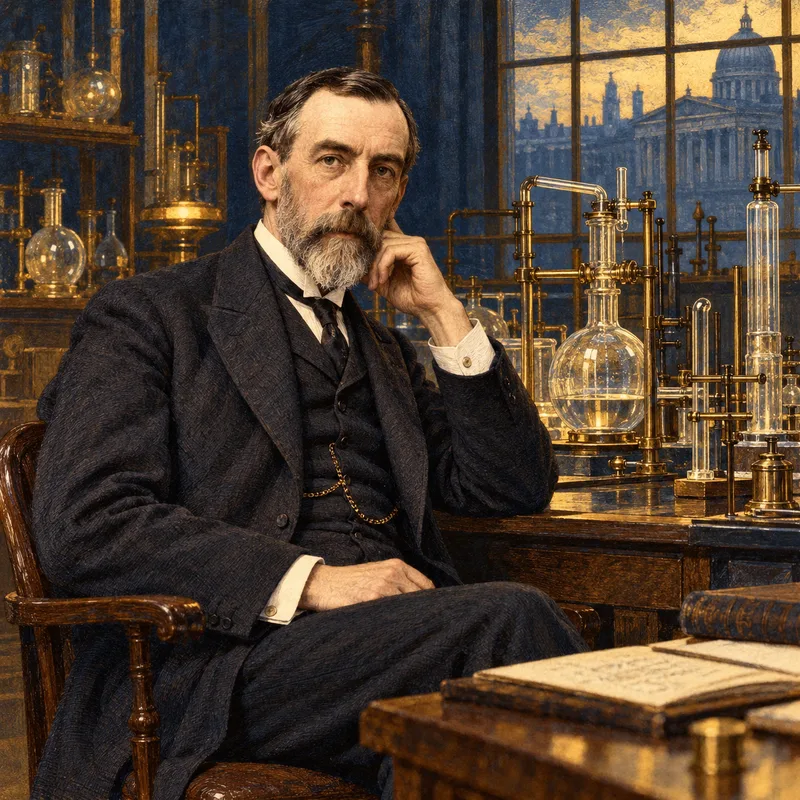
About the chemist
William Ramsay
1852-1916 · United Kingdom · Nobel Chemistry 1904
Discovery of noble gases