The discovery, explained · Chemist no. 49 of 350
William Ramsay and the Discovery of the Noble Gases
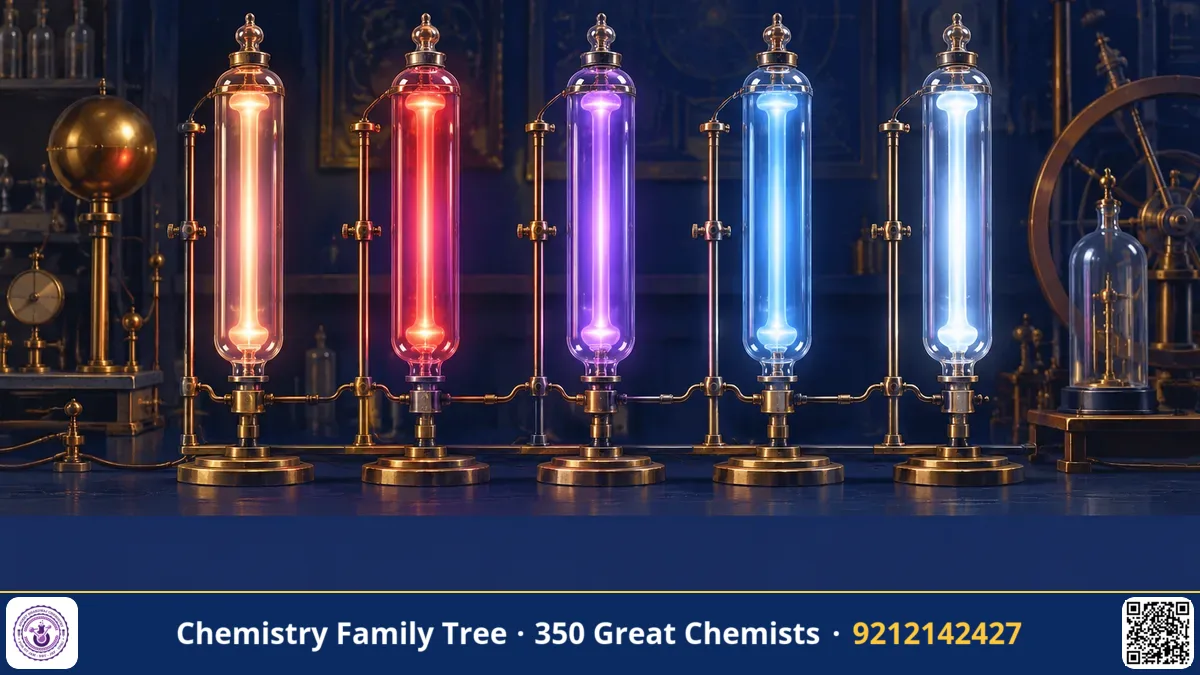
In 1893, the English physicist Lord Rayleigh noticed something strange. Nitrogen made from air was slightly heavier than nitrogen made from ammonia. The difference was tiny, only about 0.5 per cent, but it was real. The Scottish chemist William Ramsay took up the puzzle and found that air contains a whole new family of unreactive gases. Between 1894 and 1898 he discovered argon, helium on Earth, neon, krypton and xenon, and in 1910 he characterised radon. These elements filled a completely new column in the periodic table, now called Group 18. Ramsay won the Nobel Prize in Chemistry in 1904 for this work. This article explains the discovery and the chemistry for Class 11-12, B.Sc., IIT-JAM, CSIR-NET and GATE.
The Scientific Problem Before the Discovery
In the 1890s the periodic table of Mendeleev was well accepted, with about 70 elements. Everyone believed that the air was a mixture of nitrogen, oxygen, carbon dioxide and water vapour, plus traces of other things.
- The Cavendish experiment (1785) had hinted that a small bubble of gas in air resisted all attempts to react with oxygen. Nobody followed up.
- Rayleigh measured the density of nitrogen from two sources: "atmospheric nitrogen" (air after removing oxygen, CO₂ and moisture) gave 1.2572 g/L, while "chemical nitrogen" from ammonia or nitrogen compounds gave 1.2505 g/L. The difference was beyond experimental error.
- In 1868 the astronomers Pierre Janssen and Norman Lockyer had seen a bright yellow line in the Sun's spectrum, not matching any known element. Lockyer named it helium after Helios, the Sun god. Nobody had found it on Earth.
The Discovery: Step by Step
Step 1: Argon (1894)
Rayleigh and Ramsay worked together. Ramsay repeated the old Cavendish idea. He passed air, freed from oxygen, carbon dioxide and water, over red-hot magnesium turnings, which combine with nitrogen:
3Mg + N₂ → Mg₃N₂ (hot magnesium removes nitrogen)
A small amount of gas, about 1 per cent of the original air, was left. It did not react with anything. Its density was about 20 times that of hydrogen, and when excited in a discharge tube it gave a spectrum with bright lines unlike any known element. They called it argon, from the Greek argos, meaning lazy or inactive. It was announced in August 1894 at a meeting of the British Association in Oxford.
Step 2: Helium on Earth (1895)
Ramsay read that the uranium mineral cleveite gave off a gas when treated with acid. He collected it and observed its spectrum, which showed the same bright yellow line (587.6 nm) seen in the Sun. It was helium. In the same year, the Swedish chemists Per Teodor Cleve and Nils Langlet also obtained it independently. Helium was later understood to come from alpha decay of uranium and thorium.
Step 3: Neon, krypton and xenon (1898)
With his assistant Morris Travers, Ramsay liquefied air and distilled it slowly (fractional distillation), collecting the fractions that boiled at different temperatures. Three new gases appeared:
| Gas | Name meaning | Boiling point (K) | Discharge colour |
|---|---|---|---|
| Neon | Greek neos, new | 27 | Red-orange |
| Krypton | Greek kryptos, hidden | 120 | Pale violet/white |
| Xenon | Greek xenos, stranger | 165 | Blue-violet |
Step 4: Radon (1900-1910)
Friedrich Dorn discovered a radioactive gas from radium in 1900. Ramsay and Robert Whytlaw-Gray isolated it and measured its density in 1910, showing it to be the heaviest noble gas, which was named niton and later radon.
The Chemistry Behind It
Why are they inert?
Noble gases have completely filled valence shells: He 1s², and ns²np⁶ for the others. They have very high ionisation energies, zero electron affinity and no tendency to gain, lose or share electrons. They exist as monatomic gases held only by weak van der Waals (London dispersion) forces, which grow with atomic size, so boiling point increases down the group.
Trends in Group 18
| Property | Trend down the group |
|---|---|
| Atomic radius | Increases |
| Ionisation energy | Decreases (He 2372 kJ/mol to Xe 1170 kJ/mol) |
| Boiling and melting point | Increase |
| Polarisability | Increases |
| Reactivity | Increases; only Kr, Xe and Rn form compounds |
Placing them in the periodic table
Argon (atomic mass 39.95) is heavier than potassium (39.10), so an arrangement by atomic mass would put it after potassium. Ramsay and Mendeleev's logic of chemical properties placed it before potassium, as a new "Group 0" element. This anomaly was later explained by Moseley's atomic number: Ar is 18, K is 19. Mendeleev had at first doubted that argon was a new element.
The end of "inertness" (1962)
In 1962 Neil Bartlett showed that xenon reacts with platinum hexafluoride, forming Xe[PtF₆] (later shown to be a more complex mixture). Soon after, XeF₂, XeF₄, XeF₆ and XeO₃ were made:
Xe + F₂ → XeF₂      (heat or light)
Xe + 2F₂ → XeF₄     (400 °C, 1 atm)
Xe + 3F₂ → XeF₆     (250 °C, about 50-60 atm)
XeF₆ + 3H₂O → XeO₃ + 6HF
XeF₂ is linear, XeF₄ square planar and XeF₆ distorted octahedral, a favourite VSEPR question.
Applications Today
- Helium: cooling the superconducting magnets in MRI scanners, balloons, deep-sea diving mixtures, and cryogenics at 4.2 K.
- Neon: advertising signs and indicator lamps.
- Argon: inert atmosphere in arc welding and for filling electric bulbs, which stops the tungsten filament from oxidising.
- Krypton and xenon: high-intensity lamps, car headlamps and camera flash tubes; xenon is also used as an anaesthetic and in ion thrusters for spacecraft.
- Radon: a radioactive health hazard in poorly ventilated buildings; used in earthquake-prediction research in some countries.
- India: Indian industrial gas companies separate argon and neon in air separation units, and helium is imported or recovered in small amounts from natural gas.
Exam Corner
- Argon was discovered in 1894 by Rayleigh and Ramsay; abundance in dry air is about 0.93% by volume, the third most abundant gas.
- Helium has the lowest boiling point of any substance (4.2 K) and does not solidify at 1 atm, even at absolute zero.
- Ionisation energy decreases and boiling point increases down Group 18.
- XeF₂ linear (sp³d), XeF₄ square planar (sp³d²), XeF₆ distorted octahedral, XeO₃ pyramidal.
- Ramsay's method: fractional distillation of liquid air for Ne, Kr, Xe; Nobel Prize in Chemistry 1904.
Common Misconceptions
- "Noble gases never form compounds." Xenon and krypton do; the 1962 xenon-fluorine compounds are standard exam content.
- "Helium is found only in the Sun." Ramsay found it on Earth in 1895, in uranium minerals and natural gas.
- "They are called inert because they have no electrons." They are unreactive because their shells are full, not empty.
Quick Revision Box
- Rayleigh noticed N₂ density difference: 1.2572 vs 1.2505 g/L.
- Argon (1894), helium on Earth (1895), Ne, Kr, Xe (1898), Rn (1910).
- Source: air by fractional distillation; helium from natural gas and uranium minerals.
- Electron configuration: ns²np⁶ (He 1s²).
- Bartlett 1962: first xenon compound, Xe[PtF₆].
- Nobel Prize in Chemistry 1904 to Ramsay.
FAQ
Why is argon called a "lazy" gas?
The name comes from the Greek argos, meaning idle, because it did not react with anything.
Which noble gas was first found in the Sun?
Helium, from a yellow line in the solar spectrum in 1868, before it was isolated on Earth in 1895.
Why do noble gases have such low boiling points?
Because they are monatomic and held together only by weak London dispersion forces.
Which noble gas is radioactive?
Radon; all of its isotopes are radioactive.
Published by ABC Chemistry — IIT-JAM | CSIR-NET | GATE Chemistry Coaching. Visit abcchemistry.com
About the chemist
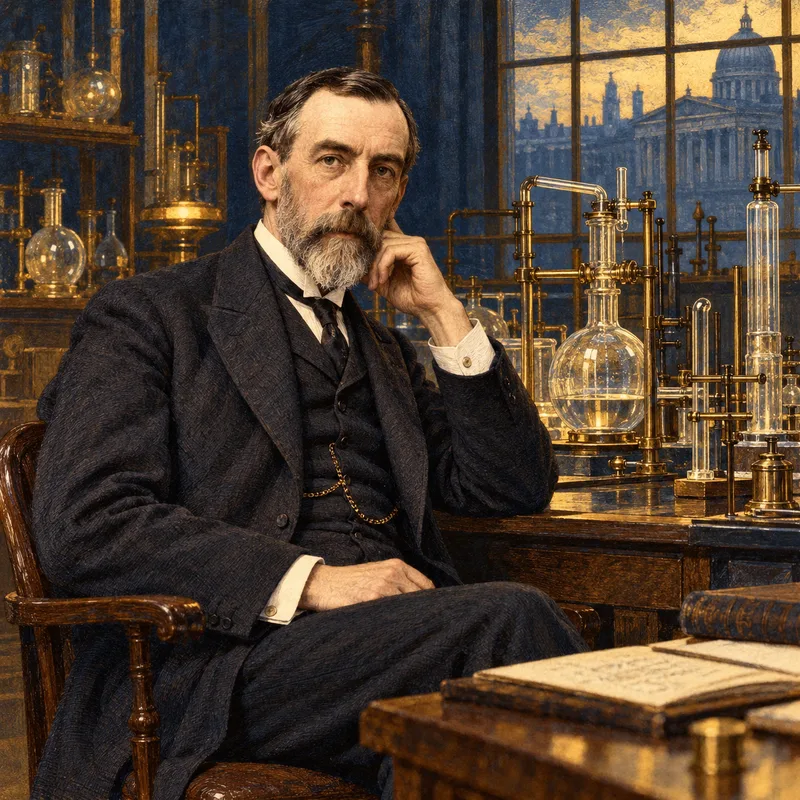
William Ramsay
1852-1916 · United Kingdom · Nobel Chemistry 1904
Discovery of noble gases