The discovery, explained · Chemist no. 155 of 350
Yuan T. Lee and the Universal Crossed Beam Machine: Seeing Any Reaction, One Collision at a Time
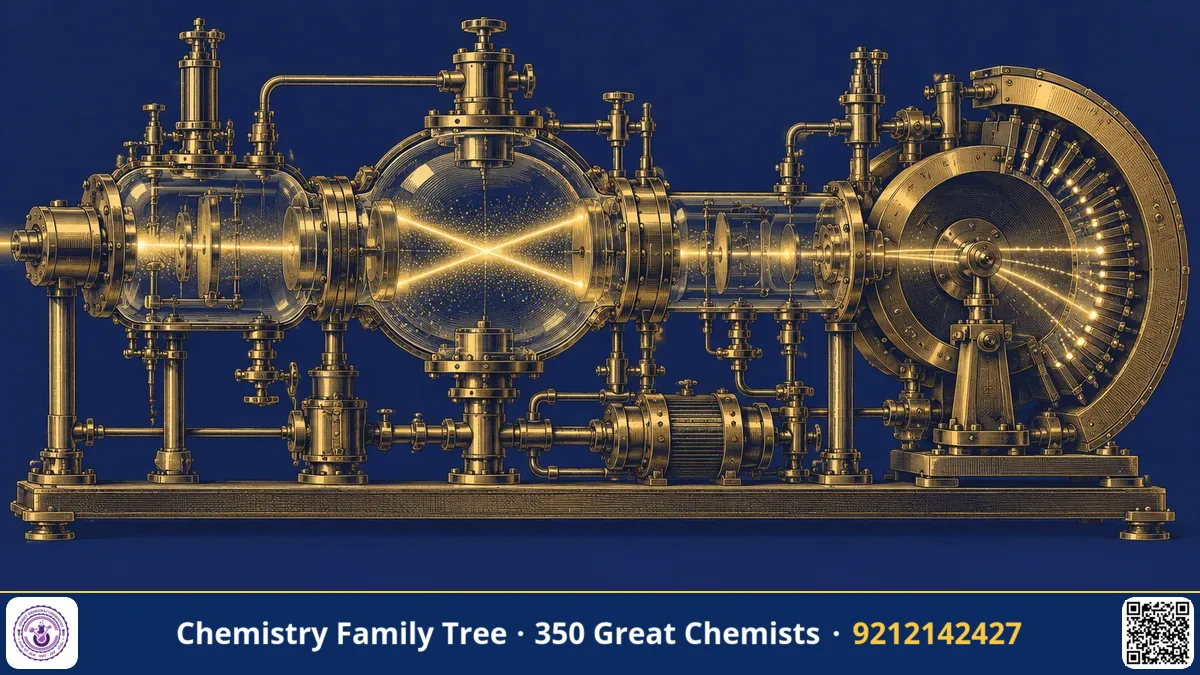
The first crossed molecular beam experiments worked beautifully, but only for a narrow family of reactions. They relied on alkali atoms, which are easy to detect with a hot wire. Most of chemistry, including organic molecules, halogens and oxygen-containing species, was out of reach. Yuan T. Lee changed that. By combining crossed beams with a sensitive mass spectrometer as a rotating detector, he made a "universal" machine that could study almost any elementary reaction. For this achievement Lee shared the 1986 Nobel Prize in Chemistry with Dudley Herschbach and John Polanyi. His machines became the standard tool of chemical dynamics.
The Scientific Problem Before the Discovery
Classical kinetics gives the rate law and rate constant of a reaction, but not the molecular details. Early beam experiments by Herschbach showed that the angular distribution of products carries rich information. However, the method had a serious limit: the detector. A surface-ionisation (hot wire) detector responds well to alkali atoms and their halides, but not to ordinary molecules such as hydrocarbons, oxygen or hydrogen halides.
Other difficulties were:
- Signals were extremely weak because few molecules collide in a crossing region of a few millimetres.
- Background gas in the vacuum chamber produced noise that could hide the real signal.
- Only a small number of reaction systems were experimentally accessible.
The challenge was to detect tiny numbers of neutral product molecules arriving at a chosen angle, identify what they are, and measure their speed.
The Discovery: A Universal Machine
Lee did postdoctoral research with Herschbach at Harvard and then began his own group at the University of Chicago, and later at the University of California, Berkeley. There he and his students designed apparatus that overcame the detection problem. The key features were:
- Differential pumping. The apparatus is divided into several chambers, each pumped separately. The source region can hold relatively high pressure to produce an intense beam, while the collision and detector regions maintain ultra-high vacuum.
- Collimation. Beams pass through skimmers and slits to form narrow, well-defined streams.
- Rotating source. Instead of moving the detector in a complicated way, the beam source chamber is made to rotate around the collision centre, so the detector sees different scattering angles.
- Mass spectrometer detection. Neutral products are ionised by electron impact, then sorted by mass-to-charge ratio in a quadrupole mass filter. This means that the detector can identify the products by their mass, making the machine universal.
- Time-of-flight measurement. A rotating slotted disc chops the product stream into pulses, and the time to travel from collision zone to detector gives the velocity. From velocity, the energy released into translation is calculated.
With such an instrument Lee studied many types of reaction, including those of halogen atoms with hydrocarbons and hydrogen halides, and reactions of oxygen atoms. An example type is:
F + D₂ → DF + D
Experiments on such reactions with hydrogen-isotope and halogen systems gave details on how much of the reaction energy appears as vibration of the new bond. Lee also used his machines to study photodissociation, in which a molecule is broken by light and the pieces fly apart, and to probe collisions of clusters.
The Chemistry Behind It
The basic idea is conservation of momentum and energy. In the centre-of-mass frame, the total momentum of the colliding pair is zero, so the products must fly apart in opposite directions with speeds fixed by their masses and the energy available. By measuring angle and speed, the experimenter reconstructs this picture and obtains a velocity–angle map of the products. Several fundamental ideas follow.
| Concept | What the beam experiment shows |
|---|---|
| Energy release | Exothermic reactions release energy that goes into product vibration, rotation, translation |
| Forward or backward scattering | Indicates direct stripping or rebound; symmetric patterns suggest a long-lived complex |
| Reaction threshold | Minimum collision energy for reaction, related to activation energy |
| Potential energy surface | The landscape that controls the dynamics; calculations are compared with data |
Mass spectrometric detection depends on ionisation by electrons, which gives ions such as M⁺, and then separation by the ratio m/z. This links the topic to the instrumental analysis syllabus.
Applications Today
- Atmospheric science: Photodissociation studies show how pollutants and ozone-related species break down.
- Combustion modelling: Branching ratios of products from radical reactions feed into engine and flame models.
- Interstellar chemistry: Gas-phase reactions at low density are studied in beams to explain molecule formation in space.
- Benchmarking theory: The detailed data provide strict tests for quantum chemistry and dynamics calculations.
- Energy research: Lee later took an interest in sustainable energy and science policy, and promoted research on solar energy and climate.
Exam Corner
- 1986 Nobel Prize in Chemistry: Herschbach, Lee and Polanyi, for the dynamics of chemical elementary processes.
- Lee's key advance: a crossed-beam machine with a mass spectrometer detector, applicable to many reactions.
- Use of high vacuum and differential pumping ensures single-collision conditions.
- Time-of-flight gives product speed; angle gives scattering distribution.
- Photodissociation: a molecule breaks apart after absorbing a photon, and fragment distribution reveals bond energies and mechanisms.
Common Misconceptions
- "Universal means it can study every reaction." It means the detector can in principle identify any species by mass, not that every reaction is easy to study.
- "Beams are used to make products." The aim is to study the process, not to produce chemicals; the number of product molecules is tiny.
- "Mass spectrometry measures the velocity." Velocity comes from the time-of-flight arrangement; the mass spectrometer identifies mass.
Quick Revision Box
- Yuan T. Lee: Taiwanese-born American chemist, 1986 Nobel Prize in Chemistry.
- Universal crossed beam machine: rotating source, differential pumping, mass spectrometer.
- Time-of-flight yields product velocity distribution.
- Centre-of-mass analysis shows how energy is partitioned.
- Also studied photodissociation and cluster collisions.
- Shared the prize with Herschbach and Polanyi.
FAQ
How was Lee's machine different from Herschbach's earlier apparatus?
Lee used a mass spectrometer as the detector and a high-sensitivity, differentially pumped design, so many more types of molecules could be studied, not only alkali compounds.
Did Lee work with Herschbach?
Yes. He was a postdoctoral researcher in Herschbach's group at Harvard before leading his own laboratory.
Why do the products fly in particular directions?
Because of conservation of momentum and the geometry of the collision. The pattern reveals whether a reaction is direct or passes through a long-lived intermediate.
Which exams cover this?
Chemical kinetics and instrumental analysis in IIT-JAM, CSIR-NET and GATE touch on collision theory, activation energy and mass spectrometry, all of which link to this work.
Published by ABC Chemistry — IIT-JAM | CSIR-NET | GATE Chemistry Coaching. Visit abcchemistry.com
About the chemist
Yuan T. Lee
1936- · Taiwan · Nobel Chemistry 1986
Crossed molecular beam dynamics