Biography · Chemist no. 278 of 350
Yuri Oganessian (born 1933): The Scientist Who Has an Element Named After Him
Yuri Tsolakovich Oganessian is a Russian nuclear physicist, born in 1933, who has spent more than six decades at the Joint Institute for Nuclear Research in Dubna, near Moscow. He is the world's leading figure in the synthesis of superheavy elements. In 2016, element 118 was named oganesson in his honour, making him only the second person (after Glenn Seaborg) to see an element named after him during his lifetime. His story is one of persistence in a field where success may come in a few atoms after weeks of work.
Early Life and Family
Yuri Oganessian was born on 14 April 1933 in Rostov-on-Don, in the Soviet Union. He is of Armenian descent, and his family belonged to the Armenian community of Rostov, a city with a long history of Armenian settlement. He grew up through the Second World War years, in a time of hardship, but he was drawn to science and mathematics at school.
Education and Mentors
He studied at the Moscow Engineering Physics Institute (MEPhI), one of the leading Soviet institutions for nuclear science, and graduated in 1956. He then joined the laboratory of nuclear reactions headed by Georgy Flerov in Dubna, which became his scientific home. Flerov, a physicist who had helped to discover the spontaneous fission of uranium in 1940 and who championed the synthesis of new elements, was his principal mentor. Oganessian carried out his doctoral studies in the field of nuclear physics and became a leading scientist in the laboratory.
Career Timeline
| Year | Event |
|---|---|
| 1933 | Born in Rostov-on-Don, USSR (14 April). |
| 1956 | Graduates from the Moscow Engineering Physics Institute; joins Flerov's laboratory at Dubna. |
| 1960s–1970s | Works on synthesis of elements 102 to 106 and on heavy-ion reactions; develops the cold-fusion approach using lead and bismuth targets. |
| 1980s | Becomes a leading researcher at the Flerov Laboratory of Nuclear Reactions. |
| 1996 | Becomes director of the Flerov Laboratory. |
| 1998–1999 | Dubna team reports the first events of element 114 (flerovium), made with ⁴⁸Ca and ²⁴⁴Pu. |
| 2000s | Collaboration with Lawrence Livermore National Laboratory (USA) produces elements 115, 116, 117 and 118. |
| 2016 | IUPAC announces the names of elements 113, 115, 117 and 118, including oganesson. |
Major Scientific Contributions
Superheavy elements. Oganessian led the experiments that produced elements 114 to 118 using ⁴⁸Ca beams and actinide targets, work done with Russian colleagues and international partners including Livermore and Oak Ridge. See our discovery article for the reactions and the chemistry.
²⁴⁹Cf + ⁴⁸Ca → ²⁹⁴Og + 3n
Cold fusion method. In the 1970s, he proposed that using lead and bismuth targets, which are magic or near-magic nuclei, would give compound nuclei with low excitation energy and therefore a better chance of surviving. This is called cold fusion in nuclear physics (not to be confused with the discredited "cold fusion" claims of 1989 about room-temperature fusion of hydrogen). The method led to the discovery of elements 107–112 at GSI in Darmstadt, Germany, and element 113 at RIKEN, Japan.
The island of stability. His experiments showed that the half-lives of the isotopes of elements 112 to 118 get longer as more neutrons are added, which supports the theory of an island of stability. These were among the first direct experimental indications of the stabilising effect of shell closures in the superheavy region.
Instruments. He directed the development of the DGFRS (Dubna Gas-Filled Recoil Separator) and other high-intensity accelerators and separators, which dramatically increased the speed and sensitivity of superheavy element experiments. The Dubna laboratory is now building a dedicated Superheavy Element Factory.
Awards, Honours and Nobel Prize
Oganessian is a member of the Russian Academy of Sciences, and has received national and international honours for his work. The strongest recognition came in 2016, when IUPAC named element 118 oganesson. He has not received a Nobel Prize, and the Nobel Prizes have not been awarded for the discovery of superheavy elements to date. The names of other elements honour his institute: flerovium (114) for the Flerov Laboratory, and dubnium (105) for the town of Dubna.
Personality, Struggles and Lesser-Known Facts
- The patience required. In some experiments, weeks of beam time produced a single atom. The first oganesson atoms were seen only after a very long run, and experiments sometimes run continuously for months.
- Science across borders. The discoveries depended on materials, such as ²⁴⁹Bk and ²⁴⁹Cf from Oak Ridge, and cooperation between Russian and American laboratories during times of political tension. Berkelium for the discovery of tennessine had a half-life of only 330 days, so it had to be transported quickly to Dubna and used immediately.
- An honour in his lifetime. Element names are normally given after the person's death. Seaborgium (1997) and oganesson (2016) are the only cases of living namesakes.
- Still working. Even in his 80s and 90s, he has remained the scientific leader of the Flerov Laboratory and continued to plan new experiments.
- A long Dubna career. He joined Flerov's laboratory as a young graduate and has stayed associated with it ever since.
Legacy and Influence on Modern Chemistry
The seventh period of the periodic table is now complete, from francium to oganesson. Chemists use these data to test how relativistic effects change chemistry, and theorists use them to refine nuclear models. The methods developed at Dubna are now being used and extended at new facilities in Russia, Japan, the USA and Germany in the search for elements 119 and 120. For Indian students, Oganessian's work shows that fundamental science can proceed through slow, careful, collective effort, and that the periodic table is a living document that is still being completed. India's own research in nuclear physics, at institutions such as the Inter-University Accelerator Centre in New Delhi, takes part in related heavy-ion research.
Lessons for Students
- Choose your projectile wisely: calcium-48 was the key to his success.
- Be patient: weeks of work may give a single atom, yet that atom can change a textbook.
- International cooperation, even in hard political times, is powerful in science.
- Keep curiosity alive for a lifetime; his research has lasted more than six decades.
Quick Facts
- Born: 14 April 1933, Rostov-on-Don, USSR (now Russia).
- Died: Living (as of the latest information).
- Nationality: Russian (of Armenian descent).
- Field: Nuclear physics and superheavy-element synthesis.
- Famous for: Leading the discovery of elements 114–118; oganesson named for him.
- Nobel Prize: None.
FAQ
Where does Yuri Oganessian work?
At the Flerov Laboratory of Nuclear Reactions of the Joint Institute for Nuclear Research (JINR), Dubna, Russia.
Which elements are linked to his team?
Flerovium (114), moscovium (115), livermorium (116), tennessine (117) and oganesson (118).
Who was his mentor?
Georgy Flerov, founder of the Dubna laboratory, after whom flerovium is named.
Why is oganesson named after a living person?
IUPAC and the discovery team chose to honour Oganessian for his pioneering contributions to superheavy element research, the second such case after seaborgium.
Published by ABC Chemistry — IIT-JAM | CSIR-NET | GATE Chemistry Coaching. Visit abcchemistry.com
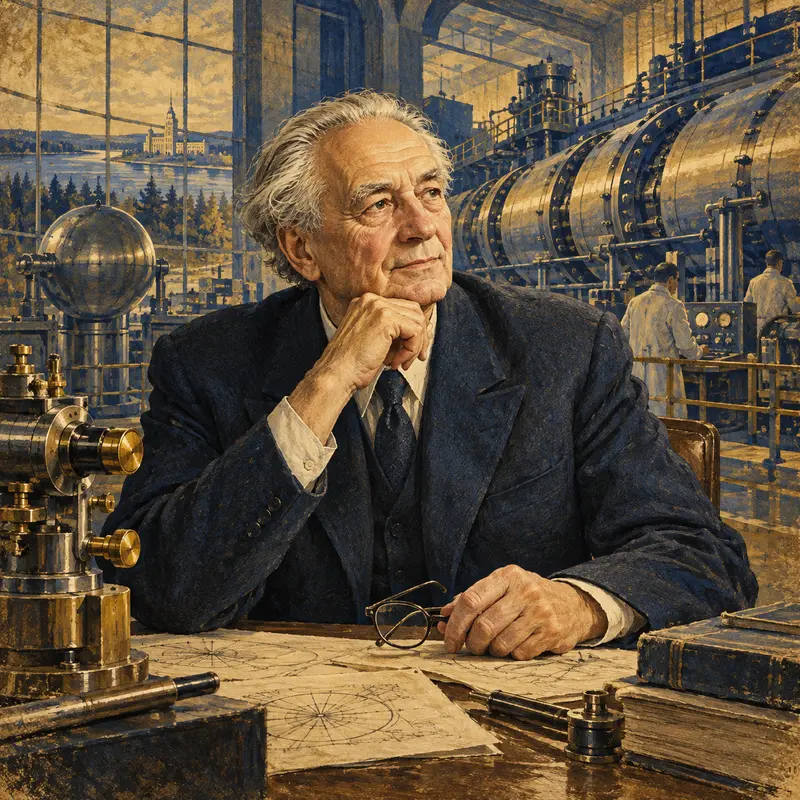
About the chemist
Yuri Oganessian
1933- · Russia
Superheavy element synthesis