The discovery, explained · Chemist no. 278 of 350
Yuri Oganessian and Oganesson: Building the Heaviest Elements Atom by Atom
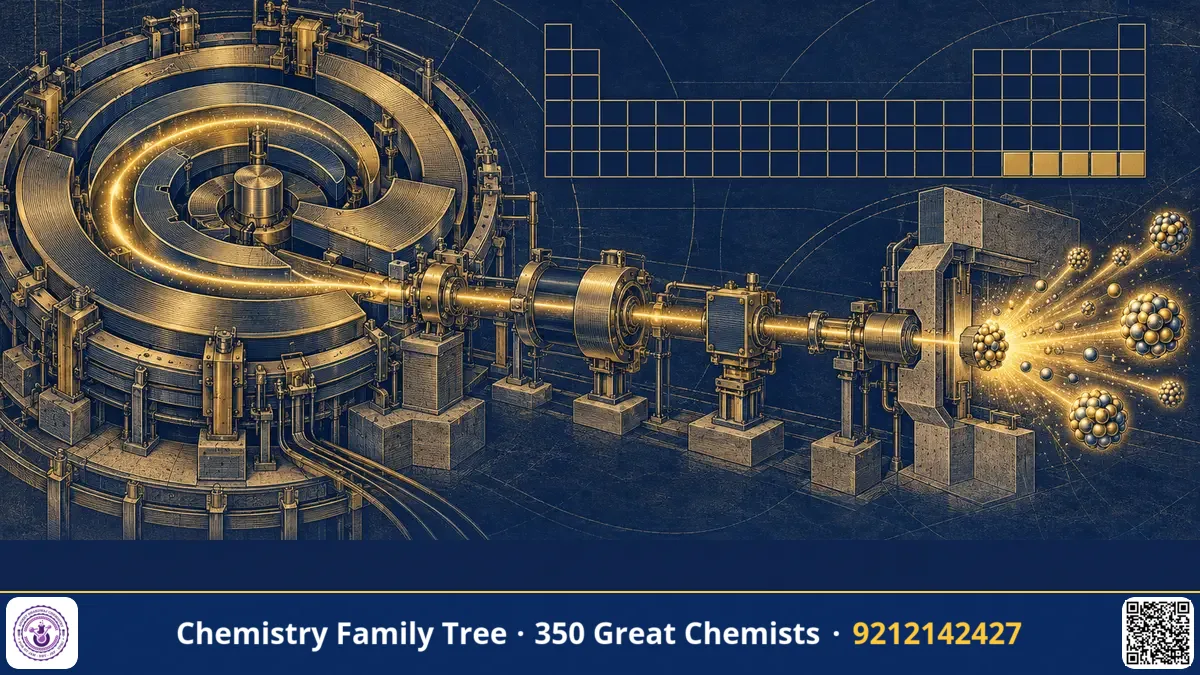
Oganesson (Og, atomic number 118) is the heaviest element known. It completes the seventh row of the periodic table and sits at the bottom of Group 18, the noble gases. It is named after Yuri Oganessian, a Russian nuclear physicist of Armenian descent who led the team at the Joint Institute for Nuclear Research (JINR) in Dubna that made it. Oganessian is only the second living person after Glenn Seaborg to have an element named in his honour. His research gave the world elements 114 to 118 (together with international partners), and tested one of the most exciting ideas in nuclear science: the island of stability.
The Scientific Problem Before the Discovery
As atoms get larger, their nuclei become harder to hold together. The positive charges of the protons repel one another with a force that grows with Z², while the strong nuclear force acts only between neighbours. Elements beyond bismuth (83) have no stable isotope, and above Z = 100 half-lives drop to seconds or milliseconds, because the nuclei fission spontaneously.
But the nuclear shell model, developed by Maria Goeppert Mayer and others, said that nuclei with "magic numbers" of protons or neutrons (2, 8, 20, 28, 50, 82, 126 and so on) are specially stable, like filled electron shells in noble gases. Nuclear theorists in the 1960s, including Glenn Seaborg and others, predicted that the next proton magic number might be 114 (or 120 or 126, depending on the model) and that the next neutron magic number would be 184. A nucleus with such numbers might live for minutes, days or even years. This region was called the island of stability. The challenge was to get there: how do you make such a nucleus?
The Discovery: Step by Step
Oganessian joined the laboratory of Georgy Flerov at Dubna in the 1950s and worked there for decades. The central problem was the choice of reaction. Fusing two nuclei requires overcoming their electrostatic repulsion, but the compound nucleus formed is highly excited and tends to fission rather than survive. Two strategies were developed:
- Cold fusion: Oganessian pioneered the idea (in the 1970s) of using lead or bismuth targets, which have a very stable (magic) nuclear structure, with medium-heavy ions such as chromium or titanium. The compound nucleus is less excited ("cold"), so it survives more often. This method was used at GSI in Darmstadt (Germany) and RIKEN (Japan) for elements 107 to 113.
- Hot fusion with calcium-48: Calcium-48 is a doubly magic nucleus (Z = 20, N = 28) with an unusual neutron excess. When it hits a heavy actinide target, the product has many neutrons and is closer to the island of stability. Oganessian's team used ⁴⁸Ca beams on actinide targets prepared from plutonium, americium, curium, berkelium and californium, many supplied by American laboratories (Oak Ridge and Lawrence Livermore).
²⁴⁴Pu + ⁴⁸Ca → ²⁸⁹Fl + 3n        (flerovium, Z = 114)
²⁴³Am + ⁴⁸Ca → ²⁸⁸Mc + 3n         (moscovium, Z = 115)
²⁴⁹Bk + ⁴⁸Ca → ²⁹⁴Ts + 3n         (tennessine, Z = 117)
²⁴⁹Cf + ⁴⁸Ca → ²⁹⁴Og + 3n         (oganesson, Z = 118)
The experiments needed enormous patience. A beam of ⁴⁸Ca ions was directed onto a rotating target for weeks. The few product nuclei were separated from the beam by a gas-filled recoil separator and implanted into a silicon detector. Each new nucleus is identified by its chain of alpha decays that ends in a known nucleus:
²⁹⁴Og → ²⁹⁰Lv + α → ²⁸⁶Fl + α → ²⁸²Cn + α → spontaneous fission
In the early 2000s, the collaboration with Lawrence Livermore National Laboratory reported the first events of element 118, and later runs added a few more. The total number of atoms of element 118 ever observed is only a handful. In December 2015, IUPAC recognised the discoveries of elements 113, 115, 117 and 118, and in November 2016 the names nihonium (113), moscovium (115), tennessine (117) and oganesson (118) became official.
The Chemistry Behind It
Oganesson has the predicted electron configuration [Rn] 5f¹⁴ 6d¹⁰ 7s² 7p⁶, which would make it a noble gas. But calculations suggest it behaves quite differently:
- Relativistic effects: In heavy atoms, the inner electrons move at a large fraction of the speed of light, and their orbitals contract. The 7p orbital splits into 7p₁/₂ and 7p₃/₂ with a big energy gap (spin–orbit coupling). The outer 7p₃/₂ electrons are weakly bound.
- Not inert: Calculations predict that oganesson is a solid at room temperature and chemically reactive, and could form compounds such as OgF₂ and OgF₄. Its electron density is not a uniform shell, but has a "smeared" structure.
- Short life: ²⁹⁴Og has a half-life of under a millisecond (about 0.7 ms), so its chemistry cannot be tested at present.
Flerovium (Z = 114), the element one step below, was studied chemically and was found to be relatively unreactive and volatile, while copernicium (112) behaves like a volatile metal. These "one-atom-at-a-time" experiments rely on gas-phase chromatography and the volatility of the single atoms.
The key lesson is that the periodic table's rules begin to break down at the extreme end: the properties of the 7th period elements are shaped by relativity and not only by the trends of the lighter elements.
Applications Today
- Nuclear theory: The measured half-lives and decay chains test the shell model and the island of stability. The longest-lived isotopes of Fl, Mc, Lv are longer than those of the lighter elements, showing that the stability effect is real, though the island has not been reached.
- Accelerator and detector technology: The ion sources, separators and digital detectors developed for superheavy element research have been used in other branches of nuclear physics, in materials science and in medical isotope production.
- Isotope production: The same laboratories make isotopes for medicine, such as radiopharmaceuticals.
- Quantum chemistry: Oganesson is a test case for computational methods that include relativity, which also matter for gold and mercury chemistry.
- Education: The seventh period now has all 118 elements, which completes the periodic table in the form we teach.
Exam Corner
- Element 118, oganesson (Og), is the last element of Group 18 and period 7, named after Yuri Oganessian; produced by ²⁴⁹Cf + ⁴⁸Ca → ²⁹⁴Og + 3n.
- Names approved in 2016: nihonium (113), moscovium (115), tennessine (117) and oganesson (118). Flerovium (114) and livermorium (116) were named in 2012.
- Magic numbers: 2, 8, 20, 28, 50, 82, 126 (neutrons: 184 predicted); the island of stability is expected near Z = 114–126, N = 184.
- Ca-48 is doubly magic (Z = 20, N = 28) and neutron rich, so it is an ideal projectile.
- Relativistic effects explain why heavy elements deviate from periodic trends (Au colour, Hg liquid, and probably Og reactivity).
Common Misconceptions
- "Oganesson is an inert gas like neon." It is in Group 18, but is predicted to be a solid with chemical reactivity.
- "Oganessian worked alone." These discoveries were made by an international team of Russian and American scientists, with large contributions from chemists and engineers.
- "The island of stability has been reached." Not yet; the isotopes made so far live for milliseconds to seconds, and the true island might be at higher neutron numbers than we can reach.
Quick Revision Box
- Oganesson (Og), Z = 118; Group 18, Period 7; named in 2016.
- Made at Dubna (with Livermore) by ⁴⁸Ca + ²⁴⁹Cf; a handful of atoms in total.
- Half-life of ²⁹⁴Og about 0.7 ms; alpha decay chain through Lv, Fl, Cn.
- Predicted to be a reactive solid because of relativistic effects.
- Shell model and magic numbers underlie the island of stability.
- Oganessian: second living person with an element named after him (after Seaborg).
FAQ
Why is calcium-48 used?
It is doubly magic and rich in neutrons, so the fusion product is closer to the stable island and less likely to fission immediately.
How can you detect an element made of only a few atoms?
By detecting the characteristic chain of alpha decays of each atom, which connects the unknown parent to nuclei that are already known.
Is oganesson useful?
Not in practice, because it exists for less than a millisecond. Its value is in science.
Did Oganessian get a Nobel Prize?
No. The Nobel Prizes have not been awarded for the superheavy elements. Naming an element after him is itself a rare scientific honour.
Published by ABC Chemistry — IIT-JAM | CSIR-NET | GATE Chemistry Coaching. Visit abcchemistry.com
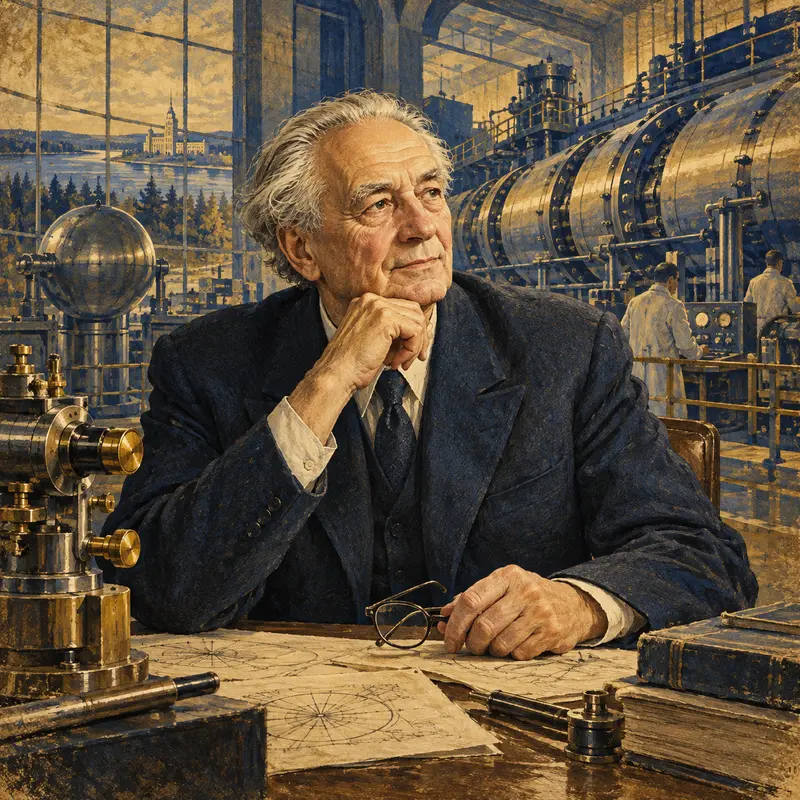
About the chemist
Yuri Oganessian
1933- · Russia
Superheavy element synthesis