Biography · Chemist no. 94 of 350
Yves Chauvin: The Industrial Chemist Who Explained Metathesis
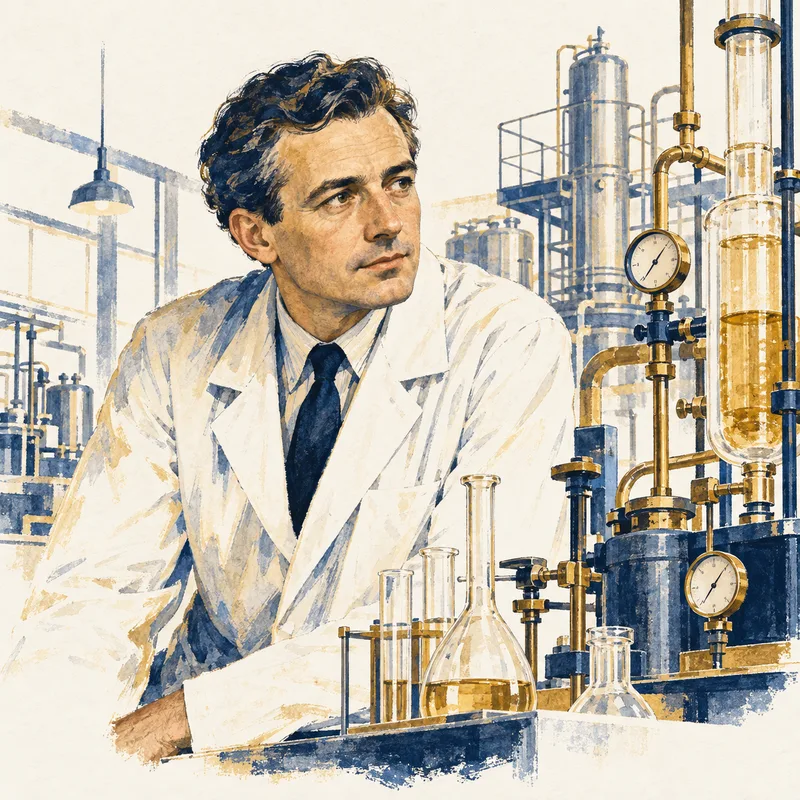
Yves Chauvin (1930-2015) was a French chemist who spent most of his working life at the Institut Français du Pétrole (IFP), a research institute for the oil and energy industry. He is famous for proposing, in 1971, the carbene mechanism of olefin metathesis, and for sharing the 2005 Nobel Prize in Chemistry with Robert Grubbs and Richard Schrock. His legacy in one line: he showed that a clear idea can matter as much as a new compound, because his mechanism guided the design of every modern metathesis catalyst.
Early Life and Family
Chauvin was born on 10 October 1930 in Menen (Menin), a town in Belgium, to French parents. He grew up in France, and he became a French scientist in every way. He did not belong to a famous academic family, and, unlike many Nobel laureates, his career was spent in an applied research setting and not in a university department. Little is public about his private life, and in this post we keep to facts that are well established. What is clear is that he combined the habits of an engineer, who thinks about processes and yields, with the curiosity of a scientist who wants to know why a reaction behaves the way it does.
Education and Mentors
Chauvin trained as a chemical engineer at the École supérieure de chimie industrielle de Lyon (now CPE Lyon), graduating in the 1950s. French engineering schools of that period combined strong chemistry with practical industrial subjects such as reactor design, separation and catalysis. This background suited a career in petroleum chemistry. In 1960 he joined the Institut Français du Pétrole, where he worked on catalysis and on the chemistry of olefins, the small unsaturated hydrocarbons produced in huge quantities by refineries. The institute gave him freedom to think about fundamental questions, which later paid off.
Career Timeline
| Year | Event |
|---|---|
| 1930 | Born in Menen (Menin), Belgium |
| 1950s | Studied chemical engineering in Lyon |
| 1960 | Joined the Institut Français du Pétrole |
| 1960s | Worked on catalysis of olefin reactions, including nickel-catalysed dimerisation |
| 1967 | The term "olefin metathesis" introduced by Calderon at Goodyear |
| 1971 | Chauvin and Jean-Louis Hérisson proposed the carbene mechanism |
| 1974 | Casey and Burkhardt gave key support with tungsten carbene chemistry |
| 1990 | Schrock reported defined molybdenum metathesis catalysts |
| 2005 | Nobel Prize in Chemistry (with Grubbs and Schrock) |
| 2015 | Died on 27 January, in Tours, France |
Major Scientific Contributions
The carbene mechanism. The central contribution is the idea that a metal alkylidene reacts with an alkene to form a metallacyclobutane and then gives a new alkene and a new metal alkylidene:
[M]=CHR + R'CH=CHR' ⇌ metallacyclobutane ⇌ [M]=CHR' + RCH=CHR'
He and his student Jean-Louis Hérisson observed product distributions that the older pairwise mechanism could not explain, and they replaced it with a chain mechanism built on metal carbenes. You can read the step-by-step logic in our discovery post on the Chauvin mechanism.
Olefin catalysis in industry. At IFP, Chauvin also worked on the catalytic dimerisation and oligomerisation of olefins using nickel complexes, processes that convert small alkenes such as propene and butenes into larger, more valuable ones. Such work shows how organometallic chemistry supports the fuel and petrochemical industries.
Ionic liquids. In later years Chauvin also studied the use of ionic liquids, which are salts that are liquid at or near room temperature, as media for catalytic reactions. This line of research connects to green chemistry because ionic liquids have almost no vapour pressure and can often be reused.
Awards, Honours and Nobel Prize
The Nobel Prize in Chemistry 2005 was shared equally by Yves Chauvin (France), Robert H. Grubbs and Richard R. Schrock (both USA) "for the development of the metathesis method in organic synthesis". Popular explanations of the prize compare metathesis to a dance in which partners change places, because carbon-carbon double bonds are cut and rebuilt. For the committee, Chauvin's role was to give the reaction its mechanism, which made the later catalyst development possible. At the time of the award Chauvin was 75 years old and a retired honorary research director of IFP, a reminder that important ideas can be recognised many years later.
Personality, Struggles and Lesser-Known Facts
- Born in Belgium, French by upbringing: Many sources list him as French because his family was French and he lived and worked there.
- Industry scientist: He is one of the few Nobel laureates in chemistry who worked almost entirely in an industrial research institute rather than a university.
- A student's contribution: The 1971 paper was written with his student Jean-Louis Hérisson. Good science often comes from a teacher-student team.
- Delayed acceptance: In the 1970s many chemists still believed in the older pairwise mechanism. The carbene mechanism became widely accepted only after more experiments by other groups, such as the work of Casey, Grubbs and Schrock.
- A prize shared across sectors: The three laureates came from different sectors: an industrial institute (Chauvin) and two university groups (Schrock, Grubbs).
Legacy and Influence on Modern Chemistry
The mechanism is now in every textbook, and almost every research paper on metathesis starts from it. Without it, catalyst design would be trial and error. With it, Schrock designed alkylidene catalysts and Grubbs designed ruthenium carbenes, aiming at stable, tolerant species that continue the cycle. The result is a reaction that builds rings, polymers and complex molecules in fewer steps and with less waste. In a classroom in India, you meet Chauvin's idea in organometallic chemistry, in catalysis and in polymer chemistry.
Lessons for Students
- Look at the data carefully. A product distribution that did not fit the accepted model led to a new mechanism.
- Do not fear the accepted view. Chauvin's proposal replaced a widely held idea.
- Theory and practice help each other. A chemical engineer's practical background gave him access to real reaction data.
- Recognition may come late. Good work should be done for its own sake.
Quick Facts Box
- Born: 10 October 1930, Menen (Menin), Belgium
- Died: 27 January 2015, Tours, France
- Nationality: French
- Field: Petrochemistry, organometallic catalysis
- Famous for: Carbene (Chauvin) mechanism of olefin metathesis
- Nobel: Chemistry 2005 (shared with Grubbs and Schrock)
FAQ
Where did Yves Chauvin work?
He worked at the Institut Français du Pétrole (IFP) near Paris from 1960 until his retirement.
What is Chauvin's most important contribution?
The proposal in 1971 that olefin metathesis proceeds through metal carbenes and metallacyclobutanes.
Did Chauvin make the Grubbs or Schrock catalysts?
No. He explained the mechanism, while Schrock and Grubbs designed efficient, well-defined catalysts that follow it.
Why is Chauvin important for exams?
Questions often ask who proposed the metathesis mechanism, what the intermediate is, or how the Nobel Prize 2005 was shared.
Published by ABC Chemistry — IIT-JAM | CSIR-NET | GATE Chemistry Coaching. Visit abcchemistry.com
About the chemist
Yves Chauvin
1930-2015 · France · Nobel Chemistry 2005
Mechanism of olefin metathesis