The discovery, explained · Chemist no. 94 of 350
Yves Chauvin and the Carbene Mechanism That Explained Olefin Metathesis
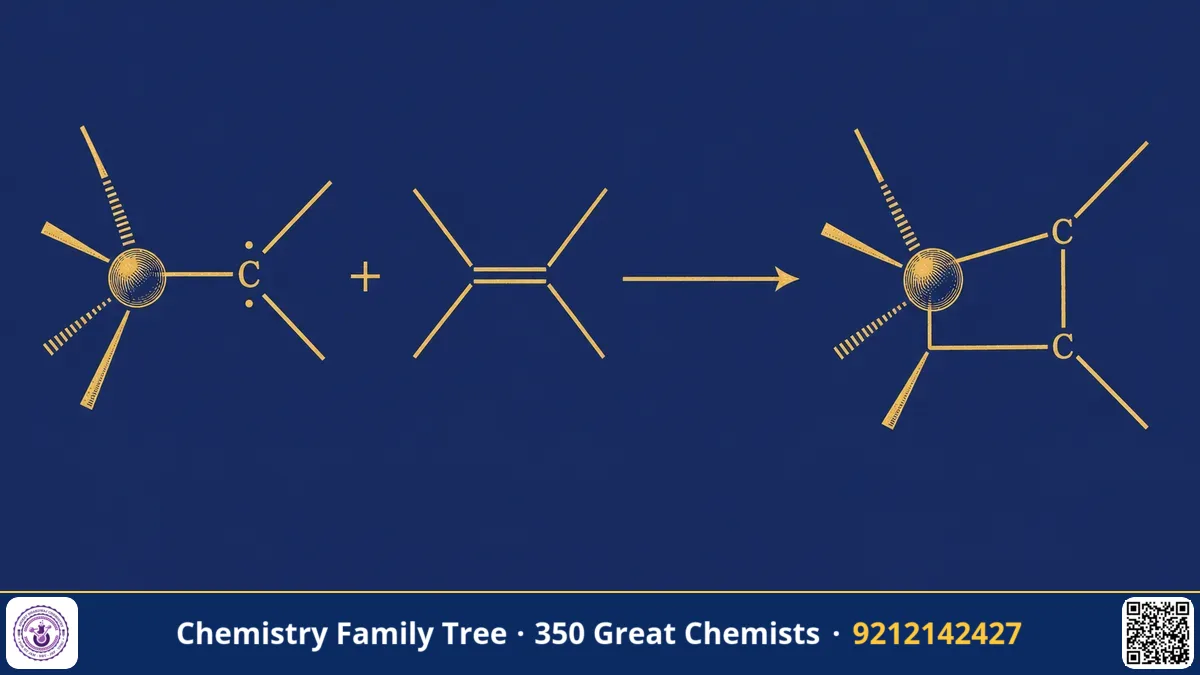
Some scientific discoveries are new compounds. Others are new explanations. Yves Chauvin's contribution belongs to the second group, and it is one of the most elegant explanations in organometallic chemistry. In 1971, working at the Institut Français du Pétrole (IFP) with his student Jean-Louis Hérisson, Chauvin proposed that olefin metathesis happens through a chain of metal carbenes and four-membered metallacycles. This single idea turned a mysterious industrial reaction into a rational one that chemists could design, and it guided Schrock and Grubbs to build their catalysts. In 2005 Chauvin shared the Nobel Prize in Chemistry with them. For students, the Chauvin mechanism is a must-know: it is short, logical and often tested.
The Scientific Problem Before the Discovery
Alkene exchange reactions were found by industrial chemists in the 1950s and 1960s. Researchers at Phillips Petroleum reported that propene could be converted into ethene and butene over molybdenum-based catalysts, and in 1967 Nissim Calderon and colleagues at Goodyear, working with tungsten-based catalysts, introduced the name "olefin metathesis". The overall change is easy to write:
R¹CH=CHR¹ + R²CH=CHR² ⇌ 2 R¹CH=CHR²
But how does it happen? The accepted guess in the 1960s was the pairwise mechanism: two alkenes coordinate to one metal, join to form a cyclobutane-like intermediate (a [2+2] cycloaddition), and then split the other way. Two problems existed. First, a concerted [2+2] reaction of two ordinary alkenes should be thermally forbidden by orbital symmetry. Second, experimental results did not fit the model well, as you will see below.
The Discovery: Step by Step
- An unexpected product pattern. Chauvin and Hérisson studied the metathesis of cyclic alkenes with acyclic ones (for example cyclopentene with a 2-alkene) using a tungsten-based catalyst. With a pairwise mechanism, the initial products should have been a simple set, with a limited number of cross-products, and the more complex ones should appear later. Instead, they saw a statistical mixture of all the cross-products right from the start.
- The new idea. A pairwise exchange could not give that pattern, so the metal must carry a growing carbene fragment that adds one alkene at a time. They proposed a metal carbene (M=CHR) as the true catalytic species.
- The cycle. The carbene adds to a C=C bond to form a metallacyclobutane. The ring then breaks open in the other direction, releasing a new alkene and creating a new carbene.
- Later proof. Many experiments supported the idea. In 1974 Charles Casey and T. J. Burkhardt showed that a tungsten carbene complex reacts with alkenes in a way consistent with the carbene mechanism. Robert Grubbs's team later isolated titanacyclobutanes, and Richard Schrock's high-oxidation-state carbenes became actual working catalysts.
The Chemistry Behind It
The cycle can be written as two linked [2+2] reactions:
Step 1:  [M]=CHR¹  +  R²CH=CHR²   →   [M]–metallacyclobutane
Step 2:  metallacyclobutane   →   [M]=CHR²  +  R¹CH=CHR²
Step 3:  [M]=CHR²  +  R¹CH=CHR¹   →   metallacyclobutane   →   [M]=CHR¹ + R¹CH=CHR²
The metallacyclobutane is a four-membered ring made of the metal and three carbons: M–CHR–CHR–CHR. Whether the ring splits "vertically" or "horizontally" decides the products, and since every step is reversible, the system finally reaches an equilibrium mixture. This is a key point: metathesis is under thermodynamic control, and a product is favoured only if something drives it, such as the loss of ethene gas or relief of ring strain.
Why does a metal make the [2+2] step easy? For two alkenes, the frontier orbitals have the wrong symmetry for a thermal concerted [2+2] reaction. In a metal carbene, the metal d orbital takes part in the bonding, so the symmetry restriction disappears. This explains why a metal is required.
Compare the two mechanisms
| Feature | Pairwise (cyclobutane) mechanism | Chauvin (carbene) mechanism |
|---|---|---|
| Active species | Metal with two bound alkenes | Metal carbene (M=CHR) |
| Intermediate | Metallacyclopentane / cyclobutane-like | Metallacyclobutane |
| Predicted early products | Limited cross-products | Statistical mixture from the start |
| Accepted today? | No | Yes |
Applications Today
- Drug synthesis: The mechanism let chemists design ring-closing metathesis steps in the synthesis of macrocyclic drugs and natural products.
- Petrochemical industry: Metathesis is used to balance supplies of propene, ethene and butenes. Yves Chauvin's own employer, IFP, worked on industrial processes for olefin chemistry.
- Polymers: Ring-opening metathesis polymerisation (ROMP) follows the same cycle.
- Green chemistry: A catalytic process that forms new C=C bonds with little waste is attractive for sustainable chemistry, which is a growing topic in Indian industry and in the syllabus.
- Research tool: Chauvin-type thinking is used to design catalysts for alkyne metathesis too.
Exam Corner
- The Chauvin mechanism (1971) involves a metal carbene and a metallacyclobutane through repeated [2+2] cycloaddition and cycloreversion steps.
- Name "olefin metathesis" was given by Calderon in 1967. The mechanism was proposed by Chauvin and Hérisson.
- Nobel Prize in Chemistry 2005: Chauvin, Grubbs and Schrock.
- In metathesis, the number of C=C bonds is conserved; the fragments are redistributed. The reaction is reversible.
- Driving forces: removal of ethene gas, or ring strain release (ROMP). Equilibrium arguments based on Le Chatelier are often asked.
Common Misconceptions
- "Chauvin invented the catalysts." No. He explained the mechanism. The efficient single-component catalysts came from Schrock and Grubbs.
- "The metal carbene is just a by-product." It is the real catalyst; the metal carbene is regenerated every cycle.
- "A concerted [2+2] occurs between two free alkenes." This is symmetry-forbidden in the ground state; the metal makes it possible.
Quick Revision Box
- Proposed in 1971 by Yves Chauvin and Jean-Louis Hérisson.
- Metal carbene + alkene gives a metallacyclobutane, which opens to a new alkene + new carbene.
- Evidence: statistical product distribution from the beginning of the reaction.
- Supported by Casey (1974), Grubbs (titanacyclobutanes) and Schrock (carbene catalysts).
- Replaced the older pairwise cyclobutane mechanism.
- Nobel Prize in Chemistry 2005.
FAQ
What is the Chauvin mechanism?
It is the accepted explanation of olefin metathesis: a metal alkylidene (carbene) reacts with an alkene to form a metallacyclobutane, which then breaks to give a new alkene and a new alkylidene.
Who coined the term "olefin metathesis"?
The term was introduced in 1967 by Nissim Calderon and co-workers at Goodyear. Chauvin later supplied the mechanism.
Why is the mechanism called a chain mechanism?
Because the carbene on the metal changes its substituent in each turn of the cycle, and the same metal keeps reacting with many alkene molecules.
Is the Chauvin mechanism useful for polymer questions?
Yes. ROMP is simply the Chauvin cycle with a strained cyclic alkene, in which each turn adds one monomer unit to the growing chain.
Published by ABC Chemistry — IIT-JAM | CSIR-NET | GATE Chemistry Coaching. Visit abcchemistry.com
About the chemist
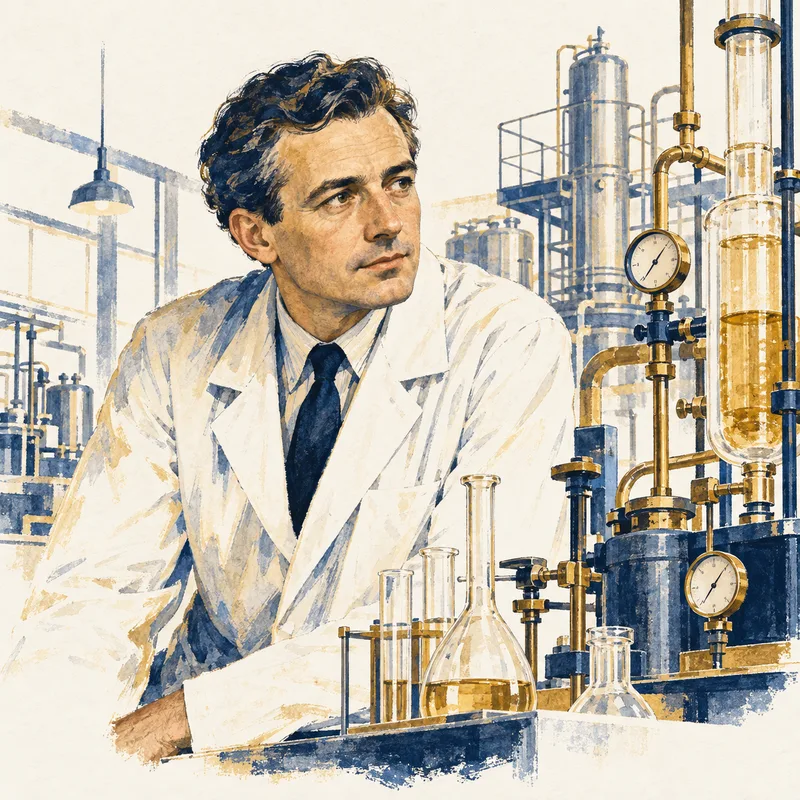
Yves Chauvin
1930-2015 · France · Nobel Chemistry 2005
Mechanism of olefin metathesis