Isotopes, Isobars and Isotones: Counting Protons, Neutrons and Electrons
Questions on protons, neutrons and electrons look easy, but they decide marks in Class 9, 10 and 11 exams. A single wrong subtraction or a forgotten charge changes the whole answer. This page gives you a fixed method and tests it on six types of problems.

The two numbers that describe an atom
- Atomic number (Z) = number of protons. It decides which element the atom is.
- Mass number (A) = number of protons + number of neutrons (the number of nucleons).
Electrons (neutral atom) = Z
Electrons (ion) = Z − (charge with its sign). Ca2+: 20 − 2 = 18. Cl−: 17 − (−1) = 18.
An atom is written as AZX, for example 3517Cl: mass number 35, atomic number 17.
Isotopes, isobars and isotones
| Name | What is the same | What is different | Example |
|---|---|---|---|
| Isotopes | Atomic number Z (same element) | Mass number A, so neutrons differ | 35Cl and 37Cl |
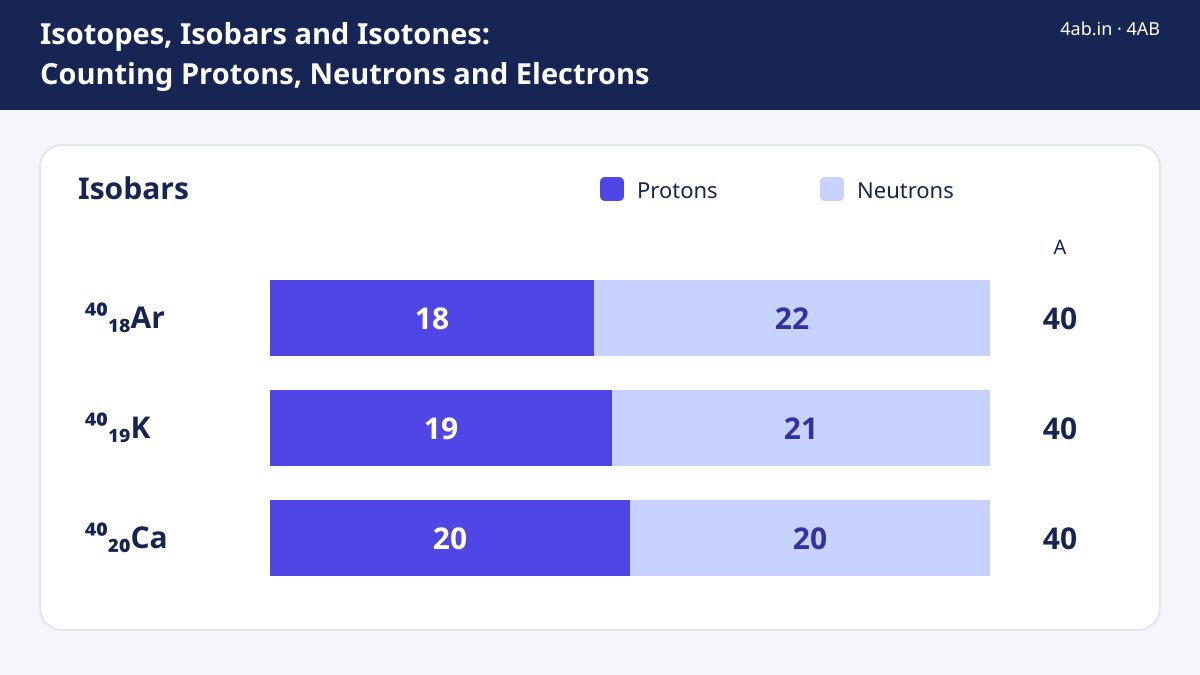
| Isobars | Mass number A | Atomic number Z (different elements) | 40Ar, 40K, 40Ca |
| Isotones | Number of neutrons | Both Z and A | 3H and 4He (2 neutrons each) |
A useful way to remember: atomic number fixes the element, mass number fixes the isotope. Hydrogen has three well-known isotopes: protium (1H, no neutron), deuterium (2H, one neutron) and tritium (3H, two neutrons). All three have one proton and one electron.
Isotopes of an element have almost the same chemical properties, because chemistry is controlled by the electrons, and the electron number is the same. Their physical properties, such as mass and density, differ slightly.
Worked example 1: neutral atom and ion of chlorine
Find the protons, neutrons and electrons in 3517Cl and in the chloride ion Cl− of the same isotope.
Protons = Z = 17. Neutrons = 35 − 17 = 18.
Neutral atom: electrons = 17.
Cl− has gained one electron: electrons = 17 + 1 = 18. Protons and neutrons stay 17 and 18, because ions form by changing electrons only.
Worked example 2: a cation
Find the particles in 4020Ca2+.
Protons = 20. Neutrons = 40 − 20 = 20. Electrons = 20 − 2 = 18.
Check: total charge = (+20) + (−18) = +2, which matches the charge shown.
Worked example 3: finding the element from neutrons and mass number
An atom has mass number 39 and 20 neutrons. Identify the element and write its electron count if neutral.
Z = A − neutrons = 39 − 20 = 19. The element with Z = 19 is potassium (K).
A neutral atom has 19 electrons. This atom is 3919K. You can find the symbol quickly with the interactive periodic table tool linked below.
Worked example 4: which pairs are which?
Species: 4018Ar, 4019K, 4020Ca, 31H, 42He.
Same A = 40 but different Z (18, 19, 20): these three are isobars.
Neutrons: H-3 has 3 − 1 = 2; He-4 has 4 − 2 = 2. Same neutrons, different Z and A: these two are isotones.
Neutrons of the first three: Ar 40 − 18 = 22, K 40 − 19 = 21, Ca 40 − 20 = 20. They are not isotones of each other.
Worked example 5: neutrons in a given mass of water
How many neutrons are present in 18.015 g of water made only of 1H and 16O? (NA = 6.022 × 10²³ per mol; molar mass of H2O = 18.015 g/mol.)
Neutrons per molecule: 1H has 0 neutrons (two H atoms give 0). 16O has 16 − 8 = 8 neutrons. Total = 8 per molecule.
Moles of water = 18.015 / 18.015 = 1.000 mol, so molecules = 6.022 × 10²³.
Neutrons = 8 × 6.022 × 1023 = 4.82 × 1024.
Worked example 6: mass number of an ion from its particles
An ion has 13 protons, 14 neutrons and 10 electrons. Find its symbol, mass number and charge.
Z = 13, so the element is aluminium. Mass number A = 13 + 14 = 27.
Charge = protons − electrons = 13 − 10 = +3. The ion is 2713Al3+. Its electron arrangement (2, 8) is the same as neon, which is why Al3+ is stable.
Common mistakes
- Using the mass number as the number of neutrons. Neutrons = A − Z.
- Changing the protons when forming an ion. Only the electrons change.
- Adding the charge for a cation. A cation has fewer electrons than protons.
- Mixing isotopes and isobars. Remember: isotopes = same place in the periodic table (same Z); isobars = same mass.
- Calling the average atomic mass the mass number. The mass number is always a whole number for one isotope.
Exam relevance
| Question type | Method |
|---|---|
| Count p, n, e from a symbol | p = Z, n = A − Z, e = Z ± charge |
| Identify an element | Find Z, then look it up |
| Classify pairs | Compare Z, A and neutron numbers |
| Particles in a given amount | Per atom or molecule × number of particles |
For how isotopes combine into an average atomic mass, see the separate article on average atomic mass. Follow your current syllabus for the depth required.
Look up the atomic number, symbol and mass of any element in the interactive periodic table.
Open the Interactive Periodic Table →Trends and exceptions are asked every year: practise previous-year CSIR-NET questions and quizzes.
More Electrochemistry articles