Strong Acid–Strong Base Titration Curve: pH at Every Stage
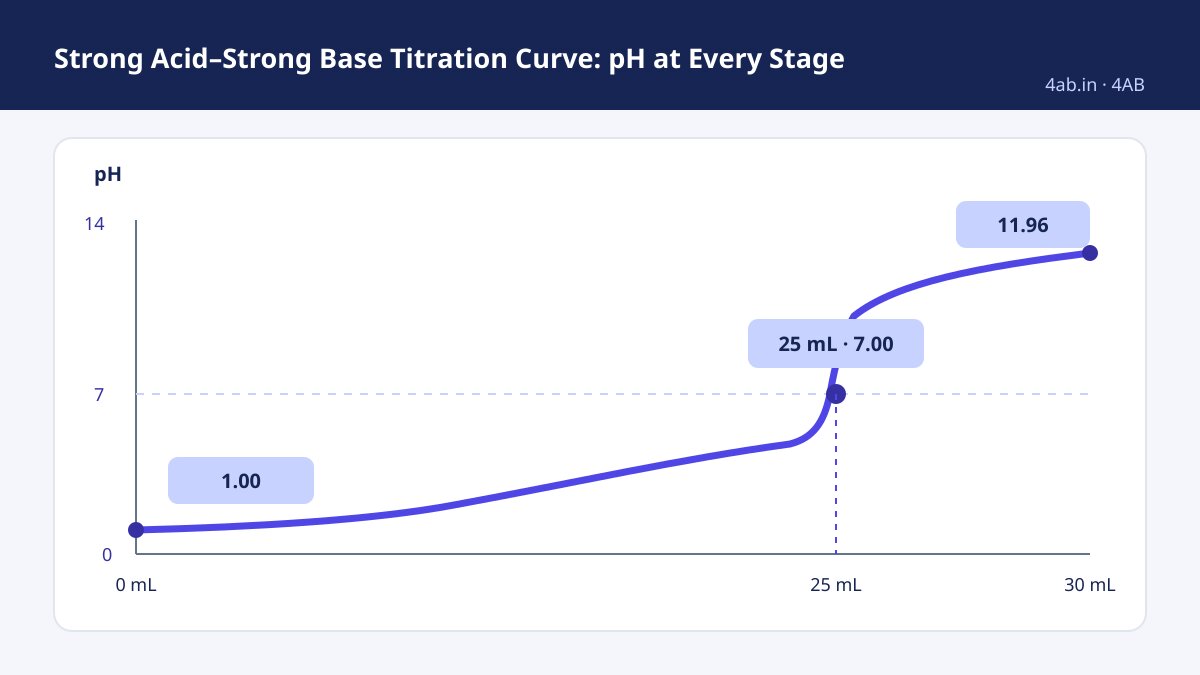
In a titration practical you add base from a burette and watch the pH change. The graph of pH against volume added is the titration curve. Board and entrance papers love it because it tests several ideas in one problem: moles, dilution, excess reagent and pH. The method is simple once you see that the curve has only four kinds of point, and each kind has its own one-line calculation.

The four regions of the curve
Take a strong acid such as HCl in the flask and a strong base such as NaOH in the burette. Both ionise completely, so no equilibrium constant is needed. All the work is mole counting.
Total volume = Va + Vb
Before equivalence: [H+] = (nacid − nbase) ÷ Vtotal
At equivalence: pH = 7 (at 25 °C)
After equivalence: [OH−] = (nbase − nacid) ÷ Vtotal, then pH = 14 − pOH
Here V is in litres or in mL (use the same unit for all volumes; the answer is the same because only a ratio matters). C is molarity in mol L−1. If V is in mL, the product V × C gives millimoles, and dividing by a volume in mL gives mol L−1 directly.
| Region | What is left in the flask | How to find pH |
|---|---|---|
| Start (no base) | Only strong acid | pH = −log Ca |
| Before equivalence | Leftover acid + neutral salt | [H+] from excess acid, divided by total volume |
| Equivalence point | Only neutral salt and water | pH = 7 |
| After equivalence | Excess base + neutral salt | [OH−] from excess base, then pOH, then pH |
Worked example 1: 25.00 mL of 0.1000 M HCl with 0.1000 M NaOH
Moles of acid. 25.00 mL × 0.1000 M = 2.500 mmol. The equivalence point needs 2.500 mmol of base, which is 25.00 mL of 0.1000 M NaOH.
(a) No base added. [H+] = 0.1000 M, so pH = −log 0.1000 = 1.000.
(b) After 10.00 mL of base. Base added = 10.00 × 0.1000 = 1.000 mmol. Acid left = 2.500 − 1.000 = 1.500 mmol. Total volume = 35.00 mL. [H+] = 1.500 ÷ 35.00 = 0.04286 M. pH = 1.368.
(c) After 24.90 mL of base. Base = 2.490 mmol. Acid left = 0.010 mmol. Volume = 49.90 mL. [H+] = 0.010 ÷ 49.90 = 2.004 × 10⁻⁴ M. pH = 3.698.
(d) After 25.00 mL of base. Acid and base are exactly equal. The solution is NaCl in water. pH = 7.000.
(e) After 25.10 mL of base. Base = 2.510 mmol; excess OH− = 2.510 − 2.500 = 0.010 mmol. Volume = 50.10 mL. [OH−] = 0.010 ÷ 50.10 = 1.996 × 10⁻⁴ M. pOH = 3.700, so pH = 14 − 3.700 = 10.300.
(f) After 30.00 mL of base. Excess base = 5.000 × 0.1000 = 0.5000 mmol. Volume = 55.00 mL. [OH−] = 0.009091 M. pOH = 2.041, pH = 11.959.
Look at what happened near the end. Going from 24.90 mL to 25.10 mL, only 0.20 mL of base, the pH jumped from 3.698 to 10.300. That steep, almost vertical part of the curve is why a single drop can change the colour of an indicator at the end point.
Worked example 2: the volumes are not equal
Question. 20.00 mL of 0.1000 M HCl is titrated with 0.2000 M NaOH. Find the volume of base needed and the pH after 9.90 mL and 10.10 mL.
Equivalence volume. Acid = 20.00 × 0.1000 = 2.000 mmol. Volume of base = 2.000 ÷ 0.2000 = 10.00 mL.
At 9.90 mL. Base = 9.90 × 0.2000 = 1.980 mmol. Acid left = 0.020 mmol. Volume = 29.90 mL. [H+] = 6.689 × 10⁻⁴ M, pH = 3.175.
At 10.10 mL. Base = 2.020 mmol; excess = 0.020 mmol. Volume = 30.10 mL. [OH−] = 6.645 × 10⁻⁴ M, pOH = 3.178, pH = 10.822.
The jump is again from about 3.2 to about 10.8 across a 0.20 mL window. A stronger burette solution means a smaller equivalence volume, but the shape stays the same.
Worked example 3: base in the flask, acid in the burette
Question. 25.00 mL of 0.1000 M NaOH is titrated with 0.1000 M HCl. Find the pH at the start and after 24.90 mL and 25.10 mL of acid.
Start. [OH−] = 0.1000 M, pOH = 1.000, pH = 13.000.
At 24.90 mL. OH− left = 2.500 − 2.490 = 0.010 mmol in 49.90 mL, giving 2.004 × 10⁻⁴ M. pOH = 3.698, pH = 10.302.
At 25.10 mL. H+ in excess = 0.010 mmol in 50.10 mL, giving 1.996 × 10⁻⁴ M. pH = 3.700.
The curve now falls instead of rising. The numbers are the mirror image of Example 1 (3.698 and 10.300 swap sides), which is a good check that your arithmetic is right.
Reading the whole curve
If you plot the points from Example 1 (pH 1.00 at 0 mL, 1.37 at 10 mL, 1.95 at 20 mL, 2.69 at 24 mL, 7.00 at 25 mL, 11.29 at 26 mL, 11.96 at 30 mL), you get a long flat stretch at low pH, a near-vertical rise through pH 7, and another flat stretch at high pH. The mid-point of the vertical part is the equivalence point. For a strong acid with a strong base it sits at pH 7, because the salt formed (NaCl) does not hydrolyse. That is also why many indicators work: any indicator whose colour change lies inside the vertical part gives the end point correctly.
Common mistakes
- Forgetting the total volume. After mixing, the concentration of leftover H+ or OH− must be divided by Va + Vb, not by the original flask volume.
- Using Ca directly before equivalence. Some students write pH = −log Ca at every point. That is correct only at the very start.
- Subtracting concentrations instead of moles. Subtract moles (or millimoles) first, then divide by the volume.
- Reading pH 7 after the equivalence point. Past the end point the solution contains excess base, so pH is above 7 (for acid in the flask).
- Forgetting 14 − pOH. Past equivalence you first get [OH−]; convert to pOH and then to pH. The value pH = 14 − pOH holds at 25 °C; textbooks that use another temperature give a different Kw.
- Applying the same idea to weak acids. A weak acid needs Ka and gives an equivalence pH above 7. This article is only for strong–strong titrations.
Exam relevance
| Question type | What to do |
|---|---|
| pH at a given volume before equivalence | Excess acid in mmol ÷ total volume, then −log |
| pH at equivalence | 7 for strong acid + strong base |
| pH after equivalence | Excess base in mmol ÷ total volume, pOH, then 14 − pOH |
| Volume of base needed | Vb = VaCa ÷ Cb |
| Choosing an indicator | Colour change must fall in the steep vertical part |
Always check the paper's own instructions: some questions give Kw at a temperature other than 25 °C, or ask for the answer to a stated number of decimal places.
After working the volumes by hand, use the pH tool to check the last step: type in the leftover [H+] or [OH−] and compare with your answer.
Open the pH / pOH Calculator →Turn this concept into marks: solve previous-year CSIR-NET questions and take a timed quiz.
More Equilibrium articles