Biography · Chemist no. 150 of 350
Aaron Klug: From Durban to the Frontiers of Structural Biology
Introduction
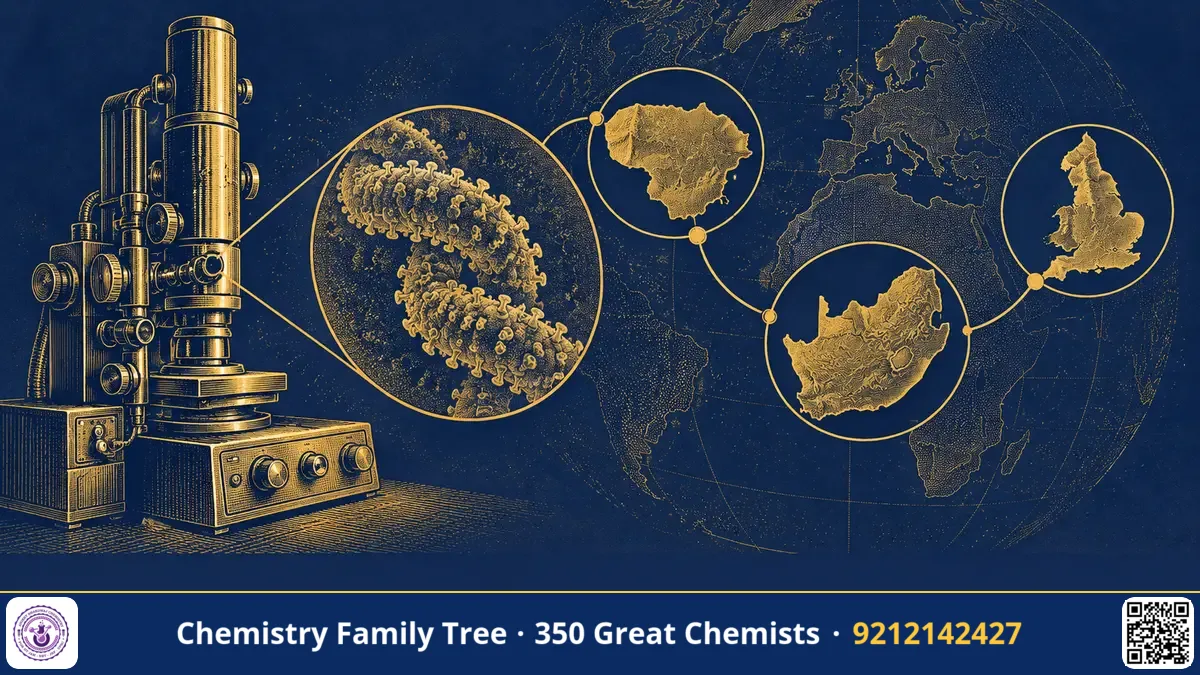
Sir Aaron Klug (1926-2018) was a Lithuanian-born South African and British scientist who developed methods to see the three-dimensional structures of viruses and large biological assemblies by electron microscopy. He also discovered the zinc finger motif. He won the Nobel Prize in Chemistry in 1982 and became one of the most distinguished figures at the Medical Research Council Laboratory of Molecular Biology in Cambridge. In one line: Klug gave structural biology its images.
Early Life and Family
Aaron Klug was born on 11 August 1926 in Želva, a small town in Lithuania, into a Jewish family. When he was two years old, his family emigrated to South Africa and settled in Durban. He attended Durban High School, where he showed strong abilities in science. He initially thought of studying medicine.
Education and Mentors
Klug began at the University of the Witwatersrand in Johannesburg, where he studied science. He took a master's degree at the University of Cape Town, where he worked with R. W. James, a prominent X-ray crystallographer, and learned crystallography. With the help of a scholarship, he went to the University of Cambridge in 1949, entering Trinity College, and he completed his PhD in 1953 under Douglas Hartree on the kinetics of phase changes in steel. After a spell at the Cavendish Laboratory, he moved to Birkbeck College, London, in 1954, where he met the crystallographer Rosalind Franklin, whose group he joined to work on viruses.
Career Timeline
| Year | Event |
|---|---|
| 1926 | Born in Želva, Lithuania on 11 August |
| 1928 | Family emigrates to South Africa |
| 1949 | Goes to Cambridge on a scholarship; Trinity College |
| 1953 | PhD at Cambridge under Douglas Hartree |
| 1954 | Joins Birkbeck College, London; works with Rosalind Franklin on viruses |
| 1958 | Franklin dies; Klug leads the virus group |
| 1962 | Joins the MRC Laboratory of Molecular Biology, Cambridge |
| 1968 | With David DeRosier, three-dimensional reconstruction from electron micrographs |
| 1970s | Nucleosome and chromatin structure |
| 1982 | Nobel Prize in Chemistry |
| 1985 | Zinc fingers in TFIIIA |
| 1986-1996 | Director of the MRC Laboratory of Molecular Biology |
| 1995-2000 | President of the Royal Society |
| 2018 | Dies in Cambridge on 20 November |
Major Scientific Contributions
Klug's contributions fall into three groups. First, he developed the methods of image reconstruction from electron micrographs, which made it possible to build 3D models of objects that cannot be crystallised. Second, he worked on structural biology of viruses, such as tobacco mosaic virus and spherical viruses, including the theory of quasi-equivalence with Donald Caspar. Third, he studied chromatin and transcription factors: his team found the repeating structure of the nucleosome and, with colleagues, the zinc finger motif of TFIIIA. In his later years, he promoted the use of designed zinc finger proteins as tools for controlling genes, and he helped set up a company to develop them. The science is explained in the companion discovery post.
Awards, Honours and Nobel Prize
- Nobel Prize in Chemistry, 1982, for the development of crystallographic electron microscopy and his structural elucidation of biologically important nucleic acid-protein complexes. It was a sole award.
- Knighted in 1988.
- Order of Merit, awarded in 1995, one of the highest honours in Britain.
- President of the Royal Society from 1995 to 2000, and Fellow of the Royal Society since 1969.
- Foreign Associate of the National Academy of Sciences of the United States and honorary degrees from many universities.
- Fellow of Peterhouse, Cambridge, and a leading figure at the Laboratory of Molecular Biology.
Personality, Struggles and Lesser-Known Facts
- A change of subject. He did his PhD on the physics of steel and then moved into biology. This move shows how powerful a physics and mathematics background can be for biology.
- Debt to Rosalind Franklin. After her death in 1958 at the age of 37, he took on the leadership of the virus group, and he often spoke with respect about her high experimental standards and wrote about her contribution to science.
- Optical bench ingenuity. To analyse micrographs, Klug used the simple tool of an optical bench to produce diffraction patterns, long before computers could handle images easily.
- Immigrant background. He arrived in South Africa as a toddler and was educated in a country far from the major centres of science. His journey to Cambridge was made possible by scholarships and his own determination.
- Family. He married Liebe Bobrow in 1948, and they had two sons.
- Applied science. In later life he worked to make zinc finger proteins into practical tools in medicine, showing that he cared about applications as well as basic discoveries.
Legacy and Influence on Modern Chemistry
The reconstruction methods that Klug developed are the ancestors of single-particle cryo-electron microscopy, which has revolutionised structural biology in recent years. His work on zinc fingers launched a large field on DNA-binding proteins and gene control. The nucleosome studies are basic to chromatin biology and epigenetics. His leadership of the Laboratory of Molecular Biology continued its tradition of producing Nobel Prize winners and landmark discoveries.
Lessons for Students
- Use tools from one field, like Fourier mathematics, to solve problems in another.
- Be ready to move across subjects, from physics to biology.
- Build clever, simple tools such as an optical bench to answer complex questions.
- Recognise and honour the work of colleagues and teachers.
- Scientific talent can arise from anywhere, with perseverance.
Quick Facts Box
- Born: 11 August 1926, Želva, Lithuania
- Died: 20 November 2018, Cambridge, England
- Nationality: British (Lithuanian-born, raised in South Africa)
- Field: Structural biology, biophysical chemistry
- Famous for: Crystallographic electron microscopy; nucleosome; zinc fingers
- Nobel: Chemistry, 1982
FAQ
Which Nobel Prize did Aaron Klug win?
The Nobel Prize in Chemistry in 1982, awarded to him alone.
Where did he work?
Mainly at Birkbeck College in London and at the MRC Laboratory of Molecular Biology in Cambridge.
How was he linked to Rosalind Franklin?
He worked in her group at Birkbeck and continued the virus structure research after her death.
Why is he relevant to students of chemistry?
His work links chemistry, physics and biology, and covers topics such as diffraction, Fourier transforms, coordination chemistry of zinc and DNA-protein interactions.
Published by ABC Chemistry — IIT-JAM | CSIR-NET | GATE Chemistry Coaching. Visit abcchemistry.com
About the chemist
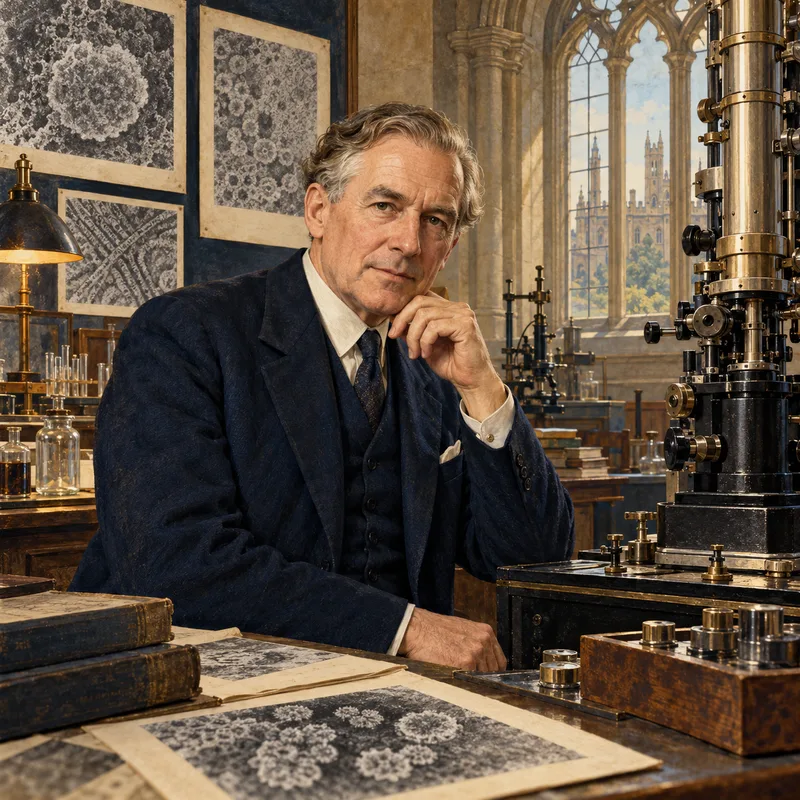
Aaron Klug
1926-2018 · United Kingdom · Nobel Chemistry 1982
Crystallographic electron microscopy