Biography · Chemist no. 151 of 350
Bruce Merrifield: The Chemist Who Taught Machines to Build Peptides
Introduction
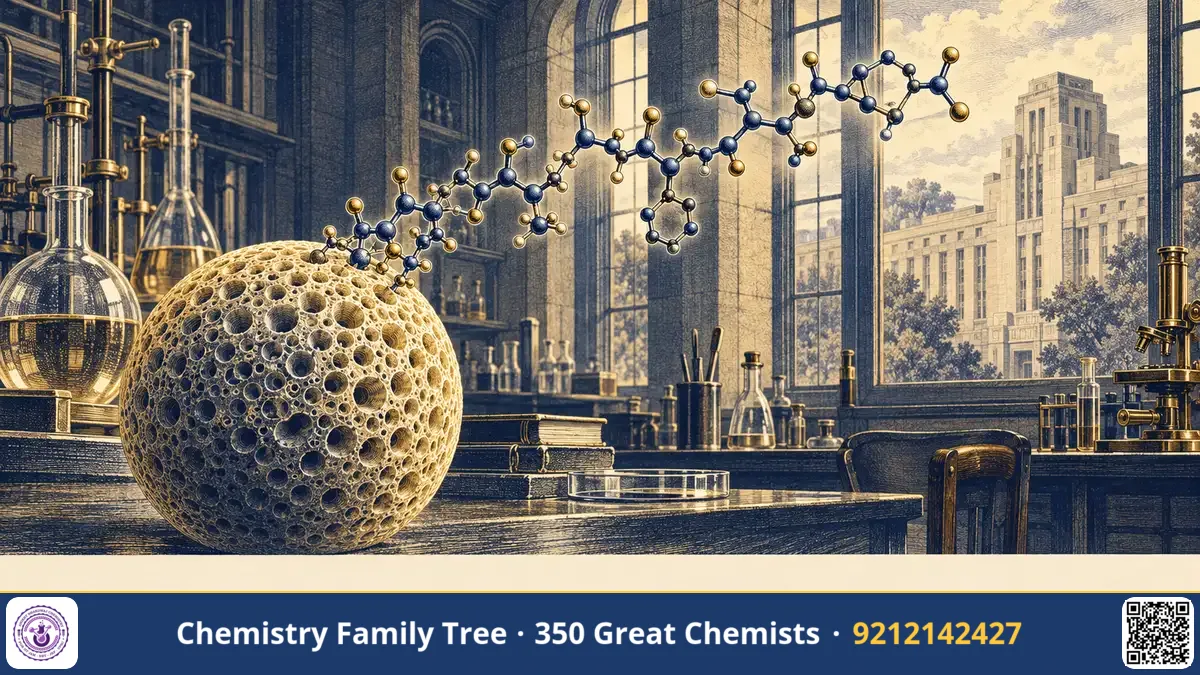
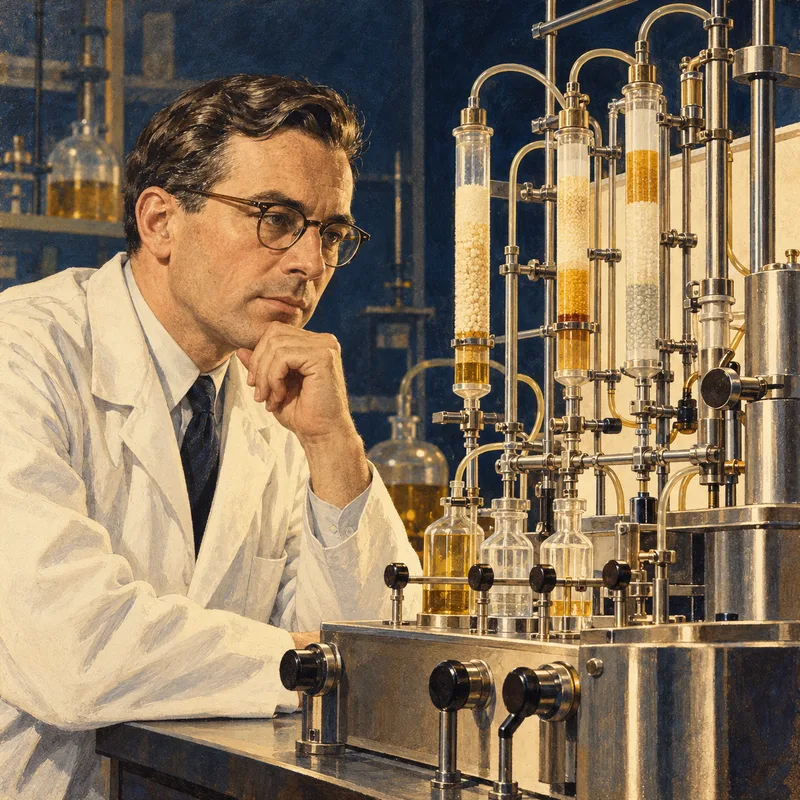
Robert Bruce Merrifield (1921-2006) was an American biochemist who invented solid-phase peptide synthesis, a method of building peptides on an insoluble polymer support. It made peptide chemistry fast, simple and automatable, and it became one of the most widely used techniques in chemistry and biology. He won the Nobel Prize in Chemistry in 1984, and was the sole recipient. In one line: Merrifield made peptides on a bead.
Early Life and Family
Bruce Merrifield was born on 15 July 1921 in Fort Worth, Texas. His family moved to California when he was a small child, and he grew up in several places in the state during the Great Depression, which affected his family's finances. He attended school in Southern California. His early life had little of the comfort that supports scientists today.
Education and Mentors
Merrifield studied chemistry at the University of California, Los Angeles (UCLA) and graduated in 1943. He continued at UCLA for graduate study in biochemistry and received his PhD in 1949 under the supervision of Max S. Dunn. His training in practical biochemistry served him well later. After his PhD, he joined the Rockefeller Institute for Medical Research in New York in 1949 to work with Dilworth W. Woolley, a biochemist whose work in the area of growth factors and peptides drew Merrifield towards peptide chemistry.
Career Timeline
| Year | Event |
|---|---|
| 1921 | Born in Fort Worth, Texas on 15 July |
| 1943 | Graduates in chemistry from UCLA |
| 1949 | PhD in biochemistry, UCLA; joins the Rockefeller Institute |
| 1959 | Conceives the idea of solid-phase peptide synthesis |
| 1962 | Bradykinin synthesised on the solid phase |
| 1963 | First paper on solid-phase peptide synthesis in the Journal of the American Chemical Society |
| 1966 | Automated peptide synthesizer |
| 1969 | Synthesis of ribonuclease A with Bernd Gutte |
| 1984 | Nobel Prize in Chemistry |
| 2006 | Dies on 14 May in Cresskill, New Jersey |
Major Scientific Contributions
His main contribution is solid-phase peptide synthesis (SPPS): attaching the first amino acid to a chloromethylated polystyrene resin, adding protected amino acids one at a time with DCC, removing the protecting groups with acid, and cleaving the finished peptide from the resin. Merrifield and his group worked on improving the method, including better resins, coupling reagents and cleavage conditions, and on understanding side reactions. They demonstrated the synthesis of peptide hormones and, in 1969, an enzyme, ribonuclease A. He also contributed to the design of the first automated peptide synthesizer. In later years his group studied antibacterial peptides such as cecropins and their analogues, which could kill bacteria. The detailed chemistry is in the companion discovery post.
Awards, Honours and Nobel Prize
- Nobel Prize in Chemistry, 1984, for his development of methodology for chemical synthesis on a solid matrix. It was a sole award.
- Member of the United States National Academy of Sciences.
- Albert Lasker Basic Medical Research Award, 1969.
- Honorary degrees from several universities, and awards from chemical and biochemical societies.
Personality, Struggles and Lesser-Known Facts
- Sceptics at the start. Many peptide chemists doubted that the solid-phase approach could produce pure peptides, because an error in a single step would carry through to the final product. Merrifield spent years improving the method and proving it worked.
- A stubborn inventor. The concept came to him in 1959 while he was thinking about how to make peptides in an easier way, and he was committed to it even though it did not yet look practical.
- Rockefeller for life. He spent his whole research career at the Rockefeller Institute, later University, where he rose from research assistant to professor.
- Family. He married Elizabeth Furlong in 1949, and they had children. He was devoted to his family.
- A tool for biologists. He continued to apply his method to biological questions, such as antibacterial peptides, rather than treating it as an end in itself.
Legacy and Influence on Modern Chemistry
The idea of doing chemistry on a solid support is now used in the synthesis of peptides, DNA and RNA, oligosaccharides and small-molecule libraries. It underlies the commercial production of peptide drugs worth many billions of dollars each year, and automated synthesizers are standard equipment in research laboratories across the world. It also made the combinatorial chemistry revolution of the 1990s possible. In India, the pharmaceutical and biotechnology industries make peptide APIs and research peptides based on SPPS.
Lessons for Students
- Look for the practical bottleneck in a field and design a new way around it.
- Be persistent even if experts are doubtful.
- A tool can be as important as a discovery, since it enables thousands of others.
- Learn from your training in other fields; his biochemistry background led him to a chemical invention.
- Keep improving your method with careful experiments and controls.
Quick Facts Box
- Born: 15 July 1921, Fort Worth, Texas, USA
- Died: 14 May 2006, Cresskill, New Jersey, USA
- Nationality: American
- Field: Biochemistry, peptide chemistry
- Famous for: Solid-phase peptide synthesis
- Nobel: Chemistry, 1984
FAQ
Where did Merrifield do his major work?
At the Rockefeller Institute for Medical Research (now Rockefeller University) in New York.
Which peptide did he make first?
Early test peptides included a tetrapeptide, Leu-Ala-Gly-Val, and then the hormone bradykinin.
Did Merrifield win the Nobel Prize alone?
Yes. The 1984 Nobel Prize in Chemistry was awarded only to him.
Why is he important for Indian students?
Protecting groups, peptide coupling and solid-phase methods are standard content of organic chemistry courses and competitive exams.
Published by ABC Chemistry — IIT-JAM | CSIR-NET | GATE Chemistry Coaching. Visit abcchemistry.com
About the chemist
Bruce Merrifield
1921-2006 · United States · Nobel Chemistry 1984
Solid-phase peptide synthesis