The discovery, explained · Chemist no. 151 of 350
Bruce Merrifield: Building Proteins on a Bead
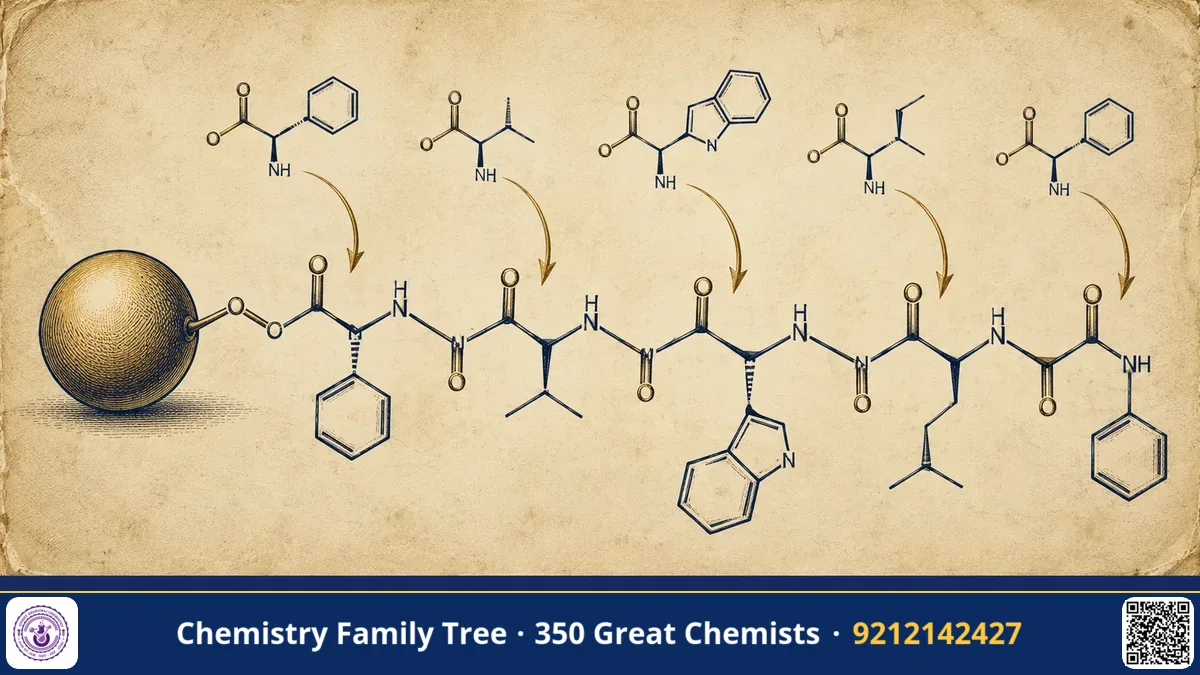
Peptide hormones like insulin, oxytocin and glucagon, many modern drugs and research reagents are made by joining amino acids in a defined order. Until the late 1950s, this was a slow and difficult task, in which every intermediate had to be isolated and purified. Bruce Merrifield (1921-2006), at the Rockefeller Institute, had a different idea: attach the growing peptide chain to an insoluble polymer bead, so that excess reagents and by-products can simply be washed away by filtration. This solid-phase peptide synthesis (SPPS) turned peptide chemistry from a specialist craft into a routine, automatable method. In 1984 he received the Nobel Prize in Chemistry, alone, for his development of methodology for chemical synthesis on a solid matrix.
The Scientific Problem Before the Discovery
A peptide bond is formed between the carboxyl group of one amino acid and the amino group of another. The problem is that each amino acid has at least two reactive groups (and some have reactive side chains). Mixing two amino acids would give a random mixture of products. The method of classical solution synthesis therefore needs protecting groups: the amino group of the first acid is blocked (for example, with the benzyloxycarbonyl (Z) group of Bergmann and Zervas), the carboxyl group is activated and coupled, the product is isolated, deprotected and the cycle begins again. Vincent du Vigneaud had used such methods to synthesise oxytocin in 1953, for which he won the 1955 Nobel Prize in Chemistry.
But in solution, each step needs extraction, crystallisation or chromatography to purify the product, and the yield falls at each stage. Making a peptide of 20 or 30 amino acids took months or years. The challenge was how to simplify purification. Merrifield, who was trained as a biochemist and had worked on peptide growth factors, wanted a faster way to make peptides for biological studies.
The Discovery and Experiments
- The idea (1959). Merrifield proposed to anchor the C-terminal amino acid to an insoluble support and then grow the chain stepwise from C to N terminus. Since the peptide stays on the bead, impurities can be removed by washing and filtering, with no loss of product.
- The support. He used polystyrene cross-linked with 1-2 percent divinylbenzene, chloromethylated to give benzylic chloride sites. The first N-protected amino acid is attached as a benzyl ester.
- Test peptide (1962-63). He and John Stewart synthesised a tetrapeptide, Leu-Ala-Gly-Val, and then the nonapeptide hormone bradykinin, which was obtained in a high yield in a few days. The 1963 paper in the Journal of the American Chemical Society reported this new methodology.
- Automation (1965-66). Merrifield and Stewart built an automated peptide synthesizer which carried out the cycle of reactions with timed valves and pumps.
- A protein. In 1969, Merrifield's group, with Bernd Gutte, reported the synthesis of the enzyme ribonuclease A (124 amino acids) on a solid support, and it showed enzymatic activity. It was an extraordinary demonstration, although the product was not as pure as the natural enzyme.
The Chemistry Behind It
The Boc/benzyl strategy
In the original method the alpha-amino group is protected by the tert-butyloxycarbonyl (Boc) group, which is removed by mild acid, while side chains are protected by benzyl-type groups, which need strong acid to remove. The cycle for each residue is:
1. Deprotect:   Resin-peptide-NH-Boc + TFA (≈50% in CH2Cl2) → Resin-peptide-NH3+ TFA-  + CO2 + isobutene
2. Neutralise:  Resin-peptide-NH3+ + R3N (e.g. diisopropylethylamine) → Resin-peptide-NH2
3. Couple:      Boc-AA-COOH + DCC → active O-acylisourea → amide bond with resin-NH2
4. Wash:        remove excess reagent and dicyclohexylurea (DCU)
5. Repeat.
Coupling with DCC
Dicyclohexylcarbodiimide (DCC) activates the carboxylic acid by forming an O-acylisourea, which is attacked by the amine:
R-COOH + C6H11-N=C=N-C6H11 → R-CO-O-C(=NC6H11)-NHC6H11
R-CO-O-C(=NC6H11)-NHC6H11 + R'-NH2 → R-CO-NH-R' + dicyclohexylurea
Racemisation of the activated amino acid is a problem, and additives such as 1-hydroxybenzotriazole (HOBt) help to suppress it. The reaction is driven to completion with an excess of reagent, which can be used because it is easily washed away.
Final cleavage
After the last residue has been added, the peptide is removed from the resin and the side-chain protecting groups are removed by treatment with strong anhydrous HF (or later with trifluoromethanesulfonic acid), together with scavengers like anisole to capture the reactive carbocations. The crude peptide is purified by HPLC.
Fmoc chemistry
Today, many labs use the Fmoc/tBu strategy, which is based on the base-labile fluorenylmethyloxycarbonyl (Fmoc) group (removed with piperidine) and acid-labile side-chain groups (removed with TFA). This avoids the use of HF. The Fmoc group was introduced by Louis Carpino in 1970. The Merrifield concept of the resin-bound chain applies to both approaches.
Monitoring and limitations
Completion of coupling can be tested by the Kaiser test, in which ninhydrin gives a blue colour with any free primary amine that remains. Incomplete couplings, aggregation of the growing chain and cumulative yield are the main limitations: if each step is 99 percent efficient, a 50-mer is obtained in about 0.9950 ≈ 60 percent yield, but with 95 percent per step it would be less than 10 percent.
Applications Today
- Pharmaceuticals. Peptide drugs such as the diabetes drug semaglutide, the osteoporosis drug teriparatide and the HIV drug enfuvirtide are made partly or wholly by solid-phase methods.
- Research. Custom peptides for antibodies, epitope mapping, enzyme assays and vaccine development are produced routinely, including in Indian biotech and contract research companies.
- Combinatorial chemistry. The solid-phase principle led to the "split and pool" libraries and to solid-phase organic synthesis of small molecules.
- Oligonucleotide synthesis. Automated DNA/RNA synthesis, which is the basis for primers, gene synthesis and mRNA vaccine research, uses the same solid-support philosophy.
- Proteins. Chemical protein synthesis, combining SPPS with native chemical ligation, can make small proteins with unnatural amino acids.
Exam Corner
- SPPS grows the chain from the C-terminus to the N-terminus on an insoluble polystyrene support.
- Boc is removed by TFA; Fmoc is removed by piperidine (base).
- DCC couples by forming an O-acylisourea; the by-product is dicyclohexylurea; HOBt reduces racemisation.
- Final cleavage in Boc chemistry uses anhydrous HF; in Fmoc chemistry, TFA.
- Merrifield won the 1984 Nobel Prize in Chemistry (sole); du Vigneaud made oxytocin in solution, 1953.
Common Misconceptions
- "Peptides are built from the N-terminus in SPPS." In SPPS the chain grows from C to N, opposite to protein biosynthesis on the ribosome.
- "The resin is a catalyst." It is only an insoluble support and anchor.
- "Merrifield's prize was in Medicine." It was Chemistry.
Quick Revision Box
- SPPS idea: 1959; bradykinin made 1962; Nobel Prize in Chemistry 1984.
- Support: chloromethylated polystyrene cross-linked with divinylbenzene.
- Cycle: deprotect (TFA), neutralise, couple (DCC), wash.
- Cleavage: HF (Boc) or TFA (Fmoc).
- Kaiser (ninhydrin) test detects free amines.
- Ribonuclease A (124 residues) synthesised in 1969 with Gutte.
FAQ
Why is solid-phase synthesis faster?
Because the peptide is attached to an insoluble bead, excess reagents and by-products are washed away by simple filtration, which avoids repeated purification.
Why does the chain grow from C to N?
The C-terminal carboxyl group is used to anchor the chain on the resin, and activated carboxyl groups of incoming amino acids couple to the free amino group of the growing chain.
What is the difference between Boc and Fmoc?
Boc is removed by acid and Fmoc by base. Fmoc chemistry avoids hazardous HF and is widely used today.
Is SPPS asked in competitive exams?
Yes. Protecting groups, peptide coupling reagents and the Merrifield method are standard organic chemistry topics for JAM, NET and GATE.
Published by ABC Chemistry — IIT-JAM | CSIR-NET | GATE Chemistry Coaching. Visit abcchemistry.com
About the chemist
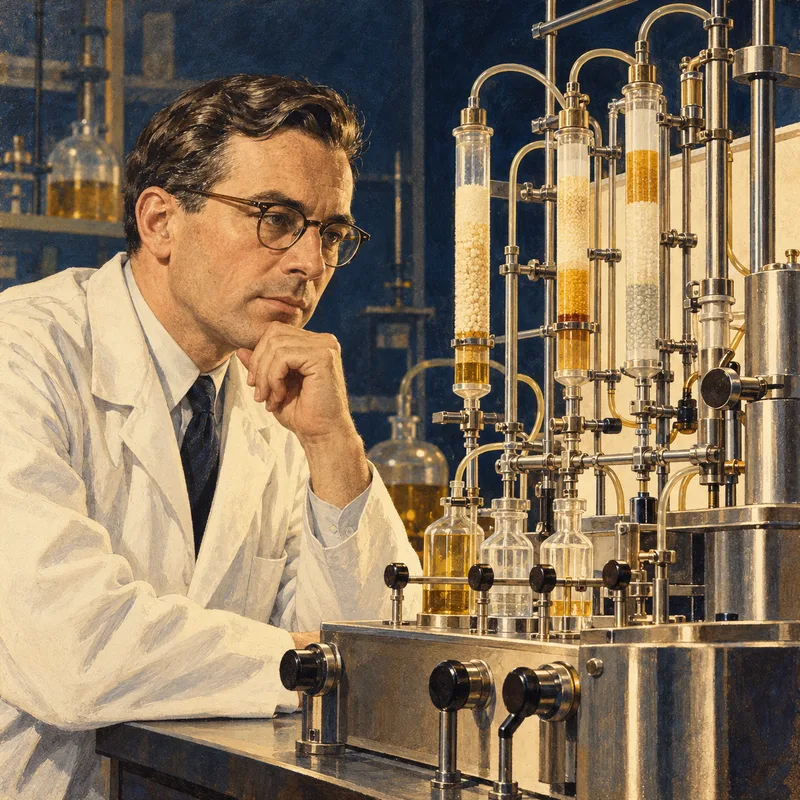
Bruce Merrifield
1921-2006 · United States · Nobel Chemistry 1984
Solid-phase peptide synthesis