The discovery, explained · Chemist no. 213 of 350
Gregory Winter: Engineering Antibodies into Medicines
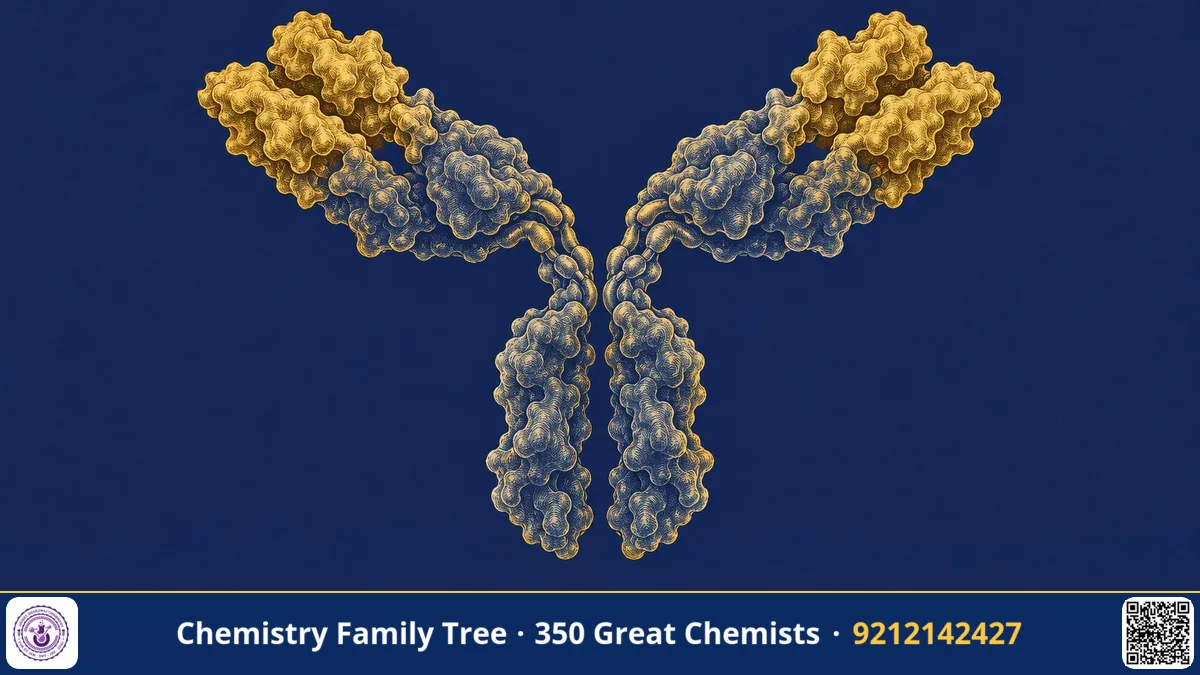
Antibodies are Y-shaped proteins made by our immune system. Each can recognise a specific target with high precision, which makes them ideal as medicines. But early therapeutic antibodies were made in mice, and the human body treated them as foreign and attacked them. Sir Gregory Winter, a British molecular biologist at Cambridge, solved this problem in two steps. In 1986 his team showed how to humanise mouse antibodies by grafting only their binding loops on to a human framework. In the 1990s, he adapted phage display, invented by George P. Smith, to evolve fully human antibodies. For this, Winter shared half of the 2018 Nobel Prize in Chemistry with Smith.
The Scientific Problem Before the Discovery
In 1975, César Milstein and Georges Köhler invented hybridoma technology, a way to make large quantities of identical (monoclonal) antibodies from mouse cells. Monoclonal antibodies became important research reagents, and people hoped to use them as drugs. But when mouse antibodies were injected into patients, the immune system produced human anti-mouse antibodies (HAMA). The result was rapid clearance of the drug, allergic reactions and loss of effect. A medicine that works once and then is neutralised is of little use for long-term diseases.
A second difficulty was that making fully human antibodies by classical hybridoma methods was hard, since one cannot immunise people with arbitrary antigens.
The Discovery: Step by Step
Step 1: Understand antibody structure
An antibody has two heavy chains and two light chains. Each chain has constant regions and a variable region. Within each variable region are three hypervariable loops called complementarity-determining regions (CDRs), supported by a more conserved framework. The CDRs form the antigen-binding site.
Step 2: CDR grafting (humanisation)
In 1986 Winter and colleagues, including Michael Neuberger and Paul Jones, replaced the CDR sequences of a human antibody with the CDRs of a mouse antibody that bound a chosen target. The resulting antibody was mostly human but kept the mouse antibody's specificity. Further adjustments to a few framework residues often restored full binding strength. This approach reduced immune rejection. Humanised antibodies such as Campath-1H were soon tried in patients, and many more followed.
Step 3: Phage display of antibody fragments
In the early 1990s, Winter's group and others cloned the genes for antibody fragments (scFv or Fab) and fused them to the phage coat protein so that the fragments were displayed on phage. They built large libraries by collecting human antibody genes, and used PCR to shuffle the gene segments. Using biopanning, they selected phages that bound a target, without needing animal immunisation.
Step 4: Evolve better binders
The selected antibody genes were mutated, and the process repeated to improve affinity, a laboratory form of the natural affinity maturation. The result was fully human antibodies with very high affinity for their targets.
The Chemistry Behind It
- Protein structure: The immunoglobulin fold is a beta-sandwich stabilised by a disulfide bond; CDR loops sit on its surface.
- Molecular recognition: Antigen binding uses shape complementarity with hydrogen bonds, van der Waals forces, salt bridges and hydrophobic effect. Affinity is given by Kd, often nanomolar or lower for drugs.
- Directed evolution: Create diversity by mutation, select for function, amplify and repeat.
- Recombinant DNA: Gene fusion, cloning and PCR are the practical tools.
- Immunogenicity: Foreign protein sequences (epitopes) are presented to T cells; humanisation reduces the number of foreign epitopes.
Mouse antibody (CDRs, binding) + Human framework → CDR grafting → humanised antibody
Human antibody gene library → phage display → biopanning → high-affinity human antibody
Applications Today
- Autoimmune diseases: Adalimumab (Humira), the first fully human antibody drug developed with phage display, blocks the inflammatory molecule TNF-alpha and treats rheumatoid arthritis, Crohn's disease and psoriasis.
- Cancer: Humanised antibodies such as trastuzumab (Herceptin) target HER2-positive breast cancer, and many immune checkpoint antibodies are in clinical use.
- Infectious disease: Antibodies against anthrax toxin and others; monoclonal antibodies were also used during the COVID-19 pandemic.
- Biosimilars in India: Indian companies produce biosimilar antibody drugs, making treatment more affordable.
- Diagnostics: Antibodies from libraries are used in test kits.
Exam Corner
- What are CDRs? Hypervariable loops of the antibody variable region that bind antigen.
- Meaning of humanisation: grafting mouse CDRs on a human framework to reduce immunogenicity.
- Adalimumab target: TNF-alpha.
- Hybridoma technology inventors: Köhler and Milstein (Nobel Prize in Physiology or Medicine, 1984).
- Winter's Nobel: Chemistry 2018, half with George P. Smith.
Common Misconceptions
- "Winter invented monoclonal antibodies." Köhler and Milstein did; Winter made them suitable for human medicine.
- "Humanised and fully human antibodies are the same." Humanised ones keep some mouse sequence in CDRs; fully human ones have none.
- "Antibodies are small molecule drugs." They are large proteins, about 150 kDa.
Quick Revision Box
- 1986: Winter's CDR grafting produced humanised antibodies.
- 1990s: Phage display used to evolve fully human antibodies.
- CDRs form the antigen-binding site; framework supports them.
- First human antibody from phage display approved as a drug: adalimumab.
- Target of adalimumab: TNF-alpha.
- Nobel Prize in Chemistry 2018 (half, with George P. Smith).
FAQ
Why are mouse antibodies a problem for patients?
The human immune system recognises mouse protein as foreign and produces antibodies against it, reducing effectiveness and causing side effects.
What is a monoclonal antibody?
An antibody produced by identical cells derived from a single parent cell, so all molecules recognise the same epitope.
How is phage display different from CDR grafting?
CDR grafting modifies an existing antibody for humans; phage display selects new antibodies from a gene library.
Why is this considered chemistry?
The work is the molecular design and evolution of proteins, which the Nobel Committee recognised as chemistry.
Published by ABC Chemistry — IIT-JAM | CSIR-NET | GATE Chemistry Coaching. Visit abcchemistry.com
About the chemist
Gregory Winter
1951- · United Kingdom · Nobel Chemistry 2018
Phage display of antibodies