Biography · Chemist no. 209 of 350
Jacques Dubochet: The Swiss Scientist Who Turned Water into Glass
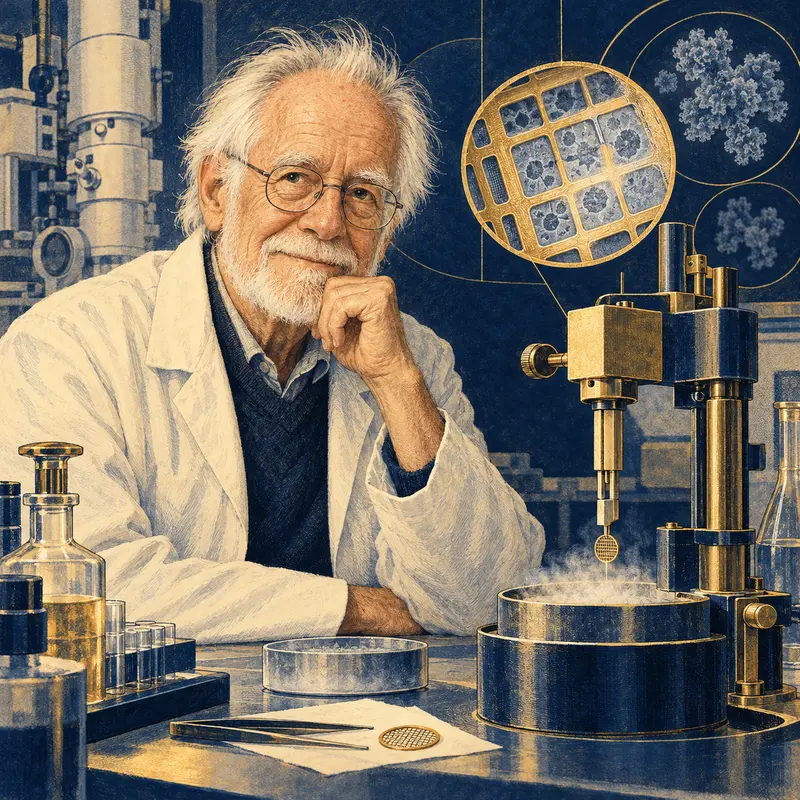
Jacques Dubochet (born 8 June 1942) is a Swiss biophysicist and emeritus professor at the University of Lausanne. In 2017 he shared the Nobel Prize in Chemistry with Joachim Frank and Richard Henderson. His legacy in one line: he made it possible to freeze biological molecules in a natural, glass-like water layer, which unlocked cryo-electron microscopy for the whole world.
Early Life and Family
Dubochet was born in Aigle, in the canton of Vaud in Switzerland. He has spoken openly about having dyslexia, which made school very difficult. He described struggling with reading and writing, and being a weak student for years. His family supported him, and he found ways around the difficulty. He later said that his experience shaped his sympathy for students who find the education system hard.
Education and Mentors
He studied at the University of Lausanne and then moved into molecular biology and biophysics at the University of Geneva and the University of Basel (Biozentrum). His early work involved electron microscopy of DNA with Eduard Kellenberger in Geneva. In 1978 he moved to the European Molecular Biology Laboratory (EMBL) in Heidelberg, Germany, where he began developing cryo-microscopy methods with colleagues including Alasdair McDowall and Jean Lepault.
Career Timeline
| Year | Event |
|---|---|
| 1942 | Born in Aigle, Switzerland |
| 1960s-1970s | Studies and begins research in Lausanne, Geneva and Basel |
| 1978 | Joins EMBL in Heidelberg |
| 1981 | With co-workers, shows that thin water films can be vitrified |
| 1984 | Publishes images of vitrified viruses |
| 1987 | Becomes professor of biophysics at the University of Lausanne |
| 2007 | Retires as professor (emeritus) |
| 2017 | Shares the Nobel Prize in Chemistry |
Major Scientific Contributions
- Vitrification of water: plunge freezing of thin aqueous films into liquid ethane to obtain amorphous ice.
- Cryo-electron microscopy of viruses: first clear pictures of hydrated viruses in vitreous ice.
- CEMOVIS: cryo-electron microscopy of vitreous sections, a technique for imaging thin sections of frozen cells and tissues in near-native state.
- Chromatin and DNA studies: earlier electron microscopy of nucleic acids and nucleosome structure.
For the underlying chemistry, read our companion post on vitrification and cryo-EM.
Awards, Honours and Nobel Prize
The 2017 Nobel Prize in Chemistry was shared by Jacques Dubochet, Joachim Frank and Richard Henderson "for developing cryo-electron microscopy for the high-resolution structure determination of biomolecules in solution". Dubochet had earlier received awards in Switzerland and Europe for his contributions to electron microscopy, and he is a member of Swiss scientific academies.
Personality, Struggles and Lesser-Known Facts
- Dyslexia: He has talked frankly about dyslexia and how it led him to think visually rather than through texts.
- A scientist who is also an activist: After retirement he engaged in local politics in Switzerland, where he was a member of a municipal body, and took public positions on social and environmental issues.
- Humour and openness: He is known for his candid and humorous speeches, and for stressing that science is a team effort.
- Emphasis on teams: He often credited colleagues such as McDowall and Lepault for the vitrification work.
- Delayed adoption: Vitrification was not immediately popular. It took decades of improvements in microscopes and detectors for cryo-EM to reach atomic resolution.
Legacy and Influence on Modern Chemistry
Dubochet's method is the foundation of single-particle cryo-EM. Combined with Henderson's work on image processing of membrane proteins and Frank's computational methods for 3D reconstruction, it led to the "resolution revolution" of the 2010s, when new electron detectors allowed atomic-resolution maps. Today thousands of structures determined by cryo-EM are stored in public databases. This has changed drug design, vaccine development and basic biology. In many labs worldwide, from Europe to India, a plunge-freezing apparatus is now routine equipment.
Dubochet's story also carries a message about how science grows. When he started working on vitrification, the idea that water could be turned into a glass without crystals was met with caution. Most of the progress came from small, careful experiments: finding the correct thickness of the water film, the right coolant, and the right handling to prevent warming and frost. Years later, other scientists improved microscopes, detectors and software, and the whole field moved forward. He has often said that no single person made cryo-EM; it was the result of many contributions over decades. His openness about his dyslexia has also made him a role model for students who learn differently, and he has encouraged teachers to look for strengths rather than weaknesses. In Switzerland he is known not only as a Nobel laureate but also as a thoughtful public speaker on education, society and the responsibilities of scientists.
Lessons for Students
- Difficulties do not define you. A dyslexic student grew into a Nobel laureate.
- Think physically. He solved a biology problem with the physics and chemistry of water.
- Persevere with unfashionable ideas. It took years for the method to find its full use.
- Share credit. Large discoveries are built by teams.
- Use science for society. He remained engaged in public life.
Quick Facts Box
- Born: 8 June 1942, Aigle, Switzerland
- Died: Living (as of this writing)
- Nationality: Swiss
- Field: Biophysics, electron microscopy
- Famous for: Vitrification of water for cryo-EM
- Nobel: Chemistry 2017, shared with Joachim Frank and Richard Henderson
FAQ
Is Dubochet a chemist?
He is a biophysicist, but the Nobel Committee honoured cryo-EM as a chemistry contribution because it reveals molecular structure.
Where did he do the vitrification work?
At EMBL in Heidelberg, Germany.
What is CEMOVIS?
Cryo-electron microscopy of vitreous sections, used to study thin slices of frozen tissue and cells.
Which other laureates shared the prize?
Joachim Frank (Germany/USA) and Richard Henderson (UK).
Published by ABC Chemistry — IIT-JAM | CSIR-NET | GATE Chemistry Coaching. Visit abcchemistry.com
About the chemist
Jacques Dubochet
1942- · Switzerland · Nobel Chemistry 2017
Cryo-electron microscopy of biomolecules