The discovery, explained · Chemist no. 209 of 350
Jacques Dubochet and Vitrification: Freezing Water Without Crystals
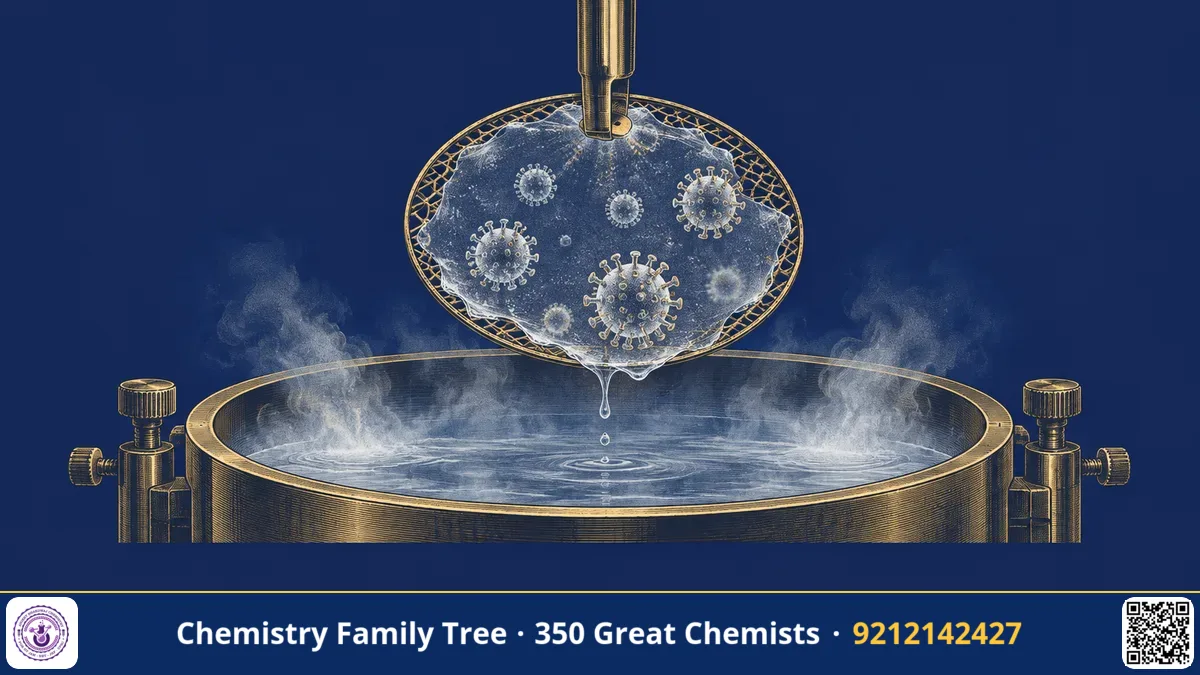
Biological molecules such as proteins and viruses live in water. To see their shape with an electron microscope, though, you need a vacuum, and in a vacuum water boils away and the sample dries and collapses. For decades this was a major obstacle. In the early 1980s, Jacques Dubochet, working at the European Molecular Biology Laboratory (EMBL) in Heidelberg, found a way to cool water so quickly that it turns into a glass-like solid instead of crystalline ice. This vitrification method keeps molecules in their natural watery shape. In 2017 Dubochet shared the Nobel Prize in Chemistry with Joachim Frank and Richard Henderson "for developing cryo-electron microscopy for the high-resolution structure determination of biomolecules in solution".
The Scientific Problem Before the Discovery
Electron microscopes use a beam of electrons with a very short wavelength, so they can in principle show atomic detail. But electrons are strongly scattered by air, so the specimen must sit in a high vacuum. Water would evaporate. Biologists used workarounds such as drying, staining with heavy metal salts, or chemical fixation. These alter the structure and give only a shadow-like picture.
Simply freezing the sample is not enough. When water freezes slowly, it forms hexagonal crystalline ice. Ice crystals expand, damage the molecules, and diffract electrons strongly, hiding the details of the sample. Cooling fast helps, but for decades it was believed that vitrifying a thin water film was not possible with ordinary methods, since pure water needs extremely high cooling rates (about a million kelvin per second) to avoid crystallising.
The Discovery: Step by Step
- Make the sample thin. A tiny drop of the watery sample is spread over a metal grid covered with a thin holey support film. Excess liquid is blotted off to leave a layer only a few hundred nanometres thick, or less. Thin layers cool much faster.
- Plunge fast into a cryogen. The grid is dropped quickly into liquid ethane held near liquid-nitrogen temperature (about 90 K). Liquid ethane is a better coolant than liquid nitrogen, because liquid nitrogen boils around the sample and forms an insulating gas layer (the Leidenfrost effect), slowing cooling. Ethane does not do this to the same extent.
- Obtain vitreous ice. The water has no time to crystallise and becomes amorphous solid water, a glass with the disordered structure of liquid water.
- Keep it cold. The frozen grid is transferred under liquid nitrogen into a cryo-holder and loaded into the microscope, kept at very low temperature during imaging.
In 1981 Dubochet and Alasdair McDowall reported that thin films of water could be vitrified, and images of vitrified virus particles followed. In 1984 the group published pictures of adenovirus embedded in vitreous water, showing the virus in its native hydrated state. Their results demonstrated that biological structures could be seen without stains or dehydration.
H₂O (liquid, thin film) → rapid cooling (~10⁵ to 10⁶ K/s) → H₂O (amorphous solid, vitreous ice)
The Chemistry Behind It
- Crystallisation kinetics: Ice crystals need nucleation and growth. If cooling is faster than these processes, the liquid structure is frozen in. This is the same principle by which glass forms from silica melt.
- Hydrogen bonding: Liquid water has a dynamic network of hydrogen bonds. In ordinary ice Ih, each molecule forms four hydrogen bonds in a regular hexagonal lattice, which is less dense than liquid water. Vitreous ice keeps a disordered network.
- Heat transfer: Cooling rate depends on sample thickness, coolant heat capacity and thermal conductivity. This explains why thin films and liquid ethane work.
- Radiation damage: Electrons break bonds and create radicals. Low temperature slows damage, and low-dose imaging protects the structure.
- Transition temperature: Vitreous water converts into crystalline ice if warmed above about 130 to 150 K, so samples must be kept cold.
Applications Today
- Structural biology: Cryo-EM now gives atomic-resolution structures of proteins, ribosomes, membrane channels and viruses.
- Drug design: Pharmaceutical companies use cryo-EM to see how drug molecules bind to targets that resist crystallisation.
- Virology: Structures of the spike protein of SARS-CoV-2 were determined rapidly by cryo-EM, helping vaccine and antibody design.
- Zika virus and others: Cryo-EM structures were obtained for viruses of public health importance.
- India: Cryo-EM facilities at Indian institutes such as IISc, NCBS and IITs now support national research in structural biology.
Exam Corner
- What is vitreous ice? Amorphous solid water formed by ultrafast cooling, without crystals.
- Why liquid ethane rather than liquid nitrogen? Better heat transfer, avoiding a vapour insulating layer.
- Nobel Prize 2017 in Chemistry: Dubochet, Frank, Henderson (cryo-EM).
- Why must the sample be thin? To allow cooling fast enough to avoid crystallisation and to let electrons pass through.
- Density relation: ordinary ice is less dense than liquid water due to open hydrogen-bonded hexagonal structure.
Common Misconceptions
- "Vitreous ice is just ordinary ice." It is amorphous, with no crystal lattice.
- "Cryo-EM freezes molecules and kills the structure." Rapid freezing preserves the native shape better than slow methods.
- "Cryo-EM photographs atoms directly." Structures are reconstructed from thousands of images by computation.
Quick Revision Box
- Dubochet developed vitrification of thin aqueous films at EMBL in the early 1980s.
- Plunge freezing into liquid ethane gives amorphous ice.
- Vitreous ice avoids crystal damage and diffraction.
- Samples are imaged at cryogenic temperature with low electron dose.
- Nobel Prize in Chemistry 2017 shared with Frank and Henderson.
- Used for ribosomes, viruses, membrane proteins.
FAQ
What does cryo mean?
It comes from Greek kryos, meaning cold or frost.
Why not use X-ray crystallography for everything?
X-ray crystallography needs well-ordered crystals, and many large or flexible biomolecules do not crystallise. Cryo-EM works with molecules in solution.
Is vitreous ice stable?
It is metastable at low temperature, and it crystallises if warmed above roughly 130 to 150 K.
Why is this in a chemistry syllabus?
It involves phase transitions, hydrogen bonding, kinetics versus thermodynamics and modern structure determination methods.
Published by ABC Chemistry — IIT-JAM | CSIR-NET | GATE Chemistry Coaching. Visit abcchemistry.com
About the chemist
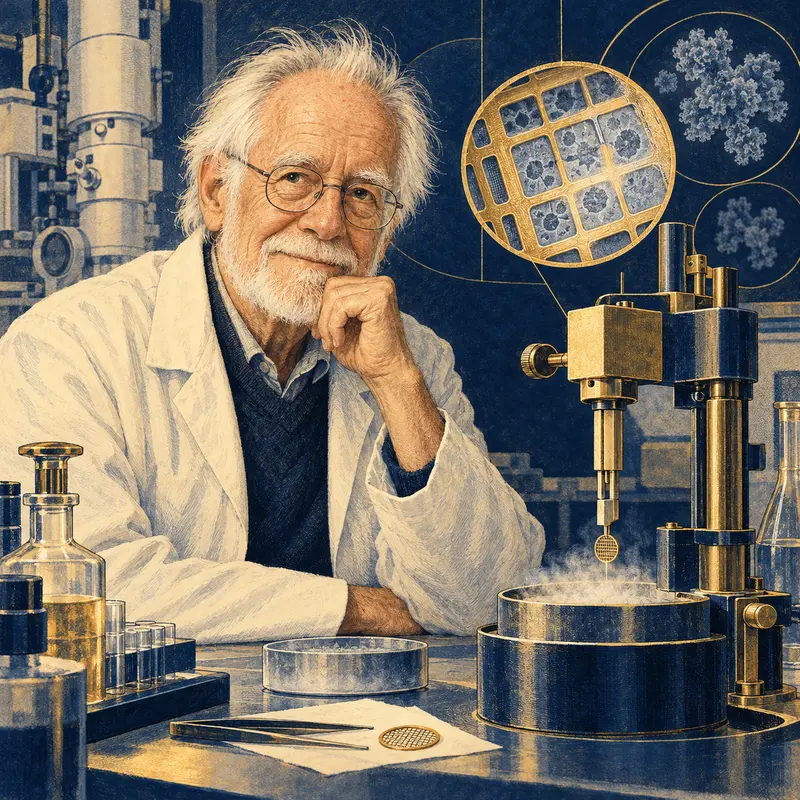
Jacques Dubochet
1942- · Switzerland · Nobel Chemistry 2017
Cryo-electron microscopy of biomolecules